
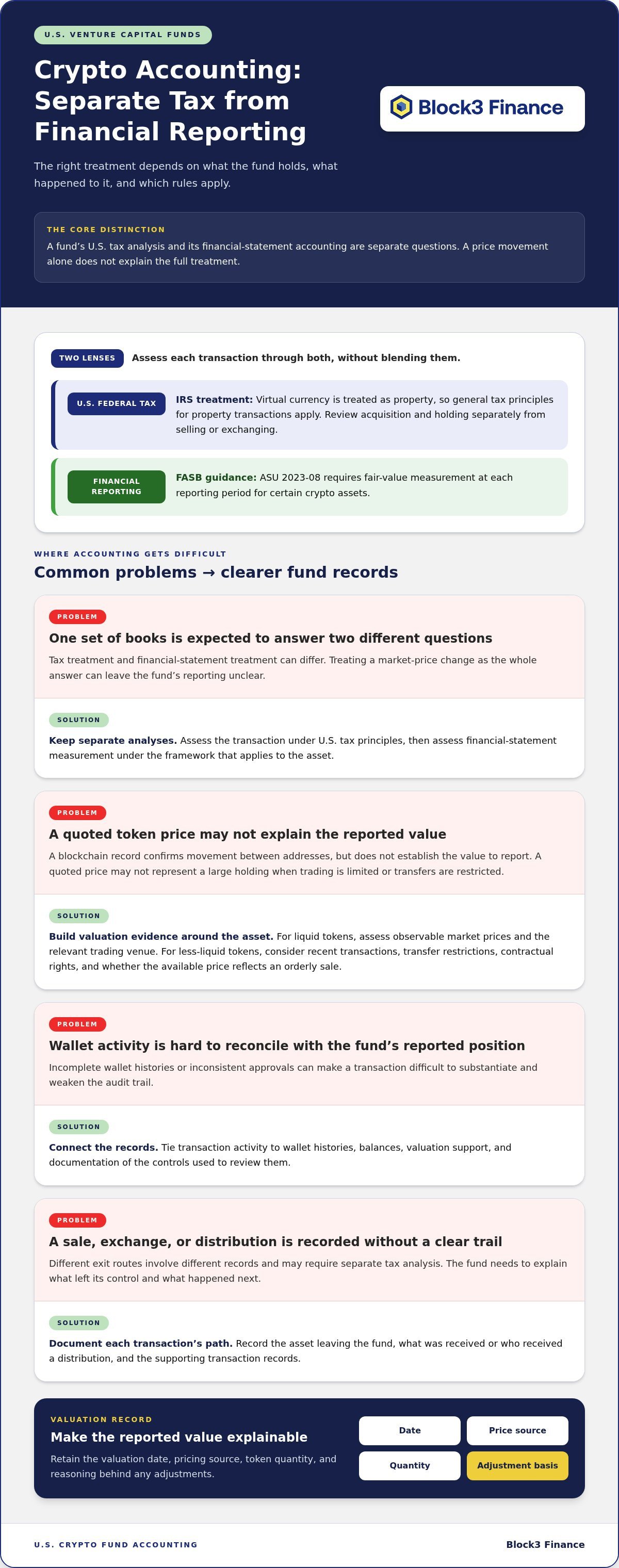
For U.S. venture capital funds, crypto accounting is appropriate when it reflects the reporting framework, the specific digital asset, and the transaction’s tax treatment. For U.S. federal tax purposes, the IRS treats virtual currency as property, so general tax principles for property transactions apply. Financial reporting is a separate question: the Financial Accounting Standards Board’s ASU 2023-08 requires fair-value measurement at each reporting period for certain crypto assets.
It’s reasonable to expect a Bitcoin or token investment to fit neatly into familiar fund accounting. In practice, the right entry depends on what the fund holds, how it acquired or disposed of the asset, and which accounting rules apply. Taxable events and financial-statement treatment can differ, so a price movement alone doesn’t tell the whole story.
This guide explains how U.S. tax treatment and accounting standards affect venture capital holdings, which records support transactions, and how Bitcoin entries may appear in the books. It also outlines when specialized accounting support can help clarify reporting, reconcile activity, and prepare documentation for review.
Key Takeaways
- Separate tax reporting from financial-statement accounting, then assess each crypto transaction under the rules that apply to it.
- Build Bitcoin entries around the fund’s acquisition, holding, and disposal activity so balances and realized results are easier to explain.
- Keep transaction records connected to wallet activity, valuations, and supporting documentation to strengthen reconciliation and audit trails.
- Review how the applicable accounting framework treats valuation changes before interpreting their effect on fund reporting.
- Consider specialized accounting support when crypto activity makes reconciliations, controls, or financial reporting difficult to manage consistently.
Cryptocurrency taxation and regulatory treatment
For U.S. venture capital funds, digital asset accounting must address both tax and financial reporting. Key risks include misclassifying transactions, keeping incomplete records, and overlooking how a fund’s assets or instruments may fit within changing regulatory frameworks.
Tax and Regulatory Changes Affecting Funds
Tax and regulatory changes are shifts in rules or interpretations that can affect a fund’s holdings, reporting, and operations. The Internal Revenue Service treats virtual currency as property for U.S. federal tax purposes, so general property transaction principles apply. A fund’s tax analysis should distinguish acquiring and holding assets from selling or exchanging them. Changes can also affect how a fund documents its decisions and communicates exposure to investors.
Regulatory developments matter to investment strategy and exit planning. The CFTC declared in 2015 that virtual currencies represented by Bitcoin met its definition of a commodity. The SEC began scrutinizing token trading and financing in 2018. The GENIUS Act establishes unified standards for stablecoin issuance and reserves, while the Clarity Act is proposed legislation concerning digital assets. These developments make the characteristics of each holding relevant, not just its ticker or market price.
Regulatory Monitoring and Crypto Audits
Regulatory monitoring means tracking developments that could affect a fund’s digital assets, token-related instruments, or operating model. A practical review connects each holding with its acquisition documents, transaction history, and intended exit route. Selling a token, exchanging it for another asset, or distributing it to investors, for example, involves different records and may require separate tax analysis.
A crypto audit examines whether balances, transaction records, and controls support the fund’s reported positions. Audit readiness includes analyzing risks and documenting processes and controls for auditor review. Clear records help explain wallet activity, valuation methods, and approval steps. A consistent digital asset accounting process can connect these records to the fund’s reporting close.
Accounting and Regulatory Risks
The main accounting and regulatory risks involve classification, valuation, tax treatment, and supporting documentation. A fund may hold Bitcoin directly, receive tokens through an investment, or own an interest linked to digital assets. These arrangements should not be treated alike without reviewing the underlying rights and transaction records.
Exit routes can reveal gaps that went unnoticed during the holding period. A sale or exchange requires the fund to identify what left its control, what it received, and how the transaction was recorded. A distribution also needs documentation linking the asset and recipient to the fund’s records. Missing wallet histories or inconsistent approvals can make an otherwise explainable transaction difficult to substantiate.
Regulatory monitoring and audit preparation work together. Funds can assign responsibility for tracking relevant changes, preserve records for each transaction, and document the controls used to review balances. Tax treatment should reflect the transaction’s facts and the fund’s tax strategy. This discipline helps the fund explain its position and support reporting as assets move toward an exit.
What is digital asset or crypto accounting?
Digital asset accounting tracks token activity, valuations, and financial statement effects for a fund. For U.S. venture capital funds, the right treatment depends on the asset, the transaction, and the applicable reporting framework.
Valuation starts by identifying what the fund owns and what evidence supports its reported value. For a liquid token, the accounting team can assess observable market prices and the trading venue relevant to the fund’s position. For a less-liquid token, it may need to weigh recent transactions, transfer restrictions, contractual rights, and whether the available price reflects an orderly sale.
A blockchain transaction record confirms movement between addresses, but it doesn’t establish the value reported in the financial statements. The fund should retain the valuation date, pricing source, token quantity, and reasoning behind any adjustments. A quoted price, for example, may not represent the value of a large holding if trading activity is limited or the token cannot be freely transferred.
Deal data provides context, not a substitute for asset-level valuation. The median crypto deal size exceeded $4.5 million in Q1 2026, but that figure describes deal size, not the fair value of a fund’s tokens. A fund should keep investment pricing, token valuation, and later financial reporting distinct.
Accounting Standards for Digital Assets
Accounting standards set how a fund recognizes and measures digital assets in its financial statements. In the United States, FASB’s ASU 2023-08 requires certain crypto assets to be measured at fair value each reporting period. The IFRS Interpretations Committee issued guidance on cryptocurrency holdings in 2019. The frameworks can differ: the U.S. rule applies to qualifying assets, while IFRS treatment may allow upward revaluation for indefinite-lived intangible assets. Identifying the framework and asset category matters because the reported value can differ.
Accounting for Crypto Investment Agreements
Accounting for a crypto investment agreement starts with its contractual rights and obligations, not its label. A token warrant, SAFT, or other agreement may provide a right to receive tokens later, set conditions for delivery, or include other settlement terms. Those terms determine what the fund records and when. Retain the agreements, amendments, payment records, and evidence of token delivery so the reported position reflects the actual instrument.
For each holding, a useful valuation file links the reported amount to evidence available on the reporting date. It can identify the pricing source, token units, market activity, restrictions, and any judgment applied to less-liquid assets. If the valuation relies on a recent transaction, record how that transaction relates to the fund’s rights and holding. This creates a clear path from source evidence to recorded value.
Funds assessing token valuations or agreement terms can discuss the accounting questions through a focused accounting consultation.
Automated transaction records and audit trails
Automated records capture blockchain activity and connect it to a fund’s accounting ledger. Venture capital funds need controls that establish who authorized each transaction, which wallet or exchange was involved, and how the activity entered the books. Evidence should include transaction records, wallet ownership, approvals, reconciliations, and documented procedures. A crypto accounting for venture capital workflow links this evidence to reporting decisions.
A blockchain transaction identifier provides a traceable reference, but doesn’t explain the business purpose on its own. A transfer between two fund-controlled wallets, for example, changes an asset’s location, not necessarily the fund’s total holdings. The accounting record should identify both addresses, the transfer date, token quantity, transaction fee, and reason for the movement.
Automation helps organize transaction volume, but it doesn’t replace review. Digital asset accounting processes can be designed to handle millions of transactions. A fund should define which wallets, custodians, and exchange accounts feed its ledger, then compare imported activity with available statements and on-chain records. Unmatched deposits, withdrawals, or token movements need documented follow-up before period-end reporting. Effective crypto accounting for venture capital links these exceptions to assigned review steps.
- Wallet ownership: Keep records linking each address to the fund, an authorized custodian, or another controlled party.
- Exchange activity: Retain exchange statements and transaction exports, then reconcile them with ledger entries.
- Approvals: Record who requested and approved transfers, including the purpose and supporting investment documentation.
- Reconciliation: Compare opening balances, recorded inflows and outflows, and closing balances for each asset.
Access controls protect the integrity of those records. Where the fund’s processes allow, separate transaction approval from recordkeeping, and retain evidence of access changes and review sign-offs. A transfer request, approval record, blockchain transaction identifier, and ledger entry, for example, create a connected audit trail. Documenting these steps helps reviewers trace a reported balance back to source activity.
Audit evidence should also explain how the fund handles exceptions. If an exchange export omits a transaction, preserve the available statement, identify the missing record, and document the reconciliation decision. If a wallet transfer lacks a clear description, connect it to investment approvals or other fund records. A consistent process makes exceptions visible instead of burying them in a general ledger balance.
For U.S. funds, transaction records also support tax analysis because the Internal Revenue Service treats virtual currency as property for federal tax purposes. Records should link each acquisition, disposal, or exchange to its date, quantity, and supporting documentation. A documented close process can bring these records together with financial reporting, giving fund managers and auditors a traceable view of assets and operations.
Benefits of hiring a crypto accountant
A crypto accountant can help a venture fund turn digital asset activity into information managers can use. Beyond bookkeeping, specialist analysis can connect a fund’s crypto positions with portfolio performance, tax planning, and financial models. This broader view makes crypto accounting for venture capital relevant to investment oversight as well as year-end reporting.
Research into complex accounting questions is one benefit of specialist support. An accountant can analyze how an asset’s rights, investment terms, and business purpose affect its treatment, then explain the implications to fund leadership. A token-linked investment, for example, may have different economic features from direct token ownership. Understanding those distinctions helps managers assess how a position fits the fund’s reporting and planning needs.
Tax coordination can also inform cash planning. A crypto tax accountant can work with a fund’s tax and legal advisors to connect transaction analysis with its broader tax strategy. This can help leadership consider the potential cash impact of a planned sale or distribution while evaluating its timing and structure. Accounting analysis and tax planning are related, but they answer distinct questions.
Financial modeling gives managers another decision-making tool. A specialist can help assess a business’s cash runway and trajectory, then present the analysis alongside relevant operating assumptions. For a fund evaluating a portfolio company, separating operating performance from crypto market movements can make forecasts easier to interpret. This is another practical dimension of crypto accounting for venture capital.
- Managerial reporting: Shape financial statements around the questions fund leaders need to answer.
- KPI development: Define performance measures that reflect the fund’s business model and digital asset exposure.
- Cash planning: Incorporate relevant tax and operating considerations into financial forecasts.
- Advisor collaboration: Coordinate accounting analysis with tax, legal, and other professional input.
A crypto accountant may also help a fund evaluate accounting software and train its users. The value is not simply faster data entry, but choosing tools that fit the fund’s reporting needs and transaction types. A team working with token investments, for example, may need a system that presents asset activity in a useful format for finance staff and fund managers.
Consider specialist accounting support when leadership cannot readily connect digital asset positions with forecasts, portfolio analysis, or management decisions. An initial discussion can focus on a concrete business question, such as how a proposed disposal affects the fund’s outlook or how to present crypto exposure in a performance review. That focus directs the work toward decisions the fund needs to make.
What accounting standards apply to venture capital funds holding cryptocurrency and digital assets?
For U.S. venture capital funds, accounting standards guide how financial activity appears in fund-level reports. Applying them requires understanding whether the fund owns a digital asset directly, holds an interest in another entity, or has a contractual claim connected to tokens. The legal and economic substance of each position shapes the accounting analysis.
That distinction matters when a fund invests in a crypto startup. The fund’s ownership interest in the company and the company’s own cryptocurrency holdings are separate items. A startup’s digital assets do not automatically become assets on the fund’s books simply because the fund owns part of the startup. Fund reporting should reflect the interest the fund actually holds.
Classification also affects how managers communicate with investors. A fund can establish a consistent accounting policy for recurring transaction types, explain significant judgments, and apply that policy across reporting periods. Two investments described informally as “token exposure,” for example, may represent different rights. Reviewing the governing documents helps ensure labels do not replace analysis.
- Identify the reporting entity: Separate the fund’s holdings from assets owned by portfolio companies.
- Review the rights: Use investment and governing documents to understand what the fund owns or can claim.
- Apply a consistent policy: Record how similar positions are assessed and explain material departures.
- Align reporting: Present accounting judgments clearly in schedules used by fund managers and investors.
Funds should also consider how accounting policies connect with tax analysis and investor reporting. These workstreams serve different purposes, but rely on shared facts about ownership, transactions, and contractual terms. A documented process for resolving differences can help managers understand why a tax position and financial statement presentation may not match.
An investor report may discuss a portfolio company’s token holdings as part of its business outlook, while the fund’s financial statements report the fund’s investment in that company. Keeping those views distinct helps readers understand whether a figure describes the fund’s asset or provides context about an underlying business.
Strong standards application depends on disciplined policy decisions, clear entity boundaries, and explanations that match the fund’s actual rights. Funds reviewing their reporting approach can contact Block3 Finance to discuss accounting support.
Record items according to the fund’s actual ownership and contractual rights, distinguishing fund-held assets from those held by portfolio companies. Establish and consistently apply a policy for recurring transaction types, document significant judgments, and report the position the fund actually holds.
Block3 Finance: Tax Filing and Reporting
Block3 Finance helps venture capital teams bring digital asset activity into tax filings, financial reporting, and audit preparation. Its Tax Filing and Reporting and Monthly Accounting services can support ongoing records and reporting needs, while Audits and Compliance can help address documentation and control processes. A Crypto Tax Accountant can help examine how transactions affect U.S. tax reporting, including disposals and exchanges.
Turn to Block3 Finance when token activity, wallet reconciliations, or inconsistent records make it difficult to prepare clear reports. Support can connect transaction records with accounting and tax workflows, helping fund teams maintain a more coherent view of their digital asset operations.
Contact Block3 Finance to discuss your fund’s accounting needs.
Build a Reporting Framework That Can Scale
The next step is to make digital asset accounting part of the fund’s operating design, rather than a task assembled at reporting time. Assign responsibility for reviewing accounting decisions, maintaining documentation, and escalating unusual transactions. A clear ownership model helps new investments and evolving fund operations fit established processes.
A disciplined approach to crypto accounting for venture capital can support more useful conversations with limited partners, auditors, and advisors. The aim is not simply to produce records, but to make the fund’s treatment understandable and repeatable as its portfolio changes. Regularly assessing whether existing processes still match the assets held can help teams identify where reporting needs attention.
Block3 Finance can help funds strengthen their accounting and reporting processes. Contact Block3 Finance to discuss your fund’s crypto accounting needs and take a considered next step toward clearer financial oversight.
Frequently Asked Questions
Is This Accounting Treatment Appropriate?
The treatment is appropriate when it matches the fund’s reporting framework, the asset’s classification, and the substance of the transaction. A fund, for example, should not automatically apply a rule for directly held crypto assets to a token warrant. Compare the recorded item with its underlying rights, then document why the selected treatment fits. An entry that ignores contractual terms or applies an unsuitable measurement model can misstate the fund’s reported position.
How should a VC fund classify and measure cryptocurrency investments under U.S. GAAP?
Under U.S. GAAP, first determine whether the holding falls within the scope of FASB’s ASU 2023-08. The standard requires qualifying crypto assets to be measured at fair value at each reporting period. A fund should assess each holding separately rather than assuming every token or crypto-linked contract qualifies. Keep the classification rationale with the reporting workpapers, especially when a portfolio includes both directly held cryptocurrency and agreement-based rights.
How do venture capital funds value illiquid tokens and crypto startup investments for fair value reporting?
Funds should base an illiquid token valuation on evidence relevant to the asset and reporting date, not simply on a headline price. Review available transaction data alongside transfer restrictions and the rights attached to the token. For a crypto startup investment, distinguish the company’s equity or contractual interest from tokens it may issue. Record the assumptions used and explain why they reflect the interest being valued.
What tax rules apply to U.S. venture capital funds investing in cryptocurrency and tokens?
For U.S. federal tax purposes, the Internal Revenue Service treats virtual currency as property, so general tax principles for property transactions apply. A fund should assess each transaction’s tax treatment, including how it acquired an asset and what happened when it later sold or exchanged it. The token’s name alone doesn’t establish the result. Keep tax analysis distinct from financial-statement valuation because they address different reporting questions.
How should a VC fund account for custody fees, transaction fees, and wallet transfers?
For a transfer between fund-controlled wallets, record both addresses, the date, token quantity, transaction fee, and reason. The transfer changes the asset’s location, not necessarily the fund’s total holdings. The material provides no specific treatment for custody fees.
How should crypto investment gains, losses, staking rewards, and airdrops be recorded?
Record gains and losses under the applicable reporting framework; ASU 2023-08 requires fair-value measurement at each reporting period for qualifying crypto assets. For tax reporting, distinguish acquiring and holding assets from selling or exchanging them, and retain transaction records and supporting documentation.

Article by
Mahad Mohamed
Mahad Mohamed is an accountant and the CEO of Block3 Finance, with over 26+ years of Canadian and international tax and accounting experience. A crypto accounting specialist since the early days of Bitcoin, he has consulted for over 38 crypto companies and collaborated with legal professionals on regulatory matters. His expertise spans corporate reorganization, cross-border tax structuring (Canada & US), tax disputes, and CRA audits.
Previously, Mahad worked for the Canada Revenue Agency (CRA), Big4 accounting firms, and served as a Rulings Officer for the Federal Tax Authority of the UAE before acquiring Tax Partners in 2014.
Block3 Finance and Tax Partners has 44 full-time accountants and over 9,800+ clients.
Disclaimer
This article provides general information only and is current as of its publication date. It has not been updated and may be out of date. It does not constitute legal advice and should not be relied upon as such. Every tax situation is unique and may differ from the examples discussed in this article. If you have specific questions, you should seek the advice of our accountants for your unique circumstances.
Frequently Asked Questions
Is This Accounting Treatment Appropriate?
The treatment is appropriate when it matches the fund’s reporting framework, the asset’s classification, and the substance of the transaction. A fund, for example, should not automatically apply a rule for directly held crypto assets to a token warrant. Compare the recorded item with its underlying rights, then document why the selected treatment fits. An entry that ignores contractual terms or applies an unsuitable measurement model can misstate the fund’s reported position.
How should a VC fund classify and measure cryptocurrency investments under U.S. GAAP?
Under U.S. GAAP, first determine whether the holding falls within the scope of FASB’s ASU 2023-08. The standard requires qualifying crypto assets to be measured at fair value at each reporting period. A fund should assess each holding separately rather than assuming every token or crypto-linked contract qualifies. Keep the classification rationale with the reporting workpapers, especially when a portfolio includes both directly held cryptocurrency and agreement-based rights.
How do venture capital funds value illiquid tokens and crypto startup investments for fair value reporting?
Funds should base an illiquid token valuation on evidence relevant to the asset and reporting date, not simply on a headline price. Review available transaction data alongside transfer restrictions and the rights attached to the token. For a crypto startup investment, distinguish the company’s equity or contractual interest from tokens it may issue. Record the assumptions used and explain why they reflect the interest being valued.
What tax rules apply to U.S. venture capital funds investing in cryptocurrency and tokens?
For U.S. federal tax purposes, the Internal Revenue Service treats virtual currency as property, so general tax principles for property transactions apply. A fund should assess each transaction’s tax treatment, including how it acquired an asset and what happened when it later sold or exchanged it. The token’s name alone doesn’t establish the result. Keep tax analysis distinct from financial-statement valuation because they address different reporting questions.
How should a VC fund account for custody fees, transaction fees, and wallet transfers?
For a transfer between fund-controlled wallets, record both addresses, the date, token quantity, transaction fee, and reason. The transfer changes the asset’s location, not necessarily the fund’s total holdings. The material provides no specific treatment for custody fees.
How should crypto investment gains, losses, staking rewards, and airdrops be recorded?
Record gains and losses under the applicable reporting framework; ASU 2023-08 requires fair-value measurement at each reporting period for qualifying crypto assets. For tax reporting, distinguish acquiring and holding assets from selling or exchanging them, and retain transaction records and supporting documentation.