
For U.S. taxpayers, crypto asset disclosure requirements include keeping records of digital asset purchases, receipts, sales, exchanges, and other dispositions to support federal income tax returns. The reporting path depends on the activity: a sale or exchange may require Form 8949, while income from staking, mining, forks, or similar activity may belong on Form 1040 (Schedule 1). Broker statements don’t replace your own records.
It’s easy to focus on a wallet balance and overlook the transaction details behind a tax calculation. Clear records of each event help connect your digital asset activity to its U.S. tax treatment.
This guide explains U.S. tax records and reporting, including how individuals report digital asset activity, how significant holdings may appear in financial statements, and how sale proceeds are disclosed. It also distinguishes personal tax reporting from accounting disclosures for certain entities.
Key Takeaways
- Organize transaction records so you can trace each digital asset event and support the tax treatment reported on your U.S. return.
- Match the type of activity, such as selling, receiving rewards, or earning mining income, to the relevant reporting path.
- Separate personal tax reporting from financial statement disclosures that may apply to entities with significant crypto holdings.
- Understand how broker-reported sale proceeds relate to your own records and why they may not tell the whole tax story.
- Identify when crypto asset issuers and offerings face SEC disclosure rules distinct from individual tax filing obligations.
Recordkeeping for digital asset transactions
A transaction record documents a digital asset event, such as a purchase, receipt, sale, exchange, or other disposition. U.S. taxpayers should retain records to support the positions reported on their federal income tax returns. Record every event, including transfers between wallets you control, so activity can be traced from its source to its outcome.
Tax basis is the amount assigned to an asset to calculate gain or loss when it is disposed of. Keep acquisition details with records of any later sale or exchange. For example, purchase and sale records together help explain the calculation, while a transaction hash can identify the related blockchain activity.
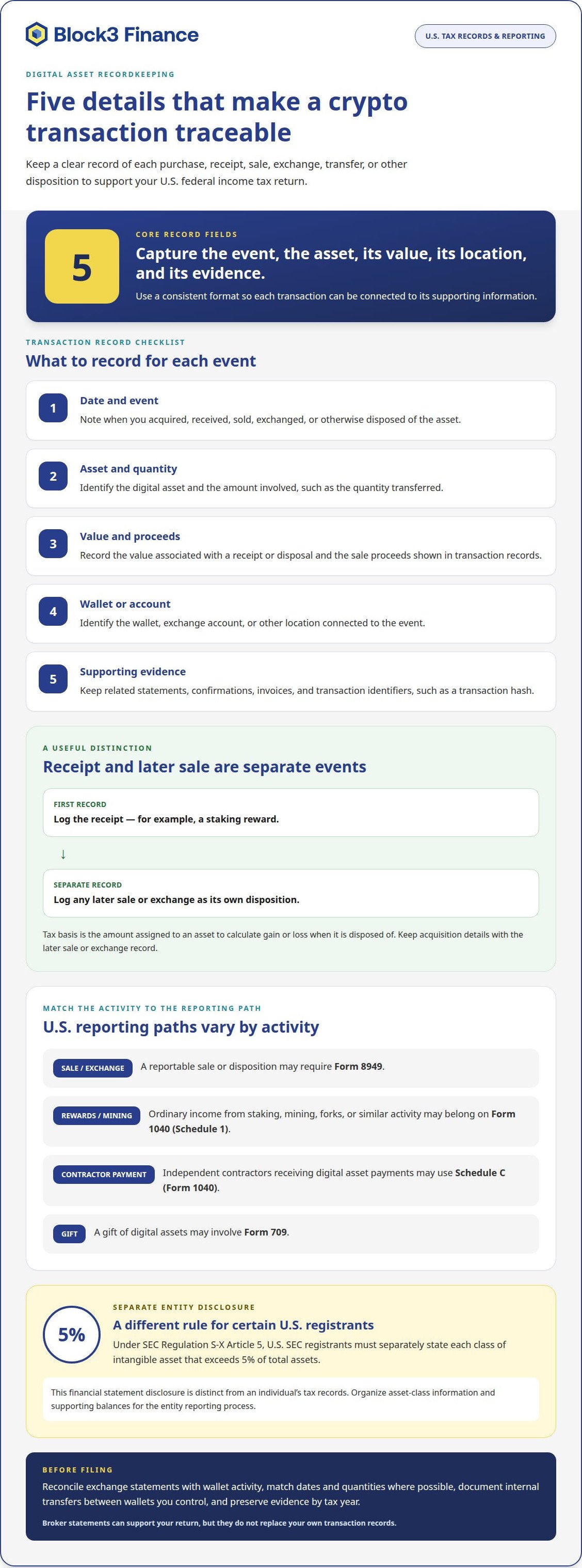
Use a consistent format for each transaction. Include the following details when available:
- Date and event: Note when you acquired, received, sold, exchanged, or otherwise disposed of the asset.
- Asset and quantity: Identify the digital asset and the amount involved, such as the quantity transferred.
- Value and proceeds: Record the value associated with receipt or disposal and the sale proceeds shown in transaction records.
- Wallet or account: Identify the wallet, exchange account, or other location connected to the event.
- Supporting evidence: Keep associated statements, confirmations, invoices, and transaction identifiers that explain the entry.
Reconcile records across platforms before preparing a return. An exchange statement may show a sale, while a wallet history shows the asset’s earlier movement. Match dates, quantities, and transaction identifiers where possible. If a transfer appears in two accounts you control, document both sides and label it as an internal movement rather than treating the entries as unrelated transactions.
Organize records by tax year and link each transaction to its supporting evidence. A spreadsheet can track the event date, asset, quantity, value, account, and document file name. For example, keep a staking reward receipt separate from the record of a later sale. This helps distinguish the initial receipt from the subsequent disposition.
Financial statement disclosures are distinct from an individual’s tax records. According to the U.S. Securities and Exchange Commission, US SEC registrants must separately state each class of intangible asset that exceeds 5% of total assets under Regulation S-X Article 5. A company should therefore organize asset-class information and supporting balances for its reporting process, rather than relying only on an individual transaction log.
Before filing, compare platform statements with wallet activity, flag missing transaction details, and preserve supporting documents for each entry. These steps connect digital asset activity to the positions reported on a U.S. federal income tax return.
Digital asset question on U.S. tax returns
A digital asset is a digital representation of value recorded on a cryptographically secured distributed ledger or similar technology under the Infrastructure Investment and Jobs Act. For U.S. taxpayers, reporting depends on what happened: a reportable sale or disposition may go on Form 8949, while ordinary income from staking, mining, forks, and similar activity may go on Form 1040 (Schedule 1). Independent contractors receiving digital asset payments may use Schedule C (Form 1040), and gifts may involve Form 709.
The digital asset question on a U.S. tax return asks taxpayers to disclose relevant activity for the tax year. Read it carefully and compare it with your transactions and income records: a wallet balance alone does not show what you did.
A disposition is an event in which an asset is sold, exchanged, or otherwise transferred out of ownership. Form 8949, Sales and Other Dispositions of Capital Assets, is used for digital asset transactions that require that form. Keep the transaction details together so the form entry can be traced to its supporting information.
- Sale or exchange: Identify the asset, transaction date, amount disposed of, and associated proceeds.
- Fork, staking, or mining: Track the receipt separately from a later sale, since the receipt and disposition are distinct events.
- Contractor payment: Record the digital asset payment and related work, then consider Schedule C (Form 1040) reporting.
- Gift: Document the transfer and recipient details, since the IRS identifies Form 709, United States Gift (and Generation-Skipping Transfer) Tax Return, for reporting a gift made in digital assets.
Ordinary income is income reported outside the capital-asset sale process. Form 1040 (Schedule 1) is identified for ordinary income from digital asset forks, staking, mining, and similar activities. For example, keep a staking receipt record distinct from an exchange statement showing a later sale. That separation helps distinguish how the asset entered your records from how it was eventually disposed of.
Broker statements can support your return, but organize them with wallet and payment records. Compare the asset, date, quantity, and proceeds across documents. If a statement reports a sale but your records lack the acquisition history, flag the gap before preparing the related return entry.
Use a final review to connect each activity to the appropriate reporting path: disposition, ordinary income, contractor payment, or gift. For help coordinating digital asset activity with U.S. tax reporting, discuss your reporting needs.
Broker reporting is another point to check against transaction records. U.S. brokers must report basis on certain digital asset transactions effected on or after Jan. 1, 2026. U.S. real estate professionals treated as brokers must report the fair market value of digital assets used in real estate transactions with closing dates on or after Jan. 1, 2026. The U.S. final broker regulations exclude decentralized or non-custodial brokers that do not take possession of the digital assets being sold or exchanged from their reporting requirements. The SEC and FINRA joint staff statement on broker-dealer custody of digital asset securities was issued on July 8, 2019, and withdrawn on May 15, 2025.
Disclosure of significant holdings
A significant holding is a crypto asset position important enough to require focused financial statement disclosure under an applicable accounting framework. Under FASB Accounting Standards Update 2023-08, entities disclose significant crypto-asset holdings, contractual sale restrictions, and changes during the reporting period. These are entity financial statement disclosures, not a universal personal tax filing schedule.
A contractual sale restriction is an agreement that limits when or how an entity may sell an asset. To prepare disclosures under FASB Accounting Standards Update 2023-08, identify holdings that qualify as significant, record any contractual restrictions, and track changes from one reporting period to the next. For example, a restriction that remains in force at period end should be distinguishable from one that began or ended during the period.
For a U.S. company, disclosures should make each reported position understandable rather than showing only a combined crypto balance. Keep supporting information for each significant holding and any restrictions, then reconcile the details to the financial statements. This clarifies what assets are held, whether disposal is limited, and how holdings changed during the reporting period.
What crypto asset disclosures are required by state securities laws? U.S. state securities laws vary with the transaction, the parties, and the state involved, so there is no single disclosure list for every crypto holding. Assess the specific offering and applicable state requirements rather than treating ordinary ownership as equivalent to an issuer’s offering.
What are the SEC’s crypto asset disclosure requirements for public companies? According to the U.S. Securities and Exchange Commission, US SEC registrants must separately state each class of intangible asset that exceeds 5% of total assets under Regulation S-X Article 5. Crypto-related reporting may also involve applicable accounting disclosures, including FASB’s requirements for significant holdings, restrictions, and changes.
An investment adviser disclosure explains relevant information about an investment and its risks to clients. What disclosures must investment advisers make about crypto asset holdings and risks? Requirements depend on the adviser’s circumstances and governing rules; there is no single crypto-specific checklist that applies to every adviser. As a practical matter, client materials can describe asset exposure, custody arrangements, valuation methods, liquidity limits, and material risks without presenting that list as a universal legal requirement.
Rights are the legal or contractual powers attached to an asset or agreement. For an entity, review governing documents for sale limits or other restrictions, then ensure the accounting records reflect those terms. A token balance alone may not show whether contractual rights affect disposal or reporting.
Keep the evidence connected: holdings schedules, restriction documents, and records of changes between periods should reconcile to the reported figures. This helps distinguish an entity’s financial statement disclosures from an individual taxpayer’s transaction reporting.
Revenue disclosures for crypto asset sales
Gross proceeds are the amount received from a digital asset sale before accounting for tax basis. For U.S. taxpayers, broker reporting helps document sale proceeds, but that figure alone does not establish taxable gain or loss. Compare reported proceeds with your transaction records and the asset’s basis.
The Infrastructure Investment and Jobs Act changed Internal Revenue Code §6045 to require broker reporting of digital asset transactions, according to the Office of the Law Revision Counsel, U.S. House of Representatives. For transactions on or after Jan. 1, 2025, U.S. brokers must report digital asset transaction information on Form 1099-DA, including gross proceeds for transactions effected on or after that date.
Basis is the amount used to calculate gain or loss when an asset is sold or otherwise disposed of. U.S. brokers must report basis on certain digital asset transactions effected on or after Jan. 1, 2026. Until then, or where a broker’s form doesn’t provide the basis information needed, taxpayers should use their own records to determine and support the amount.
A broker statement is a report of transactions handled through a broker, not a complete tax calculation. Review Form 1099-DA against exchange statements, wallet records, and purchase history. Check that the asset and transaction match, then investigate differences in proceeds or basis before using the information on a return.
Revenue Procedure 2024-28 provides transitional guidance for allocating unused digital asset basis among assets held in each taxpayer wallet or account as of Jan. 1, 2025. This matters when basis records weren’t assigned to specific assets before that date. Retain the allocation records and connect them to the relevant wallet or account.
How do U.S. crypto disclosure requirements compare for individuals, businesses, and financial institutions? Individuals report taxable activity on their tax returns, while businesses may also have financial statement disclosures and broker obligations. Financial institutions that qualify as brokers have reporting duties, including Form 1099-DA reporting for applicable transactions.
What disclosures must cryptocurrency exchanges and brokers provide? U.S. brokers must report digital asset transaction information on Form 1099-DA for transactions on or after Jan. 1, 2025, including gross proceeds for transactions effected on or after that date. Basis reporting applies to certain transactions effected on or after Jan. 1, 2026.
What are the penalties for failing to disclose crypto assets or crypto transactions? Consequences depend on the reporting obligation, the omission, and the taxpayer’s circumstances. An omitted transaction can make a return inaccurate, so identify the affected transaction and determine its correct reporting treatment before filing or amending a return.
Distinguish gross proceeds from taxable gain or loss in your review. Link the broker’s reported amount to the sale record, basis calculation, and tax return entry. This documentation helps explain how sale proceeds were reconciled, even when broker information and personal records differ.
Which SEC disclosure rules apply to crypto asset issuers and offerings?
A crypto asset exchange-traded product, or ETP, is an investment product traded on an exchange that provides exposure to crypto assets. Crypto asset ETP issuers are subject to registration requirements under the U.S. Securities Act of 1933 and Securities Exchange Act of 1934. Which disclosures apply depends on the offering and its registration context.
Regulation S-K and Regulation S-X set disclosure requirements for Securities Act registration. On July 1, 2025, SEC Division of Corporation Finance staff issued a statement addressing these requirements for crypto asset ETPs. Issuers should use the applicable registration framework to organize material information about the product, its structure, and the offering.
A registration statement provides information about securities offered to the public. For a crypto asset ETP, review disclosures against supporting records. Identify the product’s structure, the assets or exposure involved, and relevant investor risks. Then check that financial information and narrative disclosures are consistent throughout the filing.
A delayed or continuous offering is an offering made over time rather than through one immediate sale. Under Securities Act Rule 415, crypto asset ETP issuers conducting delayed or continuous offerings should include material distribution-plan information or changes in a post-effective amendment. A distribution plan describes how securities will be offered and distributed. Revisit the plan when a material change affects how the offering proceeds.
Use a structured review before filing or updating an ETP registration:
- Identify the filing context: Determine whether the issuer’s offering involves a crypto asset ETP and which registration requirements apply.
- Review the disclosure set: Check Regulation S-K and Regulation S-X information for completeness and consistency.
- Assess offering changes: For a Rule 415 offering, identify material distribution-plan information or changes that belong in a post-effective amendment.
- Connect statements to support: Maintain records that substantiate product descriptions, financial disclosures, and material updates.
Issuer obligations differ from personal tax reporting. An individual’s sale reporting does not replace an ETP issuer’s Securities Act registration disclosures. Likewise, an issuer’s offering documents do not determine an individual investor’s federal income tax treatment.
For an issuer, the practical challenge is keeping offering disclosures aligned with financial records as product details or distribution plans change. A review can map each material statement to supporting information, flag inconsistencies, and identify updates for the filing process. The SEC staff statement addresses disclosure requirements; it is not itself a rule or regulation and creates no new or additional obligations.
For support coordinating crypto activity with financial records and tax reporting, discuss your crypto reporting needs.
Issuers registering an indeterminate number of exchange-traded vehicle securities under Securities Act Rules 456(d) and 456(u) should use EDGAR fee tag “2” and security type “Exchange-Traded Vehicle Securities.”
Block3 Finance: Tax Filing and Reporting
Block3 Finance helps individuals and businesses turn complex digital asset activity into organized U.S. tax reporting. Its Tax Filing and Reporting service can support taxpayers managing sales, income, and records across multiple wallets or platforms.
Turn to a Crypto Tax Accountant when transaction histories need reconciliation or activity spans different reporting categories. Audits and Compliance can help address documentation and compliance needs, while Monthly Accounting supports ongoing records for businesses with continuing crypto activity.
The right next step depends on the work ahead: preparing a return, maintaining business records, or strengthening compliance documentation. Share the reporting challenge with Block3 Finance to discuss the relevant support. Contact Block3 Finance to start the conversation.
Build a reporting process that evolves with your activity
Crypto asset disclosure requirements can change as your digital asset activity and reporting responsibilities evolve. Make periodic reviews part of your financial process, so new transaction types and operational changes are reflected in the way you organize and report information.
Block3 Finance can help you assess your next reporting priorities and bring greater structure to the work ahead. Consider what needs attention now, then define a practical next step for keeping your records and reporting approach aligned.
Connect with Block3 Finance about your reporting needs. A deliberate process can help you move forward with clarity.
Frequently Asked Questions
What crypto asset disclosures are required in the United States?
U.S. disclosure requirements depend on the taxpayer’s activity and role, such as an individual filing a return or an entity preparing financial statements. Start by classifying each on-chain event by purpose before determining its reporting treatment. For example, document whether a transaction was a payment, a protocol reward, or an internal operational event, and keep the rationale with the related records.
How are cryptocurrency transactions reported on IRS forms, including Form 1099-DA?
Taxpayers use the applicable IRS forms for their activity, while Form 1099-DA conveys broker-reported transaction information. For calendar year 2025 transactions reported in 2026, the IRS will not impose certain filing and furnishing penalties when a broker makes a good-faith effort to report correctly and on time. That relief applies to specified broker penalties, so it shouldn’t be treated as a waiver of a taxpayer’s own reporting obligations.

Article by
Mahad Mohamed
Mahad Mohamed is an accountant and the CEO of Block3 Finance, with over 26+ years of Canadian and international tax and accounting experience. A crypto accounting specialist since the early days of Bitcoin, he has consulted for over 38 crypto companies and collaborated with legal professionals on regulatory matters. His expertise spans corporate reorganization, cross-border tax structuring (Canada & US), tax disputes, and CRA audits.
Previously, Mahad worked for the Canada Revenue Agency (CRA), Big4 accounting firms, and served as a Rulings Officer for the Federal Tax Authority of the UAE before acquiring Tax Partners in 2014.
Block3 Finance and Tax Partners has 44 full-time accountants and over 9,800+ clients.
Disclaimer
This article provides general information only and is current as of its publication date. It has not been updated and may be out of date. It does not constitute legal advice and should not be relied upon as such. Every tax situation is unique and may differ from the examples discussed in this article. If you have specific questions, you should seek the advice of our accountants for your unique circumstances.
Frequently Asked Questions
What crypto asset disclosures are required in the United States?
U.S. disclosure requirements depend on the taxpayer’s activity and role, such as an individual filing a return or an entity preparing financial statements. Start by classifying each on-chain event by purpose before determining its reporting treatment. For example, document whether a transaction was a payment, a protocol reward, or an internal operational event, and keep the rationale with the related records.
How are cryptocurrency transactions reported on IRS forms, including Form 1099-DA?
Taxpayers use the applicable IRS forms for their activity, while Form 1099-DA conveys broker-reported transaction information. For calendar year 2025 transactions reported in 2026, the IRS will not impose certain filing and furnishing penalties when a broker makes a good-faith effort to report correctly and on time. That relief applies to specified broker penalties, so it shouldn’t be treated as a waiver of a taxpayer’s own reporting obligations.