
Crypto Capital Loss Deduction Limits and Tax Treatment in the United States
A crypto loss can reduce your U.S. tax bill, but the amount you can deduct from ordinary income each year is limited. For U.S. taxpayers, the crypto capital loss deduction limits allow up to $3,000 of net capital losses to offset personal income after capital gains are accounted for, according to the Internal Revenue Service. Losses above that limit can generally be carried forward to future tax years.
It’s easy to focus on a coin’s falling value, but a decline alone doesn’t create a deductible loss. The loss generally must be realized through a taxable event, such as selling or exchanging the asset. This article explains how crypto losses are treated on a U.S. tax return, how capital gains and losses are matched, and how the annual deduction limit applies, including for different filing statuses. You’ll also see why accurate records of acquisition cost, proceeds, and transaction dates matter when calculating the result.
Key Takeaways
- A decline in a crypto asset’s value alone generally doesn’t create a deductible loss; the tax treatment depends on a completed transaction.
- In the United States, realized crypto losses can offset capital gains before any remaining loss is applied to personal income.
- The Internal Revenue Service allows up to $3,000 of excess net capital losses to offset personal income, with eligible unused losses carried forward.
- Filing status matters: the annual deduction limit for married individuals filing separately is $1500, according to the Internal Revenue Service.
- Clear records of transaction dates, proceeds, and cost basis help support the loss reported on a tax return.
Can I deduct losses from my crypto on my tax return?
Yes. Under U.S. federal tax rules, a realized crypto capital loss can reduce capital gains, and a qualifying net loss may also offset personal income. The calculation depends on the asset’s basis, sale proceeds, and whether each transaction is short-term or long-term.
Offsetting Gains With Crypto Losses
A realized crypto capital loss can offset realized capital gains from assets sold or otherwise disposed of. For example, a bitcoin sale at a loss can reduce taxable gains from another digital asset sale in the same tax year. Calculate each transaction separately, then combine the results to establish net gains or losses.
Matching Losses With Gains
For U.S. tax purposes, short-term and long-term gains and losses are first matched within their respective categories. Short-term means the asset was held for one year or less before sale; long-term means it was held for more than one year, according to the Internal Revenue Service. After this initial matching, excess losses can offset gains in the other category. Keep each asset’s acquisition date to classify the transaction correctly.
Calculating Gains and Losses From Basis
Basis is the asset’s adjusted cost for tax purposes, while proceeds are the value received when disposing of it. The gain or loss is the difference between those amounts, calculated in U.S. dollars. Compare the recorded basis of a crypto unit with the dollars received when it is sold. Reliable acquisition and transaction records support the calculation and help distinguish a realized loss from an unrealized price decline.
Reporting Gains and Deductible Losses
U.S. taxpayers generally report most virtual-currency sales and other capital transactions on Form 8949, then summarize capital gains and deductible losses on Form 1040, Schedule D. Reporting each transaction helps preserve the link between its proceeds, basis, and holding period. Include taxable transactions for the relevant tax year, even when the net result is a loss rather than a gain.
The crypto capital loss deduction limits matter after capital gains and losses have been netted. U.S. taxpayers with net capital losses exceeding their capital gains can use up to $3,000 of excess losses to offset personal income, according to the Internal Revenue Service. That limit applies to the excess loss used against personal income, not to the amount of capital gains a loss may offset. A larger remaining loss may carry forward to future tax years.
How is a loss from my crypto treated for tax purposes?
A price decline alone doesn’t establish a deductible loss. Theft, scams, bankruptcy, and worthless tokens require evidence of what happened. Selling crypto for cash or trading it for another crypto asset can create a capital gain or loss, calculated using basis and the value received.
Declines in Value and Completed Transactions
A decline in market value is an unrealized loss, meaning no disposal has fixed the result for tax purposes. For U.S. federal income tax, the loss generally becomes relevant through a completed transaction, such as selling, exchanging, or spending the asset. The IRS treats cryptocurrency as property under Notice 2014-21, so a crypto-to-crypto trade can count as an exchange of property.
For example, if an investor buys bitcoin and its market price later falls, the lower quoted price alone doesn’t establish a realized loss. Selling it for cash or exchanging it for another digital asset does. Distinguish a wallet transfer from a disposal: record the sending and receiving addresses and transaction details, then determine whether ownership changed or an asset was exchanged.
Records should link each transaction to its date, asset, units, basis, and value received. Keep exchange statements, wallet histories, and transaction IDs together. These records help distinguish a transfer from selling, spending, or swapping an asset, and support the calculation for the relevant tax year.
Losses From Theft, Scams, and Worthless Tokens
A theft, scam, bankruptcy, or token collapse doesn’t automatically establish a deductible loss for U.S. federal taxes. The facts and records matter: preserve account statements, communications, transaction histories, and bankruptcy notices to document the event and the asset involved. IRS Memo 202302011 discusses claims involving worthless and abandoned cryptocurrency under IRC Section 165.
Abandonment may receive capital-loss treatment under IRC Section 165(a), but a token’s low price alone does not show it was abandoned. A token that remains tradable and under the investor’s control may still exist as property. Distinguish a documented loss of the asset from a sharp decline, an inaccessible account, or an unresolved claim.
Reporting also matters. Beginning with the 2025 tax year, certain digital asset sale and exchange transactions are reported on Form 1099-DA. An information return does not replace the taxpayer’s own records: report taxable transactions for their tax year, even without that form. Compare broker statements with wallet and exchange histories, since the records should support both proceeds and basis.
For help organizing transaction records and reporting crypto disposals, discuss crypto tax reporting needs.
The annual limit on deducting net capital losses from ordinary income
In the United States, capital losses first reduce capital gains. Only an excess net loss may offset ordinary income, subject to a limit. The total realized loss and the amount deductible against ordinary income are therefore not necessarily the same.
Applying Losses Against Capital Gains
Capital losses reduce taxable capital gains by offsetting gains from taxable asset dispositions. The personal-income offset limit does not restrict the amount used against capital gains. For example, a realized crypto loss can offset gains from selling other investments. Add up the transactions for the tax year, then determine whether losses exceed gains. A loss used to offset gains cannot also offset ordinary income; only any remaining net loss is considered for that purpose.
Deducting Net Losses From Ordinary Income
Ordinary income includes income that isn’t treated as capital gain, and a net capital loss may offset only a limited amount of it. U.S. taxpayers with net capital losses exceeding their capital gains can use up to $3,000 of excess losses to offset personal income, according to the Internal Revenue Service. This limit concerns the excess loss applied to personal income, not the amount that may offset capital gains. Separate those two calculations when reviewing a return.
In the United States, net capital losses exceeding the $3,000 personal-income offset can be carried forward to future tax years, according to the Internal Revenue Service. That means an unused loss doesn’t simply disappear after the current return. Keep the loss amount and prior-year filing records available, so the carryforward can be accounted for when calculating a later year’s gains and deductions.
Limits by Filing Status
Filing status affects how much net capital loss may offset personal income in a tax year. For married individuals filing separately, the annual capital-loss deduction limit is $1500, according to the Internal Revenue Service. Other filing statuses generally use the $3,000 personal-income offset described above. This distinction matters when spouses file separate returns: the limit applies to each return’s filing status, so don’t assume the same amount applies across both.
For married couples filing jointly, the applicable personal-income limit is $3,000. The difference is specific to separate filing, not a different treatment of whether a crypto transaction created a capital loss. Use the filing status on the return to identify the relevant ceiling, then distinguish the allowed income offset from any loss that may remain available for a future tax year.
Realized Losses on Virtual Currency Sales
A realized loss from a virtual currency sale is generally the difference between the asset’s adjusted basis and the amount received, calculated in U.S. dollars. This matters because the sale establishes the transaction result used in the capital-loss calculation. For example, a realized $10,000 crypto loss may offset up to $10,000 of realized capital gains, or up to $3,000 of ordinary income. The remaining amount depends on the taxpayer’s gains, filing status, and applicable limits.
A crypto-to-crypto exchange can also produce a recognized capital gain or loss when the virtual currency is held as a capital asset. Selling for cash and exchanging for another asset both require a transaction-level calculation. The loss must be realized, supported by records, and included in the correct tax year before applying the personal-income limit.
Annual capital-loss deduction limits
For U.S. taxpayers, the annual limit applies to net capital losses used against ordinary income, not to each crypto asset separately. Start with taxable disposals for the tax year, then compare capital gains and losses to determine whether a loss can offset other income.
Keep the categories distinct on a tax return. A capital loss may reduce capital gains first; the personal-income limit becomes relevant only when losses exceed gains. The Internal Revenue Service allows up to $3,000 of excess net capital losses to offset personal income. That amount is a ceiling on the income offset, not a cap on recording the realized losses themselves.
Follow the calculation in this order to understand how the limit applies:
- Gather records for crypto sales, exchanges, and other taxable dispositions in the tax year.
- Calculate each transaction’s gain or loss using its basis and the value received.
- Combine capital gains and losses to determine the net result.
- Apply any remaining net loss to personal income within the applicable limit.
This sequence helps prevent a common mistake: treating every losing sale as a separate deduction from ordinary income. An investor with both gains and losses must first account for the combined capital activity. The final net loss, not an individual bitcoin or token loss, determines whether an offset against ordinary income is available.
This distinction also clarifies a tax result. A realized loss can reduce taxable capital gains even if it exceeds the amount that can be used against ordinary income. If capital gains absorb the losses, no net loss remains for the personal-income calculation. If losses remain, only the amount permitted by the limit can offset that income on the current return.
The IRS allows unused net capital losses to carry forward to future tax years when they exceed the permitted personal-income offset. Record the amount carried forward and the tax return where it originated. This creates a clear link between prior-year losses and later calculations, rather than treating each return as an isolated set of crypto transactions.
For an accurate calculation, reconcile exchange statements with wallet histories and transaction records before preparing the return. A broker’s proceeds figure alone may not establish the basis of every asset. Matching records transaction by transaction supports the reported net amount and shows whether a loss reduces capital gains, offsets ordinary income, or remains available for a later tax year.
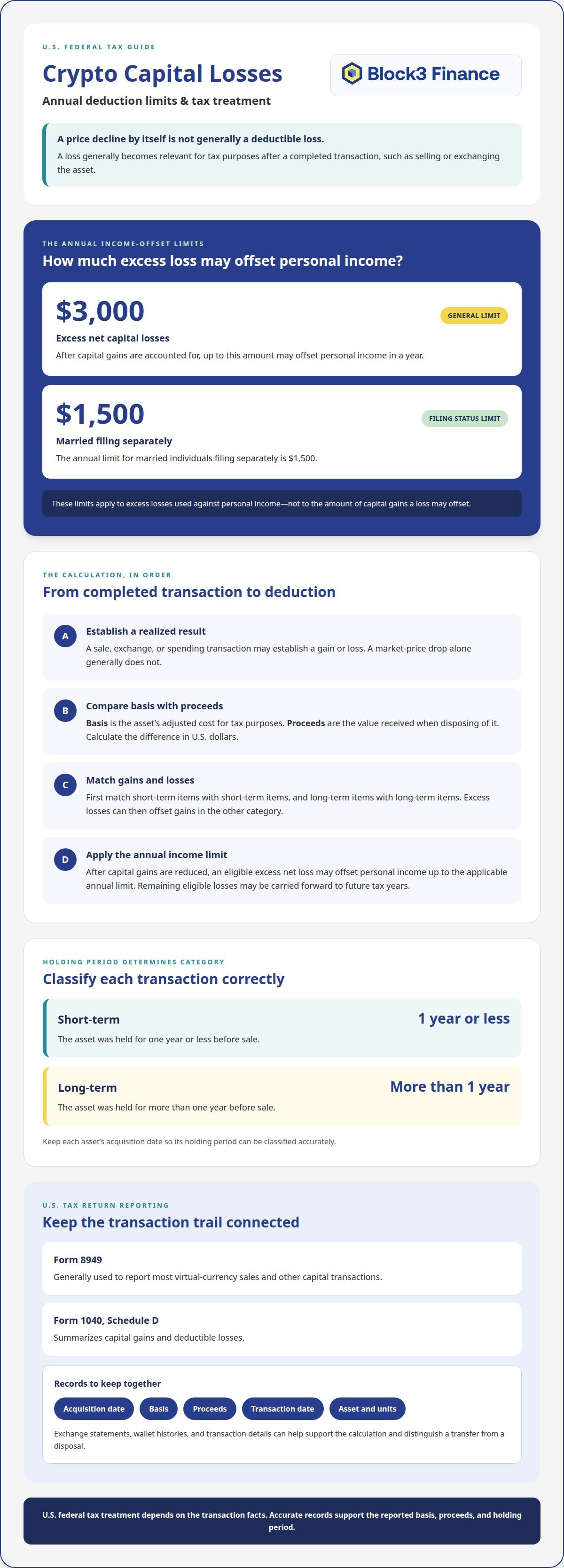
How does the $3,000 capital loss deduction limit differ for married filing jointly and married filing separately?
For U.S. taxpayers, filing status changes the amount of excess net capital loss that may offset personal income. Married couples filing jointly generally use the $3,000 limit, while married individuals filing separately have a lower limit. The distinction applies after capital gains and losses have been netted, not separately to every crypto sale.
For married individuals filing separately, the annual capital-loss deduction limit is $1500, according to the Internal Revenue Service. For a joint return, the personal-income offset limit is $3,000 under the general U.S. rule. These limits concern excess net capital losses used against personal income. Capital losses may first offset capital gains, so the loss total and the amount claimed against other income can differ.
Think of the calculation in two stages. First, combine the realized capital gains and losses for the tax year. Then determine whether a net loss remains after offsetting gains. Only that remaining amount is considered against ordinary income, subject to the limit that applies to the return. This keeps the capital-gain calculation separate from the personal-income deduction.
- Married filing jointly: Apply the $3,000 personal-income offset limit to eligible excess net capital losses.
- Married filing separately: Apply the $1500 annual limit to eligible excess net capital losses.
- Either filing status: Calculate capital gains and losses before applying the personal-income ceiling.
The practical difference is the limit, not whether a crypto transaction can create a loss. Each sale or exchange still needs its own proceeds and basis calculation. Once the transactions are combined, filing status determines how much remaining net loss can reduce ordinary income on that return. A larger net loss does not become fully deductible against ordinary income simply because the taxpayer files jointly.
Before filing, review the crypto activity reported, the return’s filing status, transaction records, net capital result, and any loss carried forward from an earlier tax year. Filing status affects the deduction limit, while transaction records establish the loss amount. Keeping these questions separate makes the calculation easier to follow.
For example, if a couple reports crypto losses on a joint return, the $3,000 ceiling applies to the eligible net loss used against personal income. If a married taxpayer files separately, the $1500 annual limit applies instead, according to the Internal Revenue Service. In both cases, the limit does not replace the need to report taxable sales and exchanges or calculate capital gains accurately.
If your filing status and crypto transactions need to be reconciled for a tax return, discuss your crypto tax filing.
Block3 Finance: Tax Filing and Reporting
Block3 Finance supports U.S. crypto tax preparation through Tax Filing and Reporting, helping organize transaction records and report digital asset activity. Turn to this support when sales, exchanges, cost-basis records, or carried-forward losses make a tax return difficult to reconcile.
Its Crypto Tax Accountant service can help bring capital gains, realized losses, and filing-status limits into one reporting process. Audits and Compliance can also support review of records and reported positions, while Monthly Accounting helps maintain organized financial records throughout the year. These services focus on accounting and tax reporting, not investment decisions.
Clear transaction histories make it easier to connect each reported amount with its supporting records. If you’d like help with crypto tax filing and reporting, contact Block3 Finance.
Build a Clearer Path for Your Next Tax Return
Use crypto records as an ongoing financial control, not a year-end scramble. A consistent process for recording trades, disposals, and basis documentation helps you review transactions clearly and prepare for future reporting. Understanding how crypto capital loss deduction limits fit into that process supports more orderly tax reporting.
Block3 Finance can support that work through Tax Filing and Reporting, Audits and Compliance, and Monthly Accounting. These services help bring transaction records and reporting requirements into a more coherent process, whether you’re preparing a return or strengthening your accounting practices.
Take the next step toward a more organized approach to crypto tax reporting. Contact Block3 Finance to discuss your tax reporting needs, and move forward with greater control over your records.
Frequently Asked Questions
How is crypto taxed?
In the United States, crypto may create taxable income or capital gains depending on the activity. Selling, spending, or exchanging a capital asset can produce a gain or loss, while crypto received for services is income. For example, buying a digital asset and later exchanging it for another asset may require a capital calculation. Taxable transactions belong on the federal return for the tax year in which they occurred, even without an information form.
How do cryptocurrency losses help me when filing my taxes?
Cryptocurrency losses can reduce capital gains, and an eligible net loss can also reduce personal income within the applicable limit. Their practical value depends on your other transactions in that tax year. For example, a loss on one token may reduce a gain from another asset, changing the net capital result shown on your return. Keep transaction records together so you can support both the loss and how it was applied.
Does the wash sale rule apply to crypto?
Under current U.S. treatment, the wash sale rule does not apply to cryptocurrency because the IRS does not classify digital currencies as securities. The rule generally concerns selling a security at a loss and acquiring the same or a substantially identical security within the specified window. That distinction does not make a crypto transaction tax-free: a sale or exchange may still create a reportable gain or loss, and records remain important.
What are the requirements for deducting a loss from my crypto?
To claim a crypto capital loss on a U.S. return, you need a realized transaction and records that support the calculation. Keep the acquisition date, units, basis, disposal date, and proceeds or value received. A price drop while you still hold the asset isn’t enough by itself. An exchange history and wallet record, for example, can help show whether a transaction was a sale, swap, or transfer.
How are cryptocurrency losses classified as capital losses for U.S. tax purposes?
Cryptocurrency held as a capital asset can produce a capital loss when disposed of for less than its adjusted basis. The holding period determines whether the result is short-term or long-term. A token becoming nearly worthless does not, by itself, establish a deductible loss if it remains tradable and under your control. For theft, abandonment, or bankruptcy, preserve documents showing what happened and when before determining the tax treatment.
What is the annual capital loss deduction limit for individuals in the United States?
For U.S. individuals, up to $3,000 of excess net capital losses can offset personal income after capital gains are accounted for, according to the Internal Revenue Service. The limit applies to the net loss used against personal income, not to each crypto transaction. Filing status can change the applicable ceiling: married individuals filing separately have an annual limit of $1500, according to the Internal Revenue Service.
Can unused crypto capital losses be carried forward, and how are they used in future tax years?
Yes. In the United States, net capital losses exceeding the personal-income offset can carry forward to future tax years. In a later year, the carried amount enters the capital-loss calculation alongside that year’s gains and losses. Keep the original return and a clear schedule of the unused amount so the carryforward remains traceable and distinct from new crypto losses.
How do short-term and long-term crypto capital losses offset capital gains?
For U.S. tax purposes, first match short-term losses with short-term gains and long-term losses with long-term gains. Any excess loss can then offset gains in the other category. The holding period determines the category, so preserve the acquisition and disposal dates for each asset. A sale list that separates assets by holding period, for example, makes it easier to reconcile transactions before summarizing them on Schedule D.

Article by
Mahad Mohamed
Mahad Mohamed is an accountant and the CEO of Block3 Finance, with over 26+ years of Canadian and international tax and accounting experience. A crypto accounting specialist since the early days of Bitcoin, he has consulted for over 38 crypto companies and collaborated with legal professionals on regulatory matters. His expertise spans corporate reorganization, cross-border tax structuring (Canada & US), tax disputes, and CRA audits.
Previously, Mahad worked for the Canada Revenue Agency (CRA), Big4 accounting firms, and served as a Rulings Officer for the Federal Tax Authority of the UAE before acquiring Tax Partners in 2014.
Block3 Finance and Tax Partners has 44 full-time accountants and over 9,800+ clients.
Disclaimer
This article provides general information only and is current as of its publication date. It has not been updated and may be out of date. It does not constitute legal advice and should not be relied upon as such. Every tax situation is unique and may differ from the examples discussed in this article. If you have specific questions, you should seek the advice of our accountants for your unique circumstances.
Frequently Asked Questions
How is crypto taxed?
In the United States, crypto may create taxable income or capital gains depending on the activity. Selling, spending, or exchanging a capital asset can produce a gain or loss, while crypto received for services is income. For example, buying a digital asset and later exchanging it for another asset may require a capital calculation. Taxable transactions belong on the federal return for the tax year in which they occurred, even without an information form.
How do cryptocurrency losses help me when filing my taxes?
Cryptocurrency losses can reduce capital gains, and an eligible net loss can also reduce personal income within the applicable limit. Their practical value depends on your other transactions in that tax year. For example, a loss on one token may reduce a gain from another asset, changing the net capital result shown on your return. Keep transaction records together so you can support both the loss and how it was applied.
Does the wash sale rule apply to crypto?
Under current U.S. treatment, the wash sale rule does not apply to cryptocurrency because the IRS does not classify digital currencies as securities. The rule generally concerns selling a security at a loss and acquiring the same or a substantially identical security within the specified window. That distinction does not make a crypto transaction tax-free: a sale or exchange may still create a reportable gain or loss, and records remain important.
What are the requirements for deducting a loss from my crypto?
To claim a crypto capital loss on a U.S. return, you need a realized transaction and records that support the calculation. Keep the acquisition date, units, basis, disposal date, and proceeds or value received. A price drop while you still hold the asset isn’t enough by itself. An exchange history and wallet record, for example, can help show whether a transaction was a sale, swap, or transfer.
How are cryptocurrency losses classified as capital losses for U.S. tax purposes?
Cryptocurrency held as a capital asset can produce a capital loss when disposed of for less than its adjusted basis. The holding period determines whether the result is short-term or long-term. A token becoming nearly worthless does not, by itself, establish a deductible loss if it remains tradable and under your control. For theft, abandonment, or bankruptcy, preserve documents showing what happened and when before determining the tax treatment.
What is the annual capital loss deduction limit for individuals in the United States?
For U.S. individuals, up to $3,000 of excess net capital losses can offset personal income after capital gains are accounted for, according to the Internal Revenue Service. The limit applies to the net loss used against personal income, not to each crypto transaction. Filing status can change the applicable ceiling: married individuals filing separately have an annual limit of $1500, according to the Internal Revenue Service.
Can unused crypto capital losses be carried forward, and how are they used in future tax years?
Yes. In the United States, net capital losses exceeding the personal-income offset can carry forward to future tax years. In a later year, the carried amount enters the capital-loss calculation alongside that year’s gains and losses. Keep the original return and a clear schedule of the unused amount so the carryforward remains traceable and distinct from new crypto losses.
How do short-term and long-term crypto capital losses offset capital gains?
For U.S. tax purposes, first match short-term losses with short-term gains and long-term losses with long-term gains. Any excess loss can then offset gains in the other category. The holding period determines the category, so preserve the acquisition and disposal dates for each asset. A sale list that separates assets by holding period, for example, makes it easier to reconcile transactions before summarizing them on Schedule D.