
Crypto controls must do more than protect private keys. For U.S. businesses, a practical framework for crypto internal controls for business operations helps protect digital assets, support accurate financial reporting, and make activity accountable across wallets, platforms, and blockchain networks.
It’s natural to focus first on who can access a wallet and approve a transfer. Those decisions matter, but U.S. businesses also need controls that connect approvals to clear records, independent reviews, and routine reconciliation. This helps ensure gaps between onchain activity and company books do not go unnoticed.
This article explains crypto internal controls and how U.S. businesses can assess wallet ownership, access permissions, logging, and operational accountability. It covers onchain risks, including transaction and protocol exposure, as well as offchain risks involving people, processes, and third parties. Use this framework to identify where controls should prevent unauthorized activity or errors, where they should detect problems, and how they can support dependable U.S. financial reporting.
Key Takeaways
- Separate transaction initiation, approval, execution, and recording so one person cannot control the full process.
- Maintain a current wallet inventory with each wallet’s purpose, owner, authorized users, and approval path.
- Use access restrictions, multiple approvals for higher-risk transfers, and time-stamped records to strengthen accountability.
- Assess both blockchain-specific exposure and offchain risks from people, processes, vendors, and protocols.
- Connect wallet activity to reliable accounting records and regular reconciliation to support reporting and audit readiness.
1. What does a “well-controlled” digital asset environment look like to regulators and auditors?
For a U.S. business, a well-controlled digital asset environment connects wallet custody, transaction approval, accounting records, and review evidence. Document each wallet’s business purpose, named owner, authorized users, and approval path. Maintain an up-to-date inventory so finance can identify company wallets and capture their activity for reporting. Include wallets held directly and those managed through custodians or platforms.
Crypto internal controls for U.S. business operations should account for blockchain transactions that may be difficult to reverse. Before execution, verify the recipient address, amount, and business purpose. One employee can prepare a payment while another approves it, with finance recording and reconciling the transaction. Separating these duties makes errors easier to identify and unsupported activity easier to investigate.
Public and private U.S. businesses share core control objectives, but their reporting and assurance needs can differ. A public company should align controls with its financial reporting and audit responsibilities. A private business should design controls around its reporting, governance, and applicable obligations. In either case, reviewers need evidence of wallet ownership, transaction approval, and how activity was recorded.
AML, sanctions screening, and KYC controls depend on a U.S. business’s activities and applicable obligations. KYC means verifying customer identity, while AML controls help identify and address suspicious activity. Transaction screening can flag activity linked to risky or restricted addresses. Documented onboarding and transaction records support compliance processes. Depending on a platform’s controls, automated AML or KYT (know-your-transaction, or screening transactions for risk) can flag or freeze transactions associated with risk.
To implement a cryptocurrency control framework, map each digital-asset risk to a control, assign an owner, document the procedure, and retain evidence of review. Then test whether the control works. For example, compare wallet activity with the accounting ledger and investigate unmatched transfers. Revisit the framework when the business adds wallets, protocols, or transaction types, or changes access.
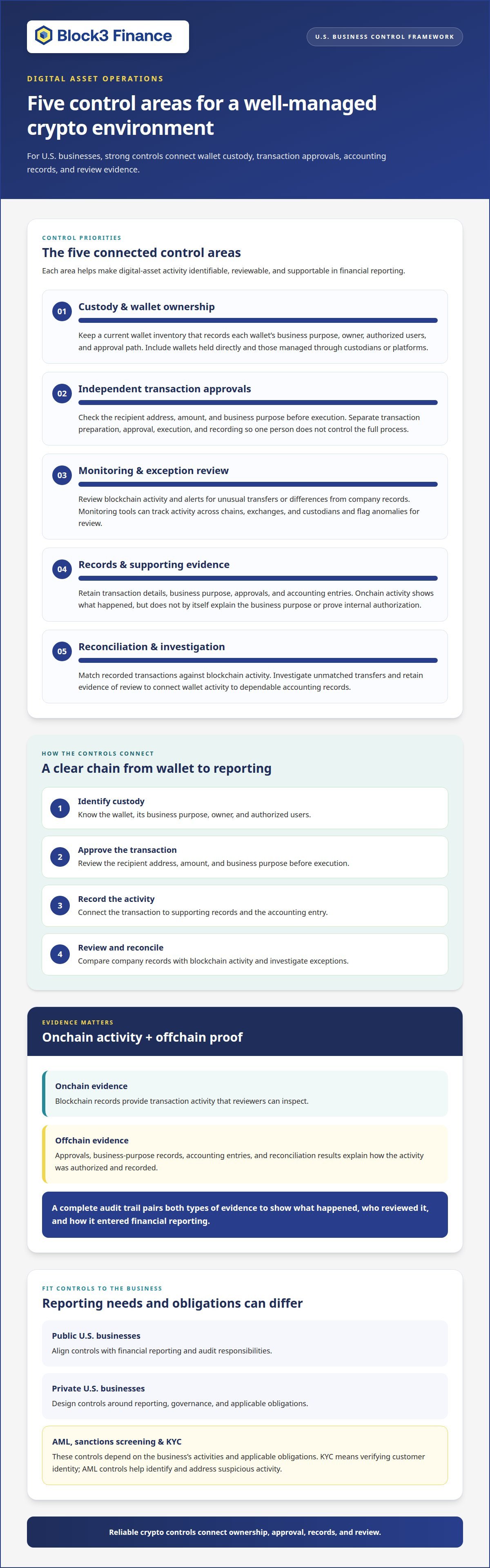
- Custody: Record each wallet’s purpose, owner, authorized users, and recovery arrangements.
- Approvals: Validate addresses and amounts before transfers, with independent review where needed.
- Monitoring: Review blockchain activity and alerts for unusual transfers or record differences.
- Records: Retain transaction details, business purpose, approvals, and accounting entries.
- Reconciliation: Match recorded transactions against blockchain activity and investigate exceptions.
Blockchain transparency lets reviewers inspect transaction activity, but it does not explain a transfer’s business purpose or prove internal authorization. Monitoring tools can track activity across chains, exchanges, and custodians, then flag anomalies for review. A complete audit trail pairs onchain evidence with offchain approvals, supporting records, and reconciliation results. This helps U.S. businesses show what happened, who reviewed it, and how the transaction entered financial reporting.
2. Wallet mismanagement risks and control failures
Wallet exposure grows when company records fall behind actual usage. A wallet created for a project may remain funded after the project ends, while its original users retain access. An exchange deposit address, treasury wallet, and test wallet may all appear in transaction histories. Without an authoritative inventory, finance may miss assets or fail to connect activity to the right business purpose.
Maintain a wallet register that records each wallet’s purpose, owner, environment, approval status, funding source, authorized users, and signers. Note whether custody is self-managed or provided by a third party. Reconcile the register with blockchain activity and internal ledgers on a defined schedule. When ownership changes, update the record and retain evidence of approval.
Govern the wallet lifecycle from creation through retirement. Require a business purpose and approval before creating or funding a wallet. Review permissions when roles change, projects close, or a wallet’s use shifts. Retire wallets that no longer serve a current need, remove stale access, and narrow unused permissions. These steps help reduce hidden exposure as the wallet inventory changes.
For a custody provider, assess its internal controls, financial condition, cybersecurity, fraud detection, conversion reliability, and accounting and tax information. Review relevant SOC 1 or SOC 2 reports, which describe controls examined by an independent service auditor. Assess whether third-party insurance covers assets both in storage and in motion, and understand the policy’s scope and exclusions before relying on it.
Self-custody requires clear private-key ownership and disciplined recovery procedures. A hardware-wallet policy should specify seed-generation arrangements, backup handling, password storage, custody responsibilities, authorized users, and transaction signers. Restrict seed phrases and private keys to approved personnel, and store recovery materials separately from routine access devices. A small test transaction, confirmed with a block explorer, can help demonstrate that a key remains operational.
Wallet failures often emerge during changes rather than routine transfers. A lost recovery phrase, departed signer, or unrecorded wallet migration can block access or leave records incomplete. Spreading self-custodied funds across multiple wallets can limit the impact of one compromised wallet, but each wallet adds inventory and reconciliation work. Assign an owner to coordinate records across wallets, exchanges, and accounting systems.
- At creation: Document purpose, owner, funding source, and approval path.
- During use: Review permissions and reconcile wallet activity to records.
- At retirement: Transfer remaining assets through an approved process, remove access, and retain closure evidence.
Clear wallet governance also supports reliable financial records. Businesses refining custody documentation and reconciliation can discuss wallet and accounting controls.
3. Logging, access control, and operational accountability
Access controls determine who can view, approve, or perform each crypto operation. Set up named user accounts for wallets, exchanges, treasury platforms, and accounting systems. Avoid shared credentials: if a transfer is disputed, individual accounts help identify who initiated or approved it. Give each person only the permissions needed for their duties, then remove access when responsibilities change.
Authentication protects those permissions. Require strong authentication for accounts that can move assets, change wallet settings, or add transaction signers. Keep administrative access separate from routine use, and document who can grant or change permissions. For example, a staff member who prepares a payment should not also approve it or alter the access log. Multiple signatures can add a review step for high-value transactions.
Logs should make each control activity traceable. Retain time-stamped evidence of who performed an action, who reviewed it, what changed, and whether the control passed. Include wallet permission changes, transaction approvals, failed access attempts, and exceptions. A reviewer should be able to trace a payment from request to approval, blockchain execution, and accounting entry without relying on memory or chat messages.
Operational accountability also depends on assigning control owners. Name a preparer, reviewer, and escalation contact for activities such as access reviews, payment approvals, and exception handling. A crypto control dashboard can show each task’s owner, reviewer, completion status, and supporting documentation. Cloud-heavy operations can map wallet administration and access governance to the Cloud Security Alliance (CSA) Cloud Controls Matrix, which connects cloud controls with operational accountability.
- Access changes: Record the request, approver, affected account, and effective change.
- Transaction review: Preserve approval evidence alongside the transaction identifier and business purpose.
- Exceptions: Log the issue, assigned owner, investigation, and resolution.
- Periodic review: Compare active permissions with current job duties and remove obsolete access.
Liquidity and counterparty access need their own controls. Limit exchange and broker permissions to necessary functions, separating trading or transfer access from account administration where possible. Document who can initiate withdrawals, update bank details, or change withdrawal destinations. Before transferring assets between a wallet and an exchange, record the business purpose and independently review the destination details. This puts counterparties in the control record instead of leaving an exchange balance unexplained.
Strong documentation supports a reliable operational trail, but logs become useful only when reviewed. Assign a reviewer to examine alerts, access changes, and incomplete control tasks. For example, an unfamiliar permission change should prompt an investigation, a recorded decision, and corrective action when needed. Regular review connects system activity to accountable people and gives finance teams evidence for reporting and audit work.
4. Onchain and offchain risk assessments
U.S. businesses should assess risks visible on a blockchain separately from risks created by people, systems, and counterparties. For an onchain review, identify the networks, tokens, smart contracts, and wallet activity connected to operations. Confirm transaction data through reliable block explorers and independent sources. If activity cannot be independently checked, investigation and reconciliation become harder.
Blockchain reliability also depends on the ecosystem supporting it. Assess whether a foundation can support ecosystem growth and maintenance, and examine the participants building or using the network. Consider whether the chain has experienced a 51% attack, which could affect confidence in transaction history. Record how each finding affects the business’s ability to hold, transfer, or account for related assets.
Offchain risks can arise from vendors, custodians, employees, or internal processes. Map the third parties involved in wallet access, transaction execution, or data, then identify what happens if a service is disrupted. For example, if an exchange report omits a transfer, compare its records with blockchain data and the internal ledger. This can help pinpoint whether the issue lies with a vendor, process, or accounting entry.
Smart contracts need a distinct control path because deployed code can affect assets without routine manual approval. Before implementation, document how the code is tested, who reviews the results, and who authorizes deployment. Assess whether the contract can move or restrict assets and whether its functions match the approved business purpose. Keep test results, code changes, approvals, and deployment details together.
- Network risk: Confirm transaction data through a block explorer and an independent source.
- Protocol risk: Identify contract functions, dependencies, and potential effects on business assets.
- Third-party risk: Map each vendor’s role, data, access, and operational dependencies.
- Process risk: Trace a sample transaction from initiation through settlement and accounting.
- U.S. regulatory risk: Map relevant federal and state obligations to onboarding, screening, recordkeeping, and reporting controls.
Risk-control mapping turns findings into accountable actions. For each risk, document the control, its owner, the evidence it produces, and how reviewers assess whether it worked. For example, the risk of unauthorized contract deployment could be addressed through restricted access, documented testing, and independent approval. If a control fails, record the exception and corrective action.
U.S. businesses should reassess controls when adopting a new DeFi (decentralized finance, or financial services that run on blockchain networks) protocol, adding a blockchain, or changing a critical vendor. A new protocol may introduce permissions and dependencies that existing checks do not address. Update the risk map, assign responsibility, and test revised controls before relying on them for operations or reporting.
5. Purpose of crypto internal controls
Controls have a strategic purpose: they let an organization use digital assets without losing sight of ownership, reporting, or accountability. A treasury policy can define why the business holds crypto, which activities support that purpose, and who may authorize them. For example, a company holding tokens for operational payments needs controls that connect each payment to an approved business activity.
Asset protection is only one outcome. Controls also make financial reporting more dependable by connecting blockchain activity with accounting records. If a business receives tokens from a customer, records should show the transaction, its business purpose, and how the receipt entered the books. This trail helps finance investigate discrepancies and explain reported balances.
A framework can also help the organization meet applicable compliance and tax-reporting needs. Customer onboarding, transaction screening, and recordkeeping can support KYC, AML, sanctions, and tax processes. Make controls reflect the business’s actual activities, such as accepting crypto payments, holding treasury assets, or transferring tokens between accounts. A control without a clear risk or business purpose may add work without improving oversight.
To implement a useful framework, connect every control to a defined objective. A transaction approval control may reduce unauthorized transfers; a reconciliation control may help identify missing or misclassified activity. Document the control owner, evidence retained, review process, and response to exceptions. This makes the framework practical for staff, rather than a policy document detached from daily operations.
- Protect assets: Clarify who can authorize activity and what the treasury policy permits.
- Support reporting: Connect transaction evidence with accounting records and reporting decisions.
- Strengthen compliance: Align onboarding, screening, and recordkeeping with business activity.
- Enable oversight: Assign owners and reviewers, then track exceptions through resolution.
Controls should evolve with the organization. Adding a payment flow, blockchain, or protocol can change the risks and the evidence needed to manage them. Review the framework when operations change, assess whether each control still addresses its intended risk, and adjust responsibilities or procedures where gaps appear. Aim for disciplined flexibility: clear guardrails for material risks without burdening routine activity with unnecessary steps.
For support aligning digital-asset records with business reporting, discuss your crypto accounting needs.
Block3 Finance
Block3 Finance helps businesses connect crypto activity with reliable accounting, reporting, and compliance processes. When wallet records, transaction histories, and financial statements need to align, its Monthly Accounting and Tax Filing and Reporting services support consistent records and reporting. Businesses preparing for an audit or seeking clearer control documentation can also turn to Audits and Compliance. A Crypto Tax Accountant can help address the tax treatment and records associated with digital-asset activity.
These services are a practical next step when internal processes need stronger financial oversight, or when existing records are difficult to reconcile. The right support depends on the work your business needs, whether that means regular accounting, tax reporting, or audit preparation. Contact Block3 Finance to discuss your crypto accounting and control needs.
Put your control framework to work
Make your framework an operating discipline, not a document set apart from daily decisions. Choose a control owner, set a review schedule, and make exceptions visible to the people responsible for resolving them. As your organization adds wallets, counterparties, or transaction types, revisit whether existing controls still fit.
A practical crypto internal controls for business framework should also connect operational evidence with dependable financial records. Block3 Finance supports that work through Monthly Accounting, Tax Filing and Reporting, and Audits and Compliance. These services can help businesses strengthen the accounting and reporting processes that sit alongside their digital-asset controls.
Start with the area where unclear ownership or incomplete records create the most friction, then define the next improvement your team can implement. Discuss your crypto controls with Block3 Finance and take a considered next step toward stronger financial oversight.
Frequently Asked Questions
What are Crypto Internal Controls?
Crypto internal controls are the policies and procedures a business uses to manage digital-asset activity and related financial records. They can cover how staff initiate transactions, manage access, record activity, and review exceptions. For example, a company might require an approved payment request before recording a crypto transfer in its finance system. A useful framework links each control to a risk and assigns someone to perform or review it.
What does a “well-controlled” digital asset environment look like to regulators and auditors?
A framework gives reviewers a clear path from a business decision to the supporting evidence and accounting outcome. For a vendor payment, that could include the invoice, approval record, transfer details, and ledger entry. Reviewers can then understand why the transaction occurred and how the company recorded it. The framework should also show how the business evaluates exceptions and updates procedures when its crypto activities change.
How should a business secure crypto wallets and private keys?
Limit wallet and key access to people who need it for their duties, and define how access is granted, changed, and removed. Store recovery information securely and document who may use it. For a self-custody wallet, establish how keys are generated and backed up, then test the recovery process. Avoid storing seed phrases alongside devices or records that could expose wallet access.
What approval and segregation-of-duties controls are needed for business crypto transactions?
Where staffing allows, separate payment preparation, authorization, execution, and accounting review. One staff member could submit a transfer request while another authorized person approves it before execution. For a transaction requiring multiple signatures, retain each signer’s approval with the payment record. Smaller teams can use an independent reviewer or scheduled owner review to reduce the risk of one person controlling the entire transaction path.
How should businesses reconcile and monitor cryptocurrency transactions?
Compare transaction records from wallets, exchanges, custodians, and accounting systems, then investigate differences rather than carrying them forward. For example, if an exchange shows a withdrawal missing from the ledger, match its transaction identifier to blockchain activity and determine its business purpose. Monitoring can also flag unexpected transfers or unusual address activity. Record the investigation outcome so unresolved items remain visible to the appropriate reviewer.
What accounting and recordkeeping controls apply to business cryptocurrency?
Keep records connecting each crypto transaction to its date, asset, amount, business purpose, authorization, and accounting treatment. Retain supporting materials such as invoices, customer records, exchange statements, and transaction identifiers. For example, a crypto payment should be traceable from its business documentation through the related wallet activity and books. Consistent records help explain reported balances and support tax reporting or audit requests.
What are the main risks of weak cryptocurrency internal controls for businesses?
Weak controls can leave unauthorized transfers, missing assets, inaccurate books, or unexplained wallet activity undetected. They can also make it difficult to establish who approved a transaction or why the business made it. For example, an old wallet with active permissions may still be used after its project has ended. Unclear records can complicate reporting and reviews, while untested recovery arrangements can obstruct access when key personnel or devices change.

Article by
Mahad Mohamed
Mahad Mohamed is an accountant and the CEO of Block3 Finance, with over 26+ years of Canadian and international tax and accounting experience. A crypto accounting specialist since the early days of Bitcoin, he has consulted for over 38 crypto companies and collaborated with legal professionals on regulatory matters. His expertise spans corporate reorganization, cross-border tax structuring (Canada & US), tax disputes, and CRA audits.
Previously, Mahad worked for the Canada Revenue Agency (CRA), Big4 accounting firms, and served as a Rulings Officer for the Federal Tax Authority of the UAE before acquiring Tax Partners in 2014.
Block3 Finance and Tax Partners has 44 full-time accountants and over 9,800+ clients.
Disclaimer
This article provides general information only and is current as of its publication date. It has not been updated and may be out of date. It does not constitute legal advice and should not be relied upon as such. Every tax situation is unique and may differ from the examples discussed in this article. If you have specific questions, you should seek the advice of our accountants for your unique circumstances.
Frequently Asked Questions
What are Crypto Internal Controls?
Crypto internal controls are the policies and procedures a business uses to manage digital-asset activity and related financial records. They can cover how staff initiate transactions, manage access, record activity, and review exceptions. For example, a company might require an approved payment request before recording a crypto transfer in its finance system. A useful framework links each control to a risk and assigns someone to perform or review it.
What does a “well-controlled” digital asset environment look like to regulators and auditors?
A framework gives reviewers a clear path from a business decision to the supporting evidence and accounting outcome. For a vendor payment, that could include the invoice, approval record, transfer details, and ledger entry. Reviewers can then understand why the transaction occurred and how the company recorded it. The framework should also show how the business evaluates exceptions and updates procedures when its crypto activities change.
How should a business secure crypto wallets and private keys?
Limit wallet and key access to people who need it for their duties, and define how access is granted, changed, and removed. Store recovery information securely and document who may use it. For a self-custody wallet, establish how keys are generated and backed up, then test the recovery process. Avoid storing seed phrases alongside devices or records that could expose wallet access.
What approval and segregation-of-duties controls are needed for business crypto transactions?
Where staffing allows, separate payment preparation, authorization, execution, and accounting review. One staff member could submit a transfer request while another authorized person approves it before execution. For a transaction requiring multiple signatures, retain each signer’s approval with the payment record. Smaller teams can use an independent reviewer or scheduled owner review to reduce the risk of one person controlling the entire transaction path.
How should businesses reconcile and monitor cryptocurrency transactions?
Compare transaction records from wallets, exchanges, custodians, and accounting systems, then investigate differences rather than carrying them forward. For example, if an exchange shows a withdrawal missing from the ledger, match its transaction identifier to blockchain activity and determine its business purpose. Monitoring can also flag unexpected transfers or unusual address activity. Record the investigation outcome so unresolved items remain visible to the appropriate reviewer.
What accounting and recordkeeping controls apply to business cryptocurrency?
Keep records connecting each crypto transaction to its date, asset, amount, business purpose, authorization, and accounting treatment. Retain supporting materials such as invoices, customer records, exchange statements, and transaction identifiers. For example, a crypto payment should be traceable from its business documentation through the related wallet activity and books. Consistent records help explain reported balances and support tax reporting or audit requests.
What are the main risks of weak cryptocurrency internal controls for businesses?
Weak controls can leave unauthorized transfers, missing assets, inaccurate books, or unexplained wallet activity undetected. They can also make it difficult to establish who approved a transaction or why the business made it. For example, an old wallet with active permissions may still be used after its project has ended. Unclear records can complicate reporting and reviews, while untested recovery arrangements can obstruct access when key personnel or devices change.