
For U.S. miners, the depreciation of crypto mining equipment can create a substantial first-year deduction, but the largest deduction now may not be the best fit if you later sell the hardware. Qualifying equipment acquired after January 19, 2025, can qualify for 100% bonus depreciation in 2026.
It’s understandable to focus on how much of the purchase cost you can deduct. The choice also affects when you claim the deduction and what may happen at sale: under Section 1245, depreciation claimed on mining equipment can be recaptured as ordinary income.
This guide explains how a tax professional weighs Section 179, bonus depreciation, and MACRS, the system for deducting an asset’s cost over time. You’ll also learn why placed-in-service timing matters and how a future sale can change the tax picture, so the deduction is assessed as part of a broader plan rather than in isolation.
Key Takeaways
- See how a tax professional weighs Section 179 against bonus depreciation based on your equipment, business income, and tax position.
- Understand how business use affects eligibility, and why forming an LLC alone doesn’t determine whether equipment can be deducted.
- Learn how MACRS spreads deductions over time and how the applicable convention can affect the first-year amount.
- Distinguish between equipment that’s ordered and equipment that’s ready and available for mining when assessing placed-in-service timing.
- Explore how a later sale can affect the tax treatment of depreciation claimed on your mining equipment.
How can a tax professional assess Section 179 or bonus depreciation for your mining equipment?
A U.S. tax professional compares Section 179, bonus depreciation, and MACRS against equipment eligibility and your tax position. For 2026, acquisition timing, placed-in-service status, and the equipment’s business use help determine which treatment may fit.
Mining Hardware Eligibility
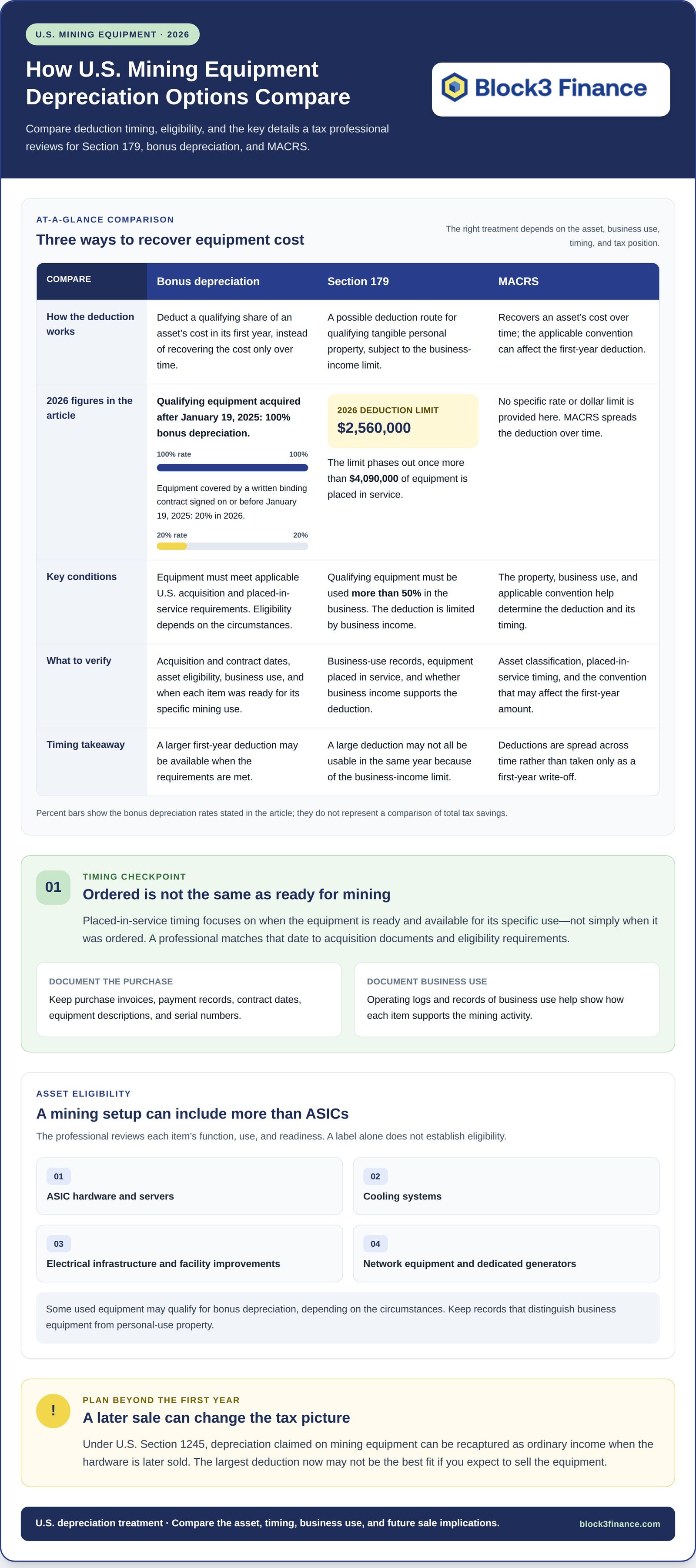
Mining hardware may qualify for bonus depreciation when it meets the applicable U.S. acquisition and placed-in-service requirements. Under Section 168(k), qualifying Bitcoin mining property may include ASIC hardware, servers, cooling systems, electrical infrastructure, facility improvements, network equipment, and dedicated generators. Eligibility matters because a mining setup can contain several asset types, not just the ASICs.
A professional reviews each item’s function, use, and date it became ready for mining. Some used equipment may qualify for bonus depreciation, depending on the circumstances. Support the assessment with purchase invoices, payment records, equipment descriptions or serial numbers, and evidence of when each asset was ready for its specific use.
Keep records that distinguish business equipment from personal-use property. Operating logs and records of business use help explain how hardware supports the mining activity. A tax professional can use these documents to classify the assets and prepare the depreciation reporting, including the election on Form 4562 when applicable.
Bonus Depreciation Rates and Timing
Bonus depreciation allows a business to deduct a qualifying share of an asset’s cost in its first year, rather than recovering the cost only through MACRS. Qualifying Bitcoin mining equipment acquired after January 19, 2025, can qualify for 100% bonus depreciation in 2026. That makes the acquisition date and the equipment’s service readiness central to the analysis.
Different timing can produce a different rate. For U.S. equipment covered by a written binding contract signed on or before January 19, 2025, the bonus depreciation rate is 20% for 2026. A professional therefore reviews purchase documents and contract dates, then matches them to the equipment’s placed-in-service date and eligibility.
Section 179 offers another possible route. According to the Internal Revenue Service, the U.S. Section 179 deduction limit is $2,560,000 for 2026. For U.S. Section 179 deductions in 2026, the limit phases out once more than $4,090,000 of equipment is placed in service, according to the Internal Revenue Service. Section 179 generally applies to qualifying tangible personal property and is limited by business income. Comparing these rules with bonus depreciation can show which deduction better aligns with the operation’s current and future tax picture.
Bitcoin Mining Equipment Treatment
Bitcoin mining equipment does not receive a separate shortcut just because it supports a blockchain operation. A tax professional assesses the property itself, its business use, acquisition history, and service date under U.S. depreciation rules. ASIC miners and related operating systems may qualify if they meet the requirements; a label alone does not establish eligibility.
To answer the practical question, yes: bonus depreciation can apply to crypto mining equipment in 2026 when the equipment qualifies and meets the relevant timing requirements. The professional also considers whether Section 179 or MACRS better fits the assets and the business’s income position. These choices can affect deduction timing and the tax consequences if equipment is later sold.
Do I need an LLC to deduct mining equipment?
An LLC is not the only factor in determining a U.S. mining-equipment deduction. Tax treatment also depends on whether the activity qualifies as a business, how the equipment is used, and how income and losses are reported.
Business Use and Eligibility
Business use means the equipment serves a genuine mining business rather than personal or hobby activity. It matters because Section 179 equipment must be used more than 50% in the business to qualify for that deduction.
An individual may report eligible computer-hardware depreciation through Schedule C of Form 1040. That means a business structure isn’t the only factor: the tax professional also evaluates the mining activity, ownership, business use, and records supporting the equipment’s role.
For example, a miner who operates ASICs for an ongoing business can document their connection to that activity through purchase records, operating logs, and business accounting. Equipment used partly for personal purposes requires a careful allocation between business and personal use. The business-use percentage can affect whether Section 179 applies.
The distinction between a business and a hobby also matters. Under the U.S. tax treatment described for 2026, crypto-mining hobby expenses aren’t deductible. An LLC filing alone doesn’t turn a hobby into a business; the activity and its records must support business treatment.
Participation is another part of the assessment. One material-participation test for a U.S. mining business requires more than 500 hours of participation during the tax year. That is one test, not the only way to assess participation. Records of actual work help establish how involved the taxpayer was.
Business Equipment Tax Treatment
U.S. business equipment deductions reduce taxable income, but other rules can limit how much loss provides a current-year tax benefit. Section 179, for example, is limited by business income, so a large equipment deduction may not all be usable in the same year.
The excess business loss limitation can also affect an individual’s return. For 2026, its threshold is $256,000 for single filers and $512,000 for married couples filing jointly. Any excess disallowed under this limitation is generally treated as a net operating loss carryforward.
A U.S. net operating loss carried forward after the excess business loss limitation can offset up to 80% of taxable income in future years. This makes the deduction’s timing important: a current-year equipment expense may create a loss, while the carryforward rules determine how that loss affects later taxable income.
A tax professional reviews the mining activity, equipment use, participation, income, and filing structure together. This analysis helps distinguish a current deduction from a loss carried into a future year. To discuss how those factors fit your operation, talk through your mining-business tax position.
MACRS depreciation
Under U.S. tax rules, MACRS spreads the cost of eligible property over assigned recovery periods. For mining operations, the asset classification and depreciation convention can affect deductions reported across tax years. These details help determine how mining hardware costs affect each return.
MACRS Recovery Periods
A MACRS recovery period is the timeframe for deducting an asset’s cost under the U.S. depreciation system. Commercial ASIC miners are generally treated as five-year MACRS property. This classification determines the schedule used to calculate deductions; miners cannot choose a period solely based on the equipment’s expected operating life.
Classification still requires attention. Computer equipment classified as asset class 00.11, information systems, has a seven-year useful life under the described MACRS treatment. A tax professional reviews what each asset is and how it functions before assigning a recovery period. An ASIC used for mining and a computer used for information processing may be treated differently for depreciation purposes.
MACRS determines how the depreciation of crypto mining equipment is allocated across tax years. The calculation depends on the assigned property class, asset cost, and applicable convention, not on mining profit or Bitcoin’s market price. This keeps equipment cost recovery separate from changes in mining revenue and distinguishes asset deductions from operating results on the return.
Asset-level records support this analysis. Purchase invoices establish costs, while equipment descriptions help distinguish ASIC miners from other computer equipment. A professional can use these details to apply the relevant classification and track deductions consistently on the business return.
Five-Year Depreciation Schedule
For qualifying five-year property, MACRS uses a 200% declining-balance method under the described treatment. This method calculates larger deductions earlier in the recovery schedule, then transitions to straight-line depreciation when that produces a larger deduction. The result is a structured cost-recovery pattern, not an equal deduction each year.
Under the U.S. half-year convention, qualifying five-year property receives a regular MACRS first-year deduction equal to 20% of its cost. That percentage applies to the property’s cost, not its mining revenue. The deduction reported for a tax year can therefore differ from the business’s operating profit.
The mid-quarter convention may change the schedule. It applies for the tax year in which property is placed in service when more than 40% of that year’s depreciable property is placed in service during October through December. A professional reviews the timing of relevant equipment purchases because a late-year concentration can affect the convention used.
For miners, a schedule for the depreciation of crypto mining equipment tracks each asset’s classification, original cost, convention, and deductions by tax year. This record helps reconcile equipment expenses with revenue and the business return, while preserving a clear history if the equipment is later sold.
Placed-in-service deadline for claiming a deduction
Under U.S. tax rules, buying mining equipment alone does not establish the year for a depreciation deduction. The key date is when the equipment is placed in service, meaning it is ready and available for its specific use. For bitcoin mining, a machine that is uninstalled or unavailable to operate has not yet reached that point.
What placed in service means for miners
For U.S. tax purposes, mining equipment is placed in service when it is ready and available for mining. It must be set up and ready to operate, not merely ordered. A purchase invoice may show when an ASIC was acquired, but it does not by itself show when the machine became operational.
For the 2026 tax year, mining equipment must be installed and running by December 31 to count for that year. A miner delivered in December but still awaiting installation may fall into a different tax year than one configured and ready to mine before the deadline. The decisive date follows operational readiness, not the order date.
A professional can assess the timeline using purchase documents, delivery records, setup details, and operating records. These materials help distinguish equipment that was ready from equipment still being installed. At a facility with several machines, recording each unit’s readiness date helps establish which equipment was placed in service during the relevant tax year.
Income, expenses, and mining activity
Placed-in-service timing determines when equipment may enter a depreciation calculation; it does not establish whether the activity qualifies as a business. These are separate questions on a U.S. return. The character of the mining activity and the equipment’s use affect whether a deduction belongs in a business calculation.
Hobby mining expenses aren’t deductible under the described U.S. treatment for 2026. That makes activity classification important before a miner treats hardware as a business expense. An LLC alone doesn’t change the nature of the activity; the facts and records must support business treatment.
Mined cryptocurrency is ordinary income at its fair market value on the date it is received. This income must be considered alongside equipment deductions when determining taxable income. A deduction reduces the amount included in the tax calculation, but it does not remove the need to report mining rewards as income.
For example, if an ASIC is ready to mine before December 31, 2026, its service timing may support including it in that year’s depreciation analysis. If the machine is not ready until later, its deduction timing may depend on the later service date. A tax professional can align equipment records, mining income, and the return so each item is reported in the appropriate period.
Depreciation recapture when selling mining equipment
A mining rig sale can create a tax consequence after years of depreciation deductions. Under U.S. rules, Section 1245 recapture means depreciation claimed on qualifying equipment may be treated as ordinary income when the asset is sold. That possibility belongs in the decision about which deduction to claim, not just in the year of sale.
For each sale, a tax professional reviews the original purchase cost, depreciation claimed, adjusted basis, and sale records. Adjusted basis is the equipment’s tax value after depreciation deductions. This review connects the prior depreciation schedule to the transaction and helps determine whether recapture applies. Keep invoices, depreciation schedules, and sale documents together rather than relying on a single figure from the original purchase.
Consider the provided example: a miner bought machinery for $30,000 and claimed $5,000 in depreciation. At the time of sale in the example, its adjusted cost is $25,000. That figure reflects the purchase cost after claimed depreciation. It gives the professional a starting point for analyzing the sale, alongside the transaction records and the asset’s depreciation history.
Trading equipment does not avoid the sale analysis. Since 2018, U.S. like-kind exchange treatment has applied only to real estate, so trading mining equipment is a taxable sale. A miner who exchanges an older rig for another unit should therefore retain records of both sides of the transaction. The equipment trade can have tax consequences even when no cash changes hands.
Sale planning also depends on the equipment’s role in the trade or business and the deductions previously claimed. A professional carries forward each asset’s depreciation history, then evaluates the sale in the year it occurs. Keep mining hardware transactions separate from operating records, such as electricity invoices, so the asset purchase, operating costs, and disposal are not confused.
The practical takeaway is clear: a large first-year deduction can be followed by ordinary income treatment at sale. Section 179, bonus depreciation, or MACRS should be considered alongside the equipment’s expected use and potential disposal. The sale price, adjusted basis, and prior deductions shape the analysis, so accurate asset-level records matter from purchase through sale.
Discuss mining-equipment sale reporting with a tax professional before finalizing a transaction.
Block3 Finance
Block3 Finance can help connect equipment records, business-use details, depreciation choices, and sale reporting into a consistent tax picture. Its Tax Filing and Reporting and Monthly Accounting services support organized reporting across mining income and equipment activity.
Turn to a Crypto Tax Accountant when you need professional analysis of how Section 179, bonus depreciation, or MACRS fits your mining operation, or how a later sale may affect prior deductions. Audits and Compliance can also support clear, well-documented reporting.
Contact Block3 Finance to discuss your mining equipment tax reporting.
Build a Tax Plan That Moves With Your Mining Operation
A sound approach to the depreciation of crypto mining equipment should account for more than the current filing. As your operation changes, equipment purchases, business use, and eventual sales can affect the tax records a professional needs to assess. Keeping these decisions connected provides a clearer foundation for future planning.
Block3 Finance can support that process through Tax Filing and Reporting, Audits and Compliance, and Monthly Accounting. These services help bring equipment records and tax reporting into a coherent picture as your mining activity evolves.
Bring your questions about equipment depreciation, documentation, or reporting to the next conversation. Contact Block3 Finance to discuss your mining tax needs and take a considered next step with confidence.
Frequently Asked Questions
Can I deduct a bitcoin miner?
Yes, a Bitcoin miner may be deductible if it is qualifying equipment used in a mining business. A tax professional assesses who owns the machine, how it supports the activity, and whether any personal use requires separate treatment. Useful supporting records include the purchase invoice, payment evidence, equipment description, and operating records linking the miner to the business. These details help establish the deduction’s basis.
How much can you write off under Section 179?
The amount depends on the tax year, eligible equipment, total qualifying property placed in service, and the business-income limitation. The statutory maximum is not necessarily the amount a taxpayer can claim: phaseout rules and the taxpayer’s circumstances can reduce the usable deduction. A professional evaluates those factors together and distinguishes the Section 179 election from other depreciation methods when preparing the return.
What Is Depreciation Recapture?
Depreciation recapture is a tax adjustment that may apply when depreciated business property is sold. It accounts for prior depreciation deductions under the sale rules, rather than treating the transaction only as a comparison of cash received and purchase price. For mining equipment, the asset’s depreciation history matters. Keep the original cost records and prior depreciation schedules available for the sale-year calculation.
What happens when I sell the miner?
The tax return must reflect an equipment sale and the relevant transaction details. Preserve the sale agreement or invoice, payment evidence, the asset’s identifying information, and its depreciation history. If a miner is exchanged as part of a trade, document both the equipment transferred and the replacement received. These records help the tax preparer distinguish the disposal from ordinary mining income and operating expenses.
How is crypto mining equipment classified for tax depreciation in the United States?
U.S. tax classification depends on each asset’s type and function, so a mining operation should not automatically treat every purchase as one combined asset. An ASIC, a server, and supporting electrical equipment may need separate descriptions and cost records. A professional uses invoices and equipment details to determine the appropriate property classification, then maintains consistent asset records for depreciation reporting and future disposal.
What is the useful life of crypto mining rigs under IRS depreciation rules?
For U.S. tax depreciation, commercial ASIC miners are generally classified as five-year MACRS property. This recovery period describes how the tax system allocates cost, not how long a rig will physically operate or remain profitable. A miner’s actual service life may differ as hardware conditions and operating decisions change, so tax depreciation records should remain separate from maintenance and equipment-replacement planning.
Can crypto mining equipment qualify for Section 179 expensing?
Yes, qualifying mining equipment may be eligible for Section 179 when it meets the U.S. requirements for business property. The tax preparer reviews the asset’s business use, ownership, and supporting purchase records, then considers the deduction alongside other available depreciation treatment. The choice affects the timing of cost recovery, so equipment schedules and the business’s broader tax position should inform the election.
How do MACRS depreciation methods and recovery periods apply to mining hardware?
MACRS applies a tax recovery period and calculation method based on the equipment’s classification. A professional tracks each asset separately, including its cost, service date, applicable convention, and deductions claimed on prior returns. This creates a consistent depreciation history for reporting and later equipment sales. Keep these records aligned with the business’s fixed-asset schedule rather than relying only on wallet or mining-pool transaction reports.

Article by
Mahad Mohamed
Mahad Mohamed is an accountant and the CEO of Block3 Finance, with over 26+ years of Canadian and international tax and accounting experience. A crypto accounting specialist since the early days of Bitcoin, he has consulted for over 38 crypto companies and collaborated with legal professionals on regulatory matters. His expertise spans corporate reorganization, cross-border tax structuring (Canada & US), tax disputes, and CRA audits.
Previously, Mahad worked for the Canada Revenue Agency (CRA), Big4 accounting firms, and served as a Rulings Officer for the Federal Tax Authority of the UAE before acquiring Tax Partners in 2014.
Block3 Finance and Tax Partners has 44 full-time accountants and over 9,800+ clients.
Disclaimer
This article provides general information only and is current as of its publication date. It has not been updated and may be out of date. It does not constitute legal advice and should not be relied upon as such. Every tax situation is unique and may differ from the examples discussed in this article. If you have specific questions, you should seek the advice of our accountants for your unique circumstances.
Frequently Asked Questions
Can I deduct a bitcoin miner?
Yes, a Bitcoin miner may be deductible if it is qualifying equipment used in a mining business. A tax professional assesses who owns the machine, how it supports the activity, and whether any personal use requires separate treatment. Useful supporting records include the purchase invoice, payment evidence, equipment description, and operating records linking the miner to the business. These details help establish the deduction’s basis.
How much can you write off under Section 179?
The amount depends on the tax year, eligible equipment, total qualifying property placed in service, and the business-income limitation. The statutory maximum is not necessarily the amount a taxpayer can claim: phaseout rules and the taxpayer’s circumstances can reduce the usable deduction. A professional evaluates those factors together and distinguishes the Section 179 election from other depreciation methods when preparing the return.
What Is Depreciation Recapture?
Depreciation recapture is a tax adjustment that may apply when depreciated business property is sold. It accounts for prior depreciation deductions under the sale rules, rather than treating the transaction only as a comparison of cash received and purchase price. For mining equipment, the asset’s depreciation history matters. Keep the original cost records and prior depreciation schedules available for the sale-year calculation.
What happens when I sell the miner?
The tax return must reflect an equipment sale and the relevant transaction details. Preserve the sale agreement or invoice, payment evidence, the asset’s identifying information, and its depreciation history. If a miner is exchanged as part of a trade, document both the equipment transferred and the replacement received. These records help the tax preparer distinguish the disposal from ordinary mining income and operating expenses.
How is crypto mining equipment classified for tax depreciation in the United States?
U.S. tax classification depends on each asset’s type and function, so a mining operation should not automatically treat every purchase as one combined asset. An ASIC, a server, and supporting electrical equipment may need separate descriptions and cost records. A professional uses invoices and equipment details to determine the appropriate property classification, then maintains consistent asset records for depreciation reporting and future disposal.
What is the useful life of crypto mining rigs under IRS depreciation rules?
For U.S. tax depreciation, commercial ASIC miners are generally classified as five-year MACRS property. This recovery period describes how the tax system allocates cost, not how long a rig will physically operate or remain profitable. A miner’s actual service life may differ as hardware conditions and operating decisions change, so tax depreciation records should remain separate from maintenance and equipment-replacement planning.
Can crypto mining equipment qualify for Section 179 expensing?
Yes, qualifying mining equipment may be eligible for Section 179 when it meets the U.S. requirements for business property. The tax preparer reviews the asset’s business use, ownership, and supporting purchase records, then considers the deduction alongside other available depreciation treatment. The choice affects the timing of cost recovery, so equipment schedules and the business’s broader tax position should inform the election.
How do MACRS depreciation methods and recovery periods apply to mining hardware?
MACRS applies a tax recovery period and calculation method based on the equipment’s classification. A professional tracks each asset separately, including its cost, service date, applicable convention, and deductions claimed on prior returns. This creates a consistent depreciation history for reporting and later equipment sales. Keep these records aligned with the business’s fixed-asset schedule rather than relying only on wallet or mining-pool transaction reports.