
Crypto activity can leave ordinary business books incomplete. For a U.S. small business, cryptocurrency bookkeeping connects each transaction to the right records: it tracks receipts and payments, reconciles activity across wallets and exchanges, and values holdings for reporting dates. The IRS treats digital assets as property for federal tax purposes, so a sale or exchange can create a gain or loss.
That complexity is real, particularly when business activity spans multiple wallets, exchanges, or blockchains. Clear records bring transactions, balances, and supporting details together in one reliable financial picture.
This article explains what crypto accounting covers and how professional bookkeeping supports accurate reporting. You’ll learn how transaction tracking works, what reconciliation checks, how reporting-date valuation fits in, and what to expect from bookkeeping services for cryptocurrency businesses.
Key Takeaways
- Connect crypto records to the general ledger so digital-asset activity fits into the business’s broader financial picture.
- Categorize transactions consistently and match the bookkeeping process to transaction volume, reporting needs, and cost considerations.
- Reconcile wallet and exchange balances, then value qualifying crypto assets at fair value for financial reporting dates under U.S. GAAP.
- For U.S. tax year 2025, certain crypto brokers and exchanges must issue Form 1099-DA; organized transaction records help support tax reporting.
- For activity across multiple blockchains, professional bookkeeping can consolidate wallet data, ledger records, and cash-flow information.
What Defines Crypto Accounting?
U.S. crypto accounting connects blockchain activity with a business’s financial records and tax reporting. It combines transaction bookkeeping, valuation, and review of how events affect income, assets, or expenses.
Crypto Bookkeeping and Accounting Definitions
Bookkeeping captures individual events, including dates, amounts, wallet addresses, fees, and counterparties. Accounting interprets those records, assigns financial categories, and prepares reports that reflect the business’s position.
For example, a bookkeeper may record a customer payment in cryptocurrency, while an accountant determines how to classify it in the ledger and related reports. A crypto accountant also reviews wallet activity, documentation, and valuation methods against the company’s accounting policies. This is the foundation of cryptocurrency bookkeeping for small business owners who need digital-asset records connected to their ordinary business accounts.
Accounting Methods for Crypto Holdings
Small businesses can use fair-value measurement for qualifying crypto assets in U.S. GAAP financial statements and track tax basis separately by tax lot. A tax lot identifies the acquisition history and basis of a specific group of units. Under FASB ASU 2023-08, U.S. companies measure qualifying in-scope assets at fair value for fiscal years beginning after December 15, 2024.
For U.S. federal tax purposes, the IRS treats digital assets as property, and a sale or exchange can create a gain or loss. The IRS also says businesses generally record cryptocurrency received for goods or services as income measured in U.S. dollars at the time of receipt.
Risks include price changes between transaction and reporting dates, incomplete records, and errors matching activity to the correct wallet or tax lot. These gaps can distort reported income, balances, or tax calculations. A consistent cryptocurrency bookkeeping for small business process preserves the records needed to assess these differences.
Software Integration With Traditional Accounting
Accounting software integrations connect wallet and exchange activity to the general ledger, the central record of financial accounts. In a QuickBooks Online workflow, a professional can import or map crypto transactions to categories such as income, assets, and fees, then reconcile entries against source records.
Automation can reduce repeated data entry, but imported records still need classification and review. For example, a transfer between company wallets should be distinguished from a customer payment or sale. Professional cryptocurrency bookkeeping for small business operations uses consistent mapping so internal transfers aren’t mistakenly recorded as new income.
Crypto accounting works alongside traditional accounting, not separately from it. The resulting reports bring digital-asset balances and business operations into one financial picture while preserving transaction details for tax reporting and review.
Tracking Cryptocurrency Investments and Business Transactions
Professional cryptocurrency bookkeeping for small business operations links each payment, sale, and wallet movement to accurate records. For U.S. businesses, those records also support income reporting and tax calculations.
Transaction Categorization and Ledger Integration
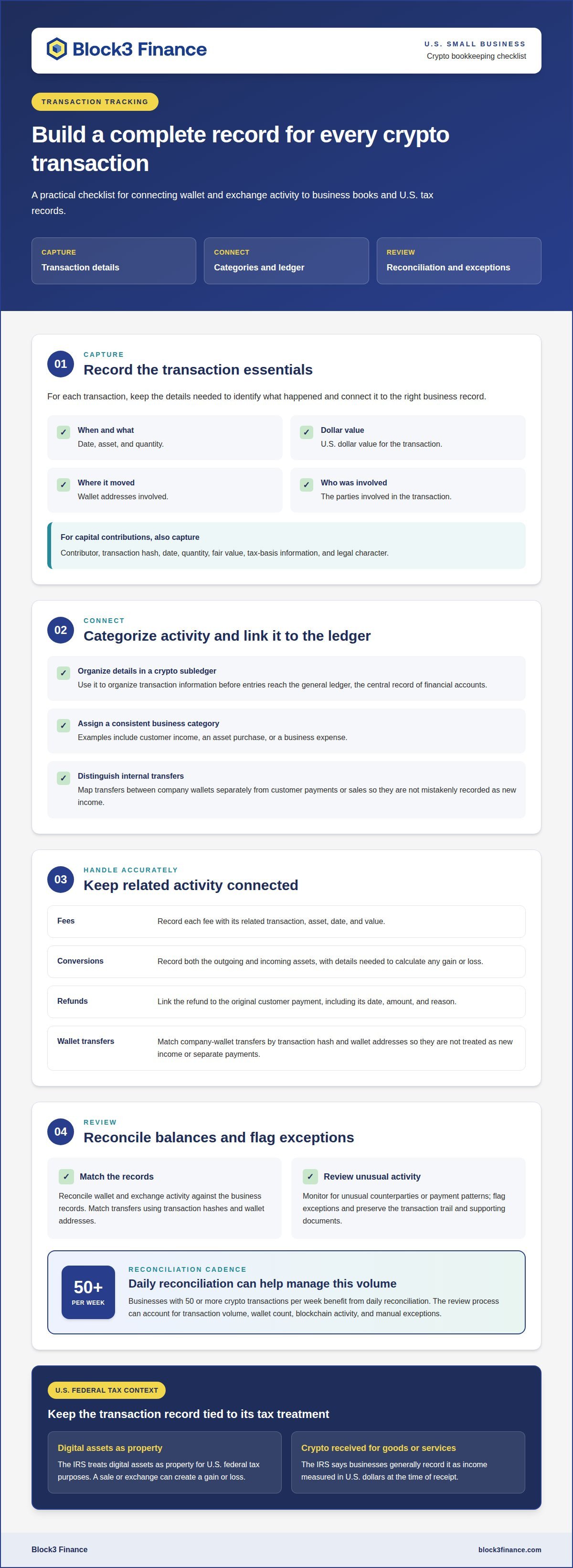
A professional bookkeeper records each transaction’s date, asset, quantity, U.S. dollar value, wallet addresses, and parties involved. A crypto subledger organizes those details before entries reach the general ledger. Categories might include customer income, an asset purchase, or a business expense.
For U.S. federal tax purposes, the Internal Revenue Service treats digital assets as property, so a sale or exchange can create a gain or loss. The Internal Revenue Service also says crypto received for goods or services is generally recorded as income in U.S. dollars at the time of receipt.
For capital contributions, records can capture the contributor, transaction hash, date, quantity, fair value, tax-basis information, and legal character. Tax basis is the amount used to calculate gain or loss when an asset is disposed of. These details connect investment activity with the company’s books and tax reporting.
Choosing cryptocurrency bookkeeping for small business support means matching the provider’s process to transaction volume, platforms, and reporting needs. Businesses with 50 or more crypto transactions per week benefit from daily reconciliation, while a provider’s cost depends on transaction volume and the scope of work.
Recording Fees, Conversions, Refunds, and Transfers
A bookkeeper records each fee with its related transaction, asset, date, and value. For conversions, the records show both the outgoing and incoming assets, with details needed to calculate any gain or loss.
Refunds should link to the original customer payment, including its date, amount, and reason. Transfers between company wallets should be matched by transaction hash and wallet addresses, preventing them from appearing as new income or separate payments.
Transaction monitoring helps identify unusual counterparties or payment patterns. A professional process can flag exceptions for review and preserve the related records, including the transaction trail and supporting documents.
For a business with 50 or more crypto transactions per week, daily reconciliation can help manage activity. A professional providing cryptocurrency bookkeeping for small business owners can assess volume, wallet count, blockchain activity, and manual exceptions when setting the review process.
Under U.S. federal tax rules, payment and sales records should show what happened, when it happened, and the associated dollar value. Consistent tracking lets a bookkeeper connect crypto activity with the general ledger and maintain transaction records for tax reporting.
Crypto Reconciliation and Reporting-Date Valuation
Reconciliation checks whether recorded crypto activity agrees with wallet, exchange, and blockchain records. Reporting-date valuation then helps present qualifying assets consistently in U.S. financial statements.
Reconcile Records Before Reporting
Businesses with crypto activity should reconcile their records regularly, matching ledger balances against wallet and exchange records. The review identifies missing transactions, duplicate entries, unmatched transfers, and differences between recorded and actual asset quantities.
A bookkeeper investigates each exception using transaction hashes, wallet addresses, exchange statements, and supporting documents. For example, a transfer recorded as a payment may instead be an internal movement between company wallets. Resolving the difference keeps the ledger and related reports aligned.
Value Assets for Financial Statements
Under FASB ASU 2023-08, qualifying in-scope crypto assets in U.S. GAAP financial statements are measured at fair value each reporting period. Changes in that value are recognized in net income. This method makes reporting-date valuation part of the close process, alongside reconciliation and review of supporting records.
The result belongs in the company’s financial reporting, not as a substitute for tax records. Tax reporting uses its own calculations and documentation. Keeping the purpose of each report clear helps prevent a financial-statement valuation from being mistaken for a tax result.
Prepare Tax Reports and Audit-Ready Support
For U.S. tax year 2025, crypto brokers and certain exchanges must issue Form 1099-DA to report digital-asset transactions. Business records should be organized to compare information returns with the company’s own transaction history and identify differences for review.
An audit-ready record set connects ledger entries to transaction hashes, wallet activity, exchange statements, valuation support, and documented reconciliation decisions. A reviewer can trace a reported balance back to its source instead of relying on a summary total without evidence.
Tax compliance also involves documenting payments made in cryptocurrency. Payments to independent contractors or other recipients may require information reporting and backup withholding, tax withheld from a payment and sent to the IRS when required under applicable rules, including rules for property payments. Organized records help determine which transactions need reporting and preserve the details supporting that treatment.
At each close, the reporting process should preserve the valuation method, reporting-date prices used, reconciled balances, and unresolved exceptions. This gives financial statements and tax reports distinct support while helping management understand what changed and why.
Professional Bookkeeping for Multiple Exchanges, Wallets, and Blockchains
Multiple wallets and blockchains create separate records for the same business treasury. Professional aggregation brings those records together while preserving each asset’s source and transaction history.
Aggregate Wallets and Reconcile Across Chains
A bookkeeping team maps each company wallet, exchange account, blockchain, and supported asset before consolidating activity. It matches wallet balances to transaction histories, exchange statements, and ledger records. The team also identifies bridge transfers, which move assets between chains, so one movement isn’t mistakenly recorded as two transactions.
Businesses should reconcile cryptocurrency quantities by asset and wallet monthly. For example, a token balance on one chain must not be combined with a similarly named asset on another chain. A consistent asset-and-wallet map improves reporting accuracy and helps preserve cost-basis information across transfers.
- Match each wallet’s opening balance and activity to its closing balance.
- Trace exchange deposits and withdrawals to the corresponding blockchain transaction.
- Separate bridge activity from sales, payments, and new asset receipts.
For operations spanning several chains, unified reporting should consolidate chain activity, bridge transactions, and cross-chain protocol interactions. That view gives finance teams one consistent picture without erasing the underlying records.
Protect Custody and Control Access
Bookkeeping records show where assets move; custody controls determine who can move them. A business can assign wallet permissions by role, limit access to authorized staff, and document transfer approvals. These controls record who initiated or approved a movement, supporting financial review.
Private-key control is central to wallet access. A private key authorizes transactions, so storing it securely and limiting access reduces exposure from misplaced credentials or unauthorized use. For holdings over $1,000, a wallet that gives the business control of its private key can keep custody distinct from exchange account access.
Use cryptocurrency exchanges to exchange assets rather than as a place to leave business holdings. A custody policy should identify which wallets hold operating funds, who controls each wallet, and how access changes when responsibilities shift. Those details help the bookkeeping team distinguish company-controlled assets from exchange balances.
For a professional monthly accounting process, wallet inventories and access records can be aligned with the ledger. This connects custody oversight to financial records while keeping private keys out of bookkeeping files.
Bookkeeping Services for Cryptocurrency Companies
Crypto companies need records shaped around how their platforms actually move assets. A bookkeeping review can map exchange activity, customer receipts, protocol rewards, operating expenses, and transfers to distinct ledger categories. That structure helps management see which operations generate income and where cash flow depends on digital assets.
Platform analysis starts with the transaction data each system provides. A bookkeeper identifies records from exchanges, payment processors, wallets, and blockchain protocols, then maps them to the company’s chart of accounts. For example, a customer payment, exchange conversion, and protocol reward should not be combined in one generic deposit category.
The ledger should preserve transaction-level detail while producing useful summaries in U.S. dollars. For each entry, records can capture the event date, asset, quantity, transaction identifier, related platform, and dollar value. This supports financial statements and lets a reviewer trace a summary balance back to its source.
- Customer receipts and revenue-related activity.
- Trading, conversion, network, and platform fees.
- Protocol rewards, operating costs, and treasury movements.
Regulatory considerations belong in the bookkeeping design, not as an afterthought. A U.S. crypto business can organize records by transaction type and retain supporting documents for tax reporting, financial review, and compliance procedures. The applicable treatment depends on what the business did, how it recorded the event, and which records support that classification.
For U.S. federal tax purposes, the Internal Revenue Service treats digital assets as property. A sale or exchange can create a gain or loss, so the records need to preserve acquisition and disposition details. A U.S. crypto tax reporting process can use those entries to connect ledger activity with tax calculations and supporting documentation.
Cash flow analysis also needs to distinguish liquid dollars from crypto holdings. A company paying expenses in dollars may face timing pressure if customer receipts arrive in tokens and later need conversion. A useful cash-flow report separates operating inflows, crypto-to-fiat conversions, and planned payments, giving management a clearer view of available funds.
Mining and staking businesses need additional categories. Their books should account for block rewards, electricity costs, and equipment depreciation. Separating these entries helps explain how operating costs relate to the digital assets earned, while keeping the ledger useful for management and reporting.
Block3 Finance
Block3 Finance helps small businesses bring cryptocurrency activity into clearer financial records through focused accounting and tax support. This can be useful when wallet and exchange data is difficult to reconcile, reporting dates are approaching, or transaction records need review before tax filing.
Monthly Accounting provides an ongoing view of business activity by organizing crypto transactions alongside the company’s wider books. A consistent process can distinguish customer receipts, asset movements, fees, and operating expenses, while giving management records for financial reporting and cash-flow decisions.
For tax work, a Crypto Tax Accountant can review transaction details and related records, while Tax Filing and Reporting covers preparing and reporting tax information. These services are useful when a business needs transaction history connected to its tax records, rather than a ledger total without supporting details.
- Monthly Accounting for recurring bookkeeping and financial records.
- Crypto Tax Accountant support for crypto-related tax questions.
- Tax Filing and Reporting for preparing and reporting tax information.
- Audits and Compliance to support review and compliance needs.
Audits and Compliance helps businesses prepare records for examination and strengthen their documentation process. Relevant records may include wallet histories, exchange statements, transaction identifiers, valuation support, and explanations for ledger adjustments. Organized evidence helps reviewers trace reported balances to underlying activity.
Before work begins, a business can prepare a concise overview of its activity: the exchanges and wallets it uses, the blockchains involved, the types of transactions it makes, and the accounting or tax records already available. That context helps define the bookkeeping challenge, from recurring reconciliation to tax reporting or compliance review.
The right point to seek professional support is when crypto activity no longer fits cleanly into existing records, when a reporting period needs a defensible close, or when the business needs tax-focused review. Block3 Finance’s services address these connected needs without treating bookkeeping, financial reporting, and tax records as separate questions.
Contact Block3 Finance to discuss your business’s cryptocurrency accounting needs.
Frequently Asked Questions
What is Crypto Bookkeeping?
Crypto bookkeeping is the organized recording of a business’s digital-asset activity for its financial records. It captures events such as receiving tokens from a customer, paying a supplier, or converting one asset into another. For example, a customer receipt should be distinguished from a later exchange conversion. That separation helps business owners understand what happened without treating every wallet balance change as income.
What are the IRS cryptocurrency recordkeeping and reporting requirements for businesses?
U.S. businesses should keep records that support the amount, timing, purpose, and parties involved in crypto transactions. This can include transaction histories, invoices, exchange statements, wallet records, and documents supporting reported values. For U.S. tax year 2025, certain crypto brokers and exchanges must issue Form 1099-DA for digital-asset transactions. Businesses can compare those information returns with their own records and resolve differences before filing.
How should a business calculate the fair market value of cryptocurrency received as payment?
For a U.S. business, record the cryptocurrency’s fair market value in U.S. dollars when it is received. The Internal Revenue Service says income from goods or services paid in cryptocurrency is generally measured in dollars at receipt. For example, retain the invoice, receipt timestamp, asset and quantity received, and valuation record used for the transaction. Those details support the income entry and later transaction analysis.
Which bookkeeping and accounting software can a professional integrate with cryptocurrency transactions for a small business?
QuickBooks Online can serve as the traditional accounting ledger in a professional crypto bookkeeping workflow. A bookkeeper can map transaction data from wallets and exchanges to the business’s accounts, then review entries that need manual treatment. The right setup depends on the company’s platforms, blockchain activity, reporting needs, and existing chart of accounts. Integration should preserve transaction detail rather than replace it with a single unexplained balance.
How much do crypto bookkeeping services and accounting software cost for small businesses?
Software pricing depends on the product and its features, such as supported exchanges, blockchain data, and reporting functions. Professional bookkeeping fees depend on transaction volume, wallet and exchange count, reconciliation needs, and the level of tax or reporting support. Service pricing depends on the business’s circumstances and is provided after a quote request. Compare scope and deliverables, not just whether a tool imports transaction data.
How can a professional reconcile a small business’s crypto wallets, exchange accounts, and bank statements?
A professional compares each platform’s activity with the company’s ledger and bank records, then traces unmatched entries to their source. For example, an exchange withdrawal that appears in a bank statement after conversion should connect to the related crypto sale and fiat deposit. Transaction identifiers, timestamps, statements, and bank references help establish that link. The bookkeeper documents unresolved differences instead of forcing balances to match.
When should a small business hire a CPA or crypto tax professional?
Bring in a CPA or crypto tax professional when digital-asset activity raises tax questions the existing accounting process cannot resolve. Examples include recurring sales or exchanges, staking or mining activity, payments to contractors, or tax records spread across several platforms. Professional support can also help when preparing a filing or responding to an audit request. A crypto tax specialist can connect transaction records with tax reporting requirements.

Article by
Mahad Mohamed
Mahad Mohamed is an accountant and the CEO of Block3 Finance, with over 26+ years of Canadian and international tax and accounting experience. A crypto accounting specialist since the early days of Bitcoin, he has consulted for over 38 crypto companies and collaborated with legal professionals on regulatory matters. His expertise spans corporate reorganization, cross-border tax structuring (Canada & US), tax disputes, and CRA audits.
Previously, Mahad worked for the Canada Revenue Agency (CRA), Big4 accounting firms, and served as a Rulings Officer for the Federal Tax Authority of the UAE before acquiring Tax Partners in 2014.
Block3 Finance and Tax Partners has 44 full-time accountants and over 9,800+ clients.
Disclaimer
This article provides general information only and is current as of its publication date. It has not been updated and may be out of date. It does not constitute legal advice and should not be relied upon as such. Every tax situation is unique and may differ from the examples discussed in this article. If you have specific questions, you should seek the advice of our accountants for your unique circumstances.
Frequently Asked Questions
What is Crypto Bookkeeping?
Crypto bookkeeping is the organized recording of a business’s digital-asset activity for its financial records. It captures events such as receiving tokens from a customer, paying a supplier, or converting one asset into another. For example, a customer receipt should be distinguished from a later exchange conversion. That separation helps business owners understand what happened without treating every wallet balance change as income.
What are the IRS cryptocurrency recordkeeping and reporting requirements for businesses?
U.S. businesses should keep records that support the amount, timing, purpose, and parties involved in crypto transactions. This can include transaction histories, invoices, exchange statements, wallet records, and documents supporting reported values. For U.S. tax year 2025, certain crypto brokers and exchanges must issue Form 1099-DA for digital-asset transactions. Businesses can compare those information returns with their own records and resolve differences before filing.
How should a business calculate the fair market value of cryptocurrency received as payment?
For a U.S. business, record the cryptocurrency’s fair market value in U.S. dollars when it is received. The Internal Revenue Service says income from goods or services paid in cryptocurrency is generally measured in dollars at receipt. For example, retain the invoice, receipt timestamp, asset and quantity received, and valuation record used for the transaction. Those details support the income entry and later transaction analysis.
Which bookkeeping and accounting software can a professional integrate with cryptocurrency transactions for a small business?
QuickBooks Online can serve as the traditional accounting ledger in a professional crypto bookkeeping workflow. A bookkeeper can map transaction data from wallets and exchanges to the business’s accounts, then review entries that need manual treatment. The right setup depends on the company’s platforms, blockchain activity, reporting needs, and existing chart of accounts. Integration should preserve transaction detail rather than replace it with a single unexplained balance.
How much do crypto bookkeeping services and accounting software cost for small businesses?
Software pricing depends on the product and its features, such as supported exchanges, blockchain data, and reporting functions. Professional bookkeeping fees depend on transaction volume, wallet and exchange count, reconciliation needs, and the level of tax or reporting support. Service pricing depends on the business’s circumstances and is provided after a quote request. Compare scope and deliverables, not just whether a tool imports transaction data.
How can a professional reconcile a small business’s crypto wallets, exchange accounts, and bank statements?
A professional compares each platform’s activity with the company’s ledger and bank records, then traces unmatched entries to their source. For example, an exchange withdrawal that appears in a bank statement after conversion should connect to the related crypto sale and fiat deposit. Transaction identifiers, timestamps, statements, and bank references help establish that link. The bookkeeper documents unresolved differences instead of forcing balances to match.
When should a small business hire a CPA or crypto tax professional?
Bring in a CPA or crypto tax professional when digital-asset activity raises tax questions the existing accounting process cannot resolve. Examples include recurring sales or exchanges, staking or mining activity, payments to contractors, or tax records spread across several platforms. Professional support can also help when preparing a filing or responding to an audit request. A crypto tax specialist can connect transaction records with tax reporting requirements.