
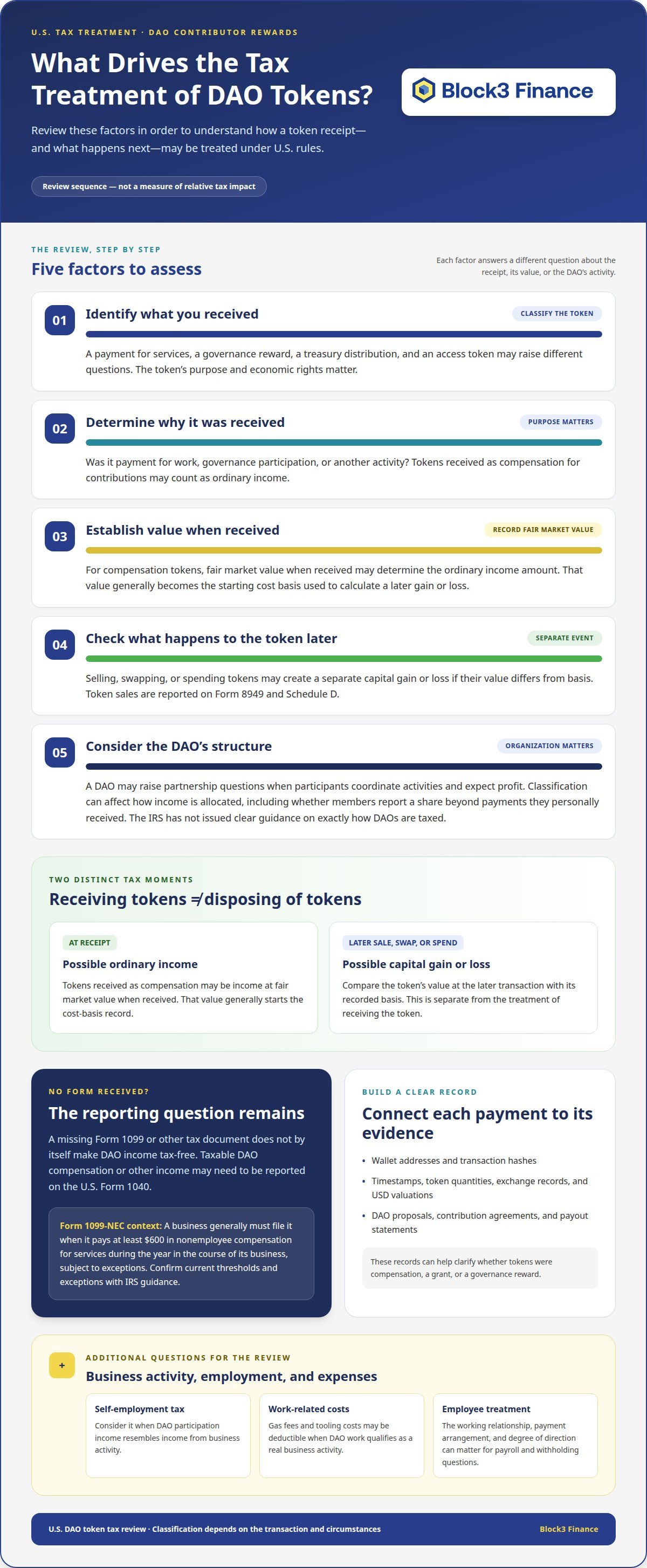
A missing tax form does not make a DAO reward tax-free. For U.S. contributors, DAO contributor compensation tax treatment generally depends on what they received, its fair market value when received, and whether it was payment for work or another activity.
It’s understandable to expect a form before reporting income, especially when compensation arrives in tokens rather than dollars. But DAO rewards may still need to be reported even when the DAO sends no Form 1099 or other tax document. According to the Internal Revenue Service, Form 1040 is the U.S. return used to report income. The tax character depends on the transaction: tokens received as payment may be ordinary income, while a later token sale or exchange may result in a capital gain or loss—the difference between the token’s value when sold or exchanged and its basis, generally its value when received.
This guide explains when contributor payments, governance rewards, and token grants may count as taxable income under U.S. rules, and how reporting works without an information return. It also covers when token sales may create a separate capital gain or loss, what to consider about self-employment tax and business expenses, and why a DAO’s structure can affect the analysis. The aim is to clarify the tax questions a professional can help resolve, without treating every token or contributor arrangement alike.
Key Takeaways
- A missing tax form doesn’t by itself remove the need to report DAO-related income; U.S. crypto income from DAO activities is reported on Form 1040 as ordinary income.
- Whether a DAO may be treated as a partnership can affect how income is allocated and taxed, so its structure matters.
- Consider self-employment tax when DAO participation income resembles income from business activity; reporting obligations can apply even when no information return arrives.
- Separate the tax treatment of receiving tokens from the potential gain or loss when you later sell or exchange them.
- For token grants, focus on their terms and whether they can be transferred or have a clear connection to future value.
How can a tax professional report DAO income if the DAO did not send me a form (1099, K-1, or anything else)?
A missing form does not erase income from DAO work under U.S. tax rules. A tax professional can reconcile wallet activity, payment records, and token values to classify what you received. A DAO contributor compensation tax review also considers whether payments came from services, governance participation, or treasury distributions.
Tax Treatment of Earned Tokens
Tokens received as compensation for DAO contributions may count as ordinary income at their fair market value when received. That value generally establishes the starting cost basis, which helps calculate a later gain or loss. For example, tokens paid for protocol work have a compensation value when received, even if the contributor holds them instead of selling them immediately.
A token’s purpose and rights matter. Tokens received for work may be compensation, while governance tokens can be treated differently depending on their economic rights. Treasury distributions may raise income questions for members and tax questions for the entity. Access tokens may also raise state tax issues when they provide software or digital services.
Tax Forms and Contributor Records
Forms support reporting, but their absence does not decide whether income is taxable. Under IRS rules, DAO receipts that constitute taxable compensation or other income may need to be reported on Form 1040 as ordinary income. Gains or losses from selling, swapping, or spending tokens later are treated separately. A professional can classify each receipt based on its purpose and the contributor’s circumstances.
Does a DAO need to issue Form 1099-NEC or other tax forms to U.S. contributors? Under IRS rules, a business generally must file Form 1099-NEC when it pays at least $600 in nonemployee compensation for services during the year in the course of its business, subject to exceptions. Check current IRS guidance for the threshold and exceptions. Contributors may still need to report income without receiving a form.
State rules can differ from federal treatment. Maryland’s digital advertising gross revenues tax covers certain digital advertising services, not access tokens generally. New York may tax certain remotely accessed software, depending on the product and circumstances. States may also require DAOs treated as partnerships to withhold on distributions to nonresident tokenholders or file composite returns. A DAO contributor compensation tax analysis should account for federal reporting and relevant state rules.
How are DAO compensation tokens taxed when sold, swapped, or used to pay expenses? These transactions may create a capital gain or loss when value differs from the recorded basis. Token sales are reported on Form 8949 and Schedule D.
Tax Forms and Contributor Records
Records should connect each payment to its purpose, value, and transaction history. A professional can reconcile wallet addresses, transaction hashes, timestamps, token quantities, exchange records, and USD valuations. DAO proposals, contribution agreements, and payout statements can help clarify whether tokens were compensation, a grant, or a governance reward.
Compensation in contributor tokens may also raise withholding or payroll questions. If a DAO treats contributors as employees, it may need to address federal and state employment taxes, including Social Security. The working relationship, payment arrangement, and degree of direction help determine whether employee treatment is relevant.
Gas fees and tooling costs may be deductible when DAO work qualifies as a real business activity. A professional can assess how the expenses relate to that activity and include the appropriate records in the reporting analysis. U.S. crypto tax reporting can coordinate income classification with token transactions and state considerations.
What are the legal concerns regarding payments by DAOs?
In the United States, questions about DAO payments involve both the reward and the organization behind it. A DAO’s structure can affect how income is allocated and whether participants face tax obligations beyond their individual payments.
DAO Partnership Treatment
A DAO may be treated as a partnership for U.S. tax purposes when participants coordinate activities and expect profit. That classification matters because members may need to report a share of the organization’s income, not only payments they personally received. The IRS has not issued clear guidance on exactly how DAOs are taxed, so the group’s operations and legal structure provide important context.
Formal entity documents are not the only factor. A group that pools treasury assets, directs protocol activity, and divides profits could raise partnership questions even without conventional paperwork. A legal wrapper, such as a company or foundation, adds context but does not, by itself, resolve the tax classification. The relationship between the wrapper and the DAO’s actual governance and financial activity matters.
Partnership treatment can create obligations for both the organization and its participants. Treasury tokens may raise member-level income questions and entity-level franchise or gross-receipts tax concerns. Some U.S. states may require DAOs structured as partnerships to withhold on distributions to nonresident tokenholders or file composite returns. State requirements can differ from federal treatment, so the DAO’s operations and payment arrangements need to be considered together.
Tax Treatment of DAO Rewards
DAO rewards can include contributor payments, governance incentives, staking returns, and liquidity rewards. Their purpose and terms matter: compensation for services, a share of profits, and rewards tied to protocol activity can raise different U.S. tax questions. A retroactive bounty remains income for the recipient; approval after the work does not change its connection to that contribution.
Governance activity and receiving a reward are distinct. Voting in a DAO is not a taxable event under the described U.S. treatment, while receiving tokens may have tax consequences. Non-transferable governance rights may be treated differently from tokens tied to yield or transferable value. The token’s economic rights and distribution terms help establish what the participant received.
Staking or providing liquidity within a DAO can generate taxable income, while selling DAO-related tokens at a profit may create capital gains. An analysis of payments should distinguish rewards for services from other protocol activity and later token transactions. Access tokens also need attention: Maryland’s digital advertising gross revenues tax applies to certain digital advertising services, not access tokens generally. New York generally taxes sales of prewritten software, including some software accessed online, but whether an access-token arrangement is covered depends on its facts.
A focused review of the DAO’s payment model and U.S. tax structure can help clarify these issues. Connect with a crypto tax professional to discuss the relevant facts.
Potential future IRS reporting and classification changes
U.S. DAO tax reporting can change as digital-asset reporting develops. Contributors should distinguish transaction disclosures from the separate question of how federal tax rules classify a DAO or its participants.
Changes to Reporting and Classification
The U.S. Treasury proposed Form 1099-DA for 2025, creating a new reporting focus on digital-asset sales. That form concerns transaction information; it does not, by itself, decide whether a DAO is a partnership, corporation, or another entity for federal tax purposes. Contributors should treat transaction reporting and entity classification as separate questions when assessing their records and filing positions.
Broker sales information may help identify digital-asset dispositions, but it does not describe every contributor payment or token grant. A report about a sale cannot establish whether tokens were originally compensation, a distribution, or another type of receipt. Likewise, an organization’s classification does not determine the character of each individual transaction. Keeping these questions separate helps avoid assuming that one form resolves the entire tax analysis.
Contributor Employment Classification
Employment classification asks whether a contributor’s relationship with a DAO is treated as employment under U.S. rules. If members are treated as employees, the DAO may need to address federal employment taxes, including Social Security, and withhold federal taxes from wages. The nature of the work, the DAO’s direction over assigned duties, and the payment arrangement help distinguish employment from independent contribution.
Payment in tokens does not settle the employment question. For example, a DAO that assigns recurring duties and directs how a contributor performs them presents different facts from a protocol that distributes governance incentives without directing participants’ work. Classification matters because wage withholding and employment-tax responsibilities differ from reporting income for independent services.
DAO Legal and Federal Tax Status
A DAO’s legal form and its U.S. federal tax classification are related but distinct. Depending on its structure, a DAO may be treated as a partnership or another entity. If participants coordinate, act together, and expect profit, federal tax law may treat the arrangement as a partnership even without formal entity documents.
Classification affects where tax is calculated and who reports the income. Corporations may pay tax at the entity level, while pass-through organizations generally allocate income to individual members. A legal wrapper can formalize a DAO’s operations, but its governance, profit-sharing, and actual activities remain relevant to the federal analysis. These distinctions help contributors understand why the DAO’s structure can affect their reporting responsibilities.
Self-employment tax and missing information returns
For U.S. DAO contributors, receiving no information return does not settle whether compensation is business income. Self-employment tax may matter when participation income resembles income from an ongoing business. This distinction affects tax planning: token rewards may arrive without cash withholding, leaving contributors to account for potential tax obligations from other resources.
What are the U.S. self-employment tax rates and estimated tax requirements for DAO contributors? If DAO participation income is treated as business income, self-employment tax may apply, and planning should account for income without withholding. The applicable rate and estimated payment needs depend on the contributor’s tax circumstances and total income; DAO work alone does not establish one universal figure.
Missing forms also require care. According to the Internal Revenue Service, in the United States a business generally must file Form 1099-MISC for at least $10 in royalties or broker payments in lieu of dividends or tax-exempt interest. That reporting rule covers those payment categories; it does not mean every DAO contributor payment belongs on that form. Some payments to corporations may be exempt from this reporting requirement while remaining taxable to the recipient.
A decentralized organization’s payment method does not determine employment status. If a DAO treats contributors as employees, it may need to address federal and state employment taxes, including Social Security, and withhold taxes from wages. Regular, directed work differs from governance participation alone. The DAO’s control over duties and the substance of the relationship help determine whether employee treatment is relevant.
A legal wrapper can clarify who contracts, pays contributors, and holds intellectual property, but it does not automatically answer every tax question. A foundation or company may formalize a DAO’s operations; the wrapper’s entity classification and payment practices still matter. If a DAO operates through a corporation, that structure may affect who reports income, while contributor status remains a separate issue.
For self-employment tax planning, a professional distinguishes service compensation from distributions, staking income, and later token sales. The analysis also considers whether the activity operates as a business and whether withholding applies. Converting a token through an exchange later is separate from receiving it for work, so both events need clear records.
Ongoing transaction reconciliation can connect DAO payments, wallet activity, and accounting records. Monthly accounting support can organize this activity for reporting and planning, including periods when a DAO issues no information return.
Contributors may need to account for self-employment tax when DAO income is treated as business income, particularly because token rewards may come without withholding. The applicable rate and estimated payment needs vary with each contributor’s tax circumstances and total income.
How are DAO token grants and governance tokens taxed when received?
Under U.S. federal tax rules, the key distinction is between voting and receiving tokens. Voting in a DAO is not a taxable event, while receiving tokens may create income depending on their purpose, value, and control.
Tokens received as payment for contributions are generally treated as ordinary income when the recipient has control. Their fair market value at receipt establishes the income amount and generally provides the starting cost basis for later transactions. For example, if a contributor receives transferable tokens for protocol work, their value when received matters even if the contributor keeps them rather than selling them.
A U.S. airdrop should be reported as income based on its fair market value when received. The same broad valuation question applies to grants, but grant terms can affect when the recipient has control. Native tokens that vest over time require careful attention to their terms and timing. Recording the grant-date price helps clarify compensation reporting and related token-securities questions.
Non-transferable governance rights illustrate why labels alone are insufficient. A grant of 50 REP-dev points on April 20 may have different recognition timing if the points cannot be transferred and lack a clear connection to future cash. Recognition may wait until the points become transferable or are clearly tied to future cash. A DAO’s grant terms therefore matter alongside the token’s stated name.
For each grant, the tax analysis separates receipt from later token activity. A contributor may receive tokens for work, gain the ability to transfer them later, and eventually sell or exchange them. Those events can have different tax consequences. A grant that vests over time also requires clear records of its terms, vesting milestones, quantity, and value at each relevant event.
Governance tokens deserve particular care when they combine voting rights with economic benefits. Tokens linked to yield may raise different income questions from non-transferable points without market value. A professional can assess whether a grant compensates services, provides governance access, or carries economic rights, then align the reporting treatment with those facts.
To assess a token grant’s timing, valuation, and reporting treatment, request a review of your DAO token grants.
Block3 Finance
Block3 Finance helps DAO contributors turn complex token activity into clear, consistent tax reporting. When compensation arrives without forms, values shift, or the DAO’s structure affects income allocation, its Tax Filing and Reporting and Crypto Tax Accountant services can bring those details together.
Support can also include Monthly Accounting for ongoing transaction records and Audits and Compliance when documentation and reporting positions need closer review. The right scope depends on the records, payment arrangements, and questions involved. This can help contributors connect token receipts and later transactions with U.S. reporting obligations.
Contact Block3 Finance to discuss your DAO compensation tax reporting.
Build a Clearer Path for DAO Compensation
DAO work continues to evolve, and how you document compensation can shape how confidently you manage its tax impact. Treat your records as part of your operating framework, not an afterthought. Clear decisions about payment terms, token grants, and accounting practices help maintain continuity as your role or the DAO’s structure changes.
A sound DAO contributor compensation tax approach should fit the facts of your work and the organization’s payment model. Block3 Finance can support that process through Tax Filing and Reporting, Audits and Compliance, and Monthly Accounting, helping align reporting with financial records and compliance needs.
Take the next step with a focused review of your DAO compensation and reporting needs. Contact Block3 Finance about DAO taxes to discuss the support that fits your situation.
Frequently Asked Questions
Are DAO rewards taxable when I receive them?
DAO rewards may be taxable when received, especially when tokens compensate services or provide economic value. For U.S. taxpayers, an airdrop is reported as income based on its fair market value at receipt. For example, distinguish a token distributed for completing a task from a non-transferable voting point with no market value. The reward’s purpose, transferability, and connection to work or yield help frame its tax treatment.
Can a tax professional determine whether gas fees and tooling used for DAO work are deductible?
Yes. A tax professional can assess whether gas fees and tooling costs relate to DAO activity that qualifies as a real business. The analysis considers the activity’s purpose, how regularly it is conducted, and whether the costs support earning business income. Transaction records, invoices, and descriptions of the work help distinguish business expenses from personal or investment costs. Deductibility depends on that business context, not simply on paying in crypto.
How are DAOs taxed?
In the United States, a DAO’s tax treatment depends partly on its legal and operating structure. It may be treated as a partnership, which can allocate income to members, while corporations may pay tax at the entity level. A DAO’s treasury activity, profit-sharing, and legal wrapper can affect the analysis. Contributors should distinguish their own compensation from any share of organizational income reported through a pass-through arrangement.
How can a tax professional help me report and pay taxes on my DAO income?
A tax professional can reconcile wallet activity, payment records, token valuations, and sales to determine reportable income and gains. For U.S. filers, DAO-related income is reported on Form 1040, the U.S. federal income tax return. Its tax character depends on the receipt: payments for services or other taxable receipts may be ordinary income, while gains or losses from later token sales or exchanges are reported separately. A professional can prepare the relevant tax reporting and identify questions involving self-employment or entity classification. The taxpayer remains responsible for paying any tax due.
Is a DAO a partnership for tax purposes?
A DAO may be treated as a partnership for U.S. tax purposes, but the label “DAO” alone does not determine its classification. Relevant facts include whether participants coordinate activities, share profits, and act together. A legal wrapper may add useful context, but actual operations matter too. If classified as a partnership, members may need to account for their allocated share of organizational income, not only direct contributor payments.
How can a tax professional report my DAO income?
A tax professional can classify each receipt by purpose, such as service compensation, a governance incentive, or a treasury distribution, then reconcile values with transaction records. The professional can also account for token sales separately from the original receipt. For U.S. taxpayers, the Internal Revenue Service identifies Form 1040 as the U.S. return used to report DAO income. The income’s tax character depends on the receipt; later token sales or exchanges may result in separate gains or losses. Missing forms do not prevent this analysis.
How are DAO contributors classified for U.S. federal tax purposes?
U.S. contributors may be treated as employees, independent service providers, or participants receiving other income, depending on the working relationship and the nature of the payment. A DAO’s direction over duties and the contributor’s ongoing role are relevant to employment analysis. Employee treatment can involve withholding and employment taxes; business-like participation can raise self-employment tax questions. Payment in tokens alone does not establish the contributor’s federal classification.
Are DAO contributor payments taxable as wages, self-employment income, or other income?
DAO payments can fall into different categories under U.S. tax rules. Payments for work may be wages if the contributor is treated as an employee, or business income when the activity resembles self-employment. Other rewards may be reported as other income, depending on their purpose and circumstances. For example, a one-time governance incentive differs from compensation for ongoing, directed services. Classification affects reporting and possible withholding or self-employment tax.

Article by
Mahad Mohamed
Mahad Mohamed is an accountant and the CEO of Block3 Finance, with over 26+ years of Canadian and international tax and accounting experience. A crypto accounting specialist since the early days of Bitcoin, he has consulted for over 38 crypto companies and collaborated with legal professionals on regulatory matters. His expertise spans corporate reorganization, cross-border tax structuring (Canada & US), tax disputes, and CRA audits.
Previously, Mahad worked for the Canada Revenue Agency (CRA), Big4 accounting firms, and served as a Rulings Officer for the Federal Tax Authority of the UAE before acquiring Tax Partners in 2014.
Block3 Finance and Tax Partners has 44 full-time accountants and over 9,800+ clients.
Disclaimer
This article provides general information only and is current as of its publication date. It has not been updated and may be out of date. It does not constitute legal advice and should not be relied upon as such. Every tax situation is unique and may differ from the examples discussed in this article. If you have specific questions, you should seek the advice of our accountants for your unique circumstances.
Frequently Asked Questions
Are DAO rewards taxable when I receive them?
DAO rewards may be taxable when received, especially when tokens compensate services or provide economic value. For U.S. taxpayers, an airdrop may be reported as income based on its fair market value at receipt when it meets the applicable IRS rules. For example, distinguish a token distributed for completing a task from a non-transferable voting point with no market value. The reward’s purpose, transferability, and connection to work or yield help frame its tax treatment. A later token sale is a separate event from receiving the reward.
Can a tax professional determine whether gas fees and tooling used for DAO work are deductible?
Yes. A tax professional can assess whether gas fees and tooling costs relate to DAO activity that qualifies as a real business. The analysis considers the activity’s purpose, how regularly it is conducted, and whether the costs support earning business income. Transaction records, invoices, and descriptions of the work help distinguish business expenses from personal or investment costs. Deductibility depends on that business context, not simply on paying in crypto.
How are DAOs taxed?
In the United States, a DAO’s tax treatment depends partly on its legal and operating structure. It may be treated as a partnership, which can allocate income to members, while corporations may pay tax at the entity level. A DAO’s treasury activity, profit-sharing, and legal wrapper can affect the analysis. Contributors should distinguish their own compensation from any share of organizational income reported through a pass-through arrangement.
How can a tax professional help me report and pay taxes on my DAO income?
A tax professional can reconcile wallet activity, payment records, token valuations, and sales to determine reportable income and gains. For U.S. filers, crypto-related DAO receipts that are taxable as ordinary income may be reported on Form 1040, according to the Internal Revenue Service. Later token sales are separate from the original receipt and may have different tax treatment. A professional can prepare the relevant tax reporting and identify questions involving self-employment or entity classification. The taxpayer remains responsible for paying any tax due.
Is a DAO a partnership for tax purposes?
A DAO may be treated as a partnership for U.S. tax purposes, but the label “DAO” alone does not determine its classification. Relevant facts include whether participants coordinate activities, share profits, and act together. A legal wrapper may add useful context, but actual operations matter too. If classified as a partnership, members may need to account for their allocated share of organizational income, not only direct contributor payments.
How can a tax professional report my DAO income?
A tax professional can classify each receipt by purpose, such as service compensation, a governance incentive, or a treasury distribution, then reconcile values with transaction records. The professional can also account for token sales separately from the original receipt. For U.S. taxpayers, crypto-related DAO receipts that are taxable as ordinary income may be reported on Form 1040, according to the Internal Revenue Service. Missing forms do not prevent this analysis.
How are DAO contributors classified for U.S. federal tax purposes?
U.S. contributors may be treated as employees, independent service providers, or participants receiving other income, depending on the working relationship and the nature of the payment. A DAO’s direction over duties and the contributor’s ongoing role are relevant to employment analysis. Employee treatment can involve withholding and employment taxes; business-like participation can raise self-employment tax questions. Payment in tokens alone does not establish the contributor’s federal classification.
Are DAO contributor payments taxable as wages, self-employment income, or other income?
DAO payments can fall into different categories under U.S. tax rules. Payments for work may be wages if the contributor is treated as an employee, or business income when the activity resembles self-employment. Other rewards may be reported as other income, depending on their purpose and circumstances. For example, a one-time governance incentive differs from compensation for ongoing, directed services. Classification affects reporting and possible withholding or self-employment tax. A later token sale is separate from the initial payment and is not itself a wage, self-employment income, or other income receipt.