
Clean blockchain data alone doesn’t make crypto reporting defensible. Under U.S. GAAP (U.S. accounting rules for financial reporting), defensible crypto accounting depends on applying the right accounting treatment and supporting reported balances with reliable records, clear policies, and appropriate disclosures. ASU 2023-08 (an update to U.S. accounting rules), issued in December 2023, requires entities to measure qualifying crypto assets at fair value (a current market-based value) each reporting period and recognize changes in net income.
It’s understandable to focus first on tracking wallet activity, but defensible crypto accounting also requires a consistent process for reconciling transactions, assessing applicable rules, and explaining material balances. This article outlines how U.S. businesses and investors can strengthen their crypto accounting with sound policies, reliable transaction records, and clear financial statement disclosures. It also explains how professional accounting and compliance support can help bring these pieces together when crypto activity makes reporting more complex.
Key Takeaways
- Determine whether crypto assets fall within ASU 2023-08 or require a different accounting treatment.
- Understand how fair-value changes, impairment considerations, and custody risks affect financial reporting.
- See how wallet reconciliation and complete transaction records support reliable balances and reporting.
- Build accounting policies that clarify asset treatment, disclosures, and audit evidence.
- Learn when monthly accounting and audit and compliance support can help businesses and investors strengthen their reporting.
Challenges in digital asset accounting and reporting
U.S. businesses must classify crypto assets before deciding how to report them. U.S. GAAP, the accounting rules used for financial statements, provides different treatments depending on an asset’s characteristics and the transaction involved.
Treatment Before ASU 2023-08
Before ASU 2023-08, most entities outside certain specialized industries treated held crypto as indefinite-lived intangible assets. These are nonphysical assets with no predictable end to their useful lives. Companies generally recorded them at original cost and reduced that amount when impairment indicators appeared. Impairment means recognizing that an asset’s recorded value has fallen. This earlier treatment matters because a later price recovery did not reverse a recognized loss.
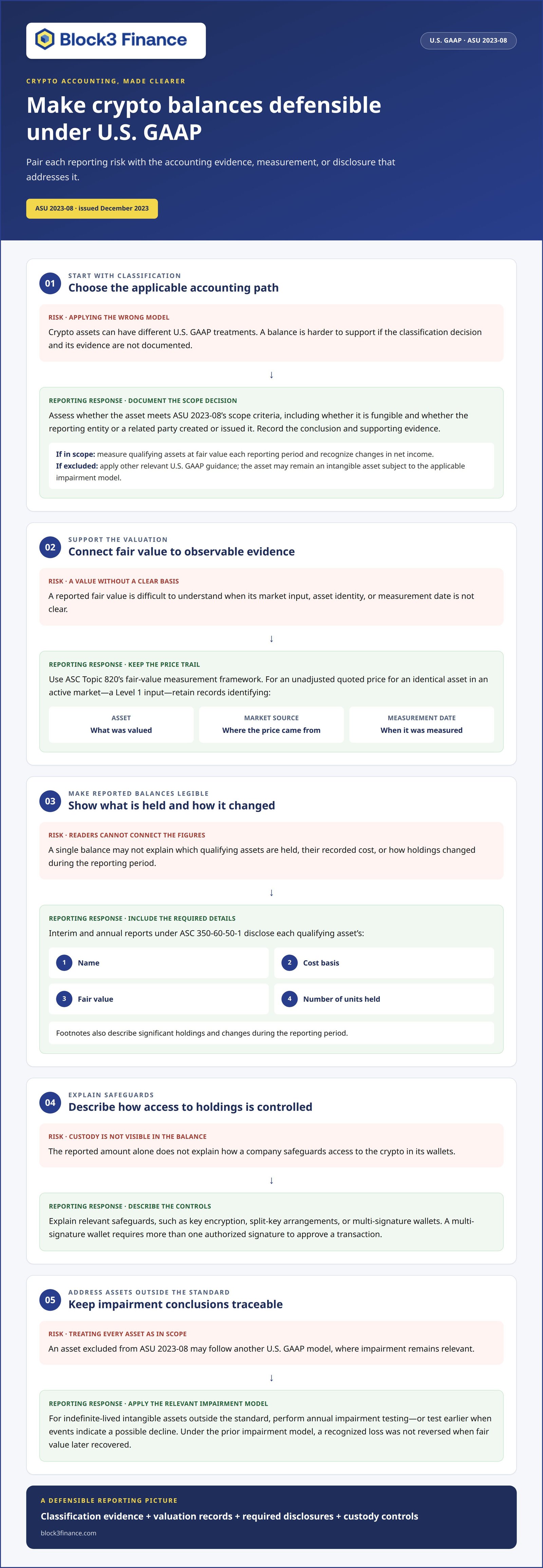
ASU 2023-08, issued in December 2023, changed the accounting for some crypto assets under U.S. GAAP. Its scope is defined in ASC 350-60-15-1. ASC means the Accounting Standards Codification, the organized source of U.S. GAAP requirements. The criteria include whether an asset is fungible, meaning interchangeable with another unit, and whether the reporting entity or a related party created or issued it.
The scope distinction determines which accounting model applies. For example, a qualifying asset follows ASU 2023-08, while an excluded asset is generally accounted for under other U.S. GAAP guidance. That asset may remain an intangible asset and be subject to the applicable impairment model. Defensible crypto accounting documents the classification decision and the evidence supporting it.
Differences Across Accounting and Tax Rules
U.S. financial reporting and federal tax reporting answer different questions, so their calculations may differ. U.S. GAAP determines how a company presents crypto assets in financial statements; the IRS treats crypto as property for federal tax purposes. Defensible crypto accounting keeps the accounting treatment separate from tax calculations and records the reasoning behind each conclusion.
- Financial statements: Apply the U.S. GAAP treatment appropriate to the asset and transaction.
- Federal tax reporting: Apply property-transaction principles to taxable activity.
- Supporting records: Keep the accounting conclusion and tax calculation traceable to their evidence.
For example, a company’s financial-statement carrying amount and tax basis can serve different reporting purposes. A digital asset accounting process helps keep those records distinct and supports a clear explanation of each amount.
Fair value, impairment, and custodial risk disclosures
Under U.S. GAAP, accounting for crypto holdings depends on whether the asset falls within the applicable guidance. ASU 2023-08 covers qualifying assets and sets out fair-value measurement and disclosure requirements. Fair value means the price an asset would receive in an orderly market transaction at the measurement date.
For qualifying crypto assets, companies measure fair value each reporting period and recognize increases or decreases in net income. ASC Topic 820 is the U.S. GAAP framework for measuring fair value. It helps companies assess the valuation inputs used, including market prices and any adjustments needed to reflect the asset being measured.
An unadjusted quoted price for an identical asset in an active market is a Level 1 input under U.S. GAAP. In plain terms, this is a directly observable market price with no adjustment. When a company uses that price, its valuation records should identify the asset, the market source, and the measurement date so readers can understand the basis for the reported amount.
Interim and annual financial reports under ASC 350-60-50-1 disclose each qualifying asset’s name, cost basis, fair value, and number of units held. Cost basis is the amount recorded for the asset before later measurement changes. Footnotes also describe significant holdings and changes during the reporting period, helping readers connect the reported figures with activity during that period.
Impairment means reducing an asset’s recorded value when its value has fallen under the applicable accounting model. It remains relevant for crypto assets outside ASU 2023-08. Under the prior impairment model, a recognized loss could not be reversed when fair value later recovered. Indefinite-lived intangible assets outside the standard require annual impairment testing, or earlier testing when events indicate a possible decline.
Custodial disclosures explain how a company safeguards access to its crypto holdings. Controls can include key encryption, split-key arrangements, or multi-signature wallets. A multi-signature wallet requires more than one authorized signature to approve a transaction. Describing these controls helps readers understand how access is restricted and how the company protects assets held in its wallets.
A useful reporting review connects valuation evidence, impairment conclusions, and custody controls. For example, records for an in-scope token can show its quoted market price, reported units, and wallet safeguards. Keeping these details together gives financial statement readers a clearer view of both the reported value and the controls surrounding the holding.
Crypto transaction tracking and wallet reconciliation
Crypto accounting professionals connect on-chain activity with financial records and tax calculations to value and document transactions. They match each transfer to supporting evidence, identify its purpose, and apply the relevant valuation basis. For U.S. tax records, the Internal Revenue Service states that a digital asset’s basis is generally its cost in U.S. dollars.
Wallet reconciliation compares activity across wallets, exchanges, and the balance sheet. For example, a transfer between two company-controlled wallets should be distinguished from a payment or disposal. Matching transaction identifiers, dates, quantities, and counterparties helps explain differences between wallet histories and recorded holdings. The reconciliation provides reviewers with a traceable path from digital activity to reported balances.
Transaction records also support tax reporting. The Internal Revenue Service proposed a rule requiring taxpayers to identify disposed digital-asset units in their books and records no later than the sale, disposition, or transfer. This matters when assets acquired at different times or costs are later disposed of. Records should link each disposal to the units selected and their relevant cost basis.
ASU 2023-08 also affects opening balances when an entity adopts it. At the beginning of the fiscal year of adoption, the entity recognizes a cumulative-effect adjustment in opening retained earnings. Accounting records therefore need to distinguish the transition adjustment from current-period transactions and income. That separation helps explain why opening equity differs from previously reported amounts.
Crypto lending requires its own transaction trail. The SEC indicated it would not object to derecognizing (removing an asset from the balance sheet) a lent digital asset and initially recognizing a loan receivable (an amount due from the borrower) at the fair value of the assets lent. The SEC indicated it would not object to initially and subsequently measuring the loan receivable at the fair value of the digital assets lent, with a credit allowance (an estimate of amounts that may not be repaid) consistent with expected credit loss accounting (estimating and recording potential losses when borrowers may not repay). Loan agreements, wallet movements, and valuation records help support this treatment.
For example, when a company transfers tokens under a lending arrangement, reconciliation should link the outgoing wallet movement to the receivable entry. Documentation should identify the assets lent, provide transaction evidence, and support the fair-value measurement. A separate credit allowance record makes the expected credit loss assessment visible rather than obscuring it within the asset balance.
Strong transaction tracking keeps holding, income, and balance sheet records aligned. It also distinguishes an internal wallet transfer from a taxable disposal or lending event. By reconciling on-chain activity with financial statements and retaining valuation support, accounting professionals create a clearer audit trail across accounting and tax reporting.
Accounting policies and audit readiness
Clear policies connect digital-asset activity to financial statements and supporting evidence. They define how a company applies U.S. accounting requirements and documents decisions for review.
Internal Controls for Crypto Accounting
Internal controls define who can authorize, record, and review crypto activity. Key encryption and multi-signature wallets can help restrict access to digital assets. For example, a company may require multiple authorized signatures before approving a wallet transaction. Separating approval from recording creates a reviewable control and helps reduce unauthorized activity.
Policies should also reflect the accounting treatment for each activity. ASC stands for Accounting Standards Codification, the organized collection of U.S. accounting standards. A documented review can identify the relevant guidance, record the company’s conclusion, and name the approver. Defensible crypto accounting relies on this evidence to support consistent decisions across reporting periods.
Common Crypto Accounting Mistakes
Common mistakes include applying guidance to the wrong transaction, omitting disclosures, or using an accounting conclusion for tax records without analysis. For example, ASC 350-60 covers certain crypto assets under ASU 2023-08. Recording an asset under that standard without assessing its scope can lead to an unsupported classification or measurement.
Lending arrangements can require additional disclosure analysis. ASC 326 is the U.S. accounting standard for credit losses; it informs disclosures about expected losses on crypto lending receivables. ASC 275 covers risks and uncertainties, including vulnerabilities from concentrations in lending arrangements. If a company records a loan but leaves out its credit-loss analysis or concentration risks, readers may not see important judgments behind the balance.
Revenue transactions and acquisitions also need clear policy treatment. ASC 606 is the U.S. revenue-recognition standard; its guidance addresses crypto received from customers and whether a company acts as principal or agent. ASC 805 covers business combinations, including crypto assets acquired in an acquisition. For example, an acquisition file should connect the transaction terms to the company’s accounting conclusion.
SEC registrants also consider Regulation S-X, the SEC’s rules for the form and content of financial statements. Article 5-02 addresses balance-sheet presentation, including crypto-related intangible assets. A review can trace each material balance from classification through presentation and approval. Documented controls and policies support audit-ready reporting during audit and compliance reviews.
Accounting support for crypto businesses and investors
Useful accounting support connects a crypto business’s activity to its reporting, tax calculations, and supporting records. For example, a startup receiving tokens for services needs to document the transaction, determine its accounting treatment, and retain evidence for later review. Investors also need records linking acquisitions and disposals to reported gains or losses.
For U.S. businesses, Notice 2014-21 treats crypto assets as property rather than currency for federal tax purposes. That means a business should distinguish a token payment, a sale, and a wallet transfer instead of treating each movement alike. The transaction’s purpose and evidence help determine how it enters accounting and tax records.
Cost-basis methods affect how a company calculates gains and losses when disposing of crypto assets. Companies may use different approaches to calculate gains and losses when disposing of crypto assets. Specific identification links a disposal to selected units, while FIFO uses the earliest-acquired units. A consistent policy helps explain the calculation behind reported results.
Private companies also need support for unusual events, not only routine trades. When a business combination includes crypto assets, ASC 805 informs the accounting analysis. If goodwill arises, the amount paid for a business above the value of its identifiable assets and liabilities, the AICPA Practice Aid notes that private companies may elect straight-line amortization, meaning equal expense amounts over time, over ten years or less, unless another useful life is more appropriate. This can affect how the transaction is reflected in financial reports.
Revenue arrangements deserve careful review. A company receiving tokens from a customer should document the contract, the transaction, and the accounting conclusion. ASC 606-10-32-21 addresses crypto assets received in revenue transactions, while ASC 606-10-55-36A covers principal-versus-agent considerations. These references help clarify which facts drive the revenue presentation.
Regulatory obligations can also vary by company and transaction. SEC registrants, for example, consider disclosure requirements that may apply to their operations and financial reporting. A support process should identify the entity’s reporting status and relevant activity, determine applicable disclosures, and link each conclusion to records. This helps businesses avoid treating every token event as an ordinary purchase or sale.
Investors and companies benefit from keeping tax reporting distinct from financial statements. A transaction record should identify the asset, event, valuation basis, and supporting evidence. A crypto tax reporting process can then connect documented activity to the relevant U.S. tax calculations without assuming those calculations match financial-statement treatment.
Block3 Finance: Monthly Accounting
Block3 Finance is a practical next step when crypto activity needs consistent accounting and reporting support. Monthly Accounting helps organize recurring financial records, while Tax Filing and Reporting addresses the preparation of crypto-related filings. These services can be relevant when a business has ongoing wallet activity, token transactions, or reporting responsibilities that require coordinated records.
For example, a company may need its accounting records to reflect crypto holdings and transactions while keeping tax calculations distinct from financial-statement treatment. Monthly Accounting can support that ongoing accounting function; a crypto accounting service is relevant when digital-asset activity forms part of regular business operations. The appropriate records depend on the company’s activity and reporting needs.
Tax Filing and Reporting helps with the separate task of preparing crypto-related tax filings. A Crypto Tax Accountant can support analysis of transactions, cost basis, and gains or losses under applicable U.S. tax rules. For example, when a company disposes of units acquired at different costs, the records and accounting method affect how the tax calculation is documented.
Audits and Compliance can support a business reviewing its accounting records, disclosures, and evidence. This work links reported balances with the policies and records behind them. A company preparing financial statements, responding to audit requests, or strengthening compliance documentation may benefit from a structured review of its digital-asset accounting.
The right support depends on the task. Ongoing bookkeeping needs point to monthly accounting; filing obligations call for tax reporting support; questions about transaction treatment may require a crypto tax accountant; and audit or compliance needs call for a review of records and disclosures. These functions can work together while keeping financial reporting and tax reporting distinct.
To begin a professional engagement, businesses typically provide relevant accounting records and information about their crypto activity. This context helps define the work around the company’s reporting needs, transactions, and existing documentation. A clear scope focuses attention on the accounting questions that matter most, rather than treating every crypto transaction as identical.
If you’d like to discuss your accounting needs, contact Block3 Finance.
Frequently Asked Questions
Are there things you’d recommend so companies can get ahead now?
Yes. Companies can establish a documented process before transaction volumes or reporting complexity grow. Define who approves wallet activity, how records reach accounting, and who reviews unusual transactions, such as token payments or lending arrangements. Align finance and tax reporting calendars, and record policy decisions as they change. A crypto accounting professional can help identify gaps and prioritize work based on the company’s activities.
What does defensible crypto accounting mean?
Defensible crypto accounting means that reported amounts and classifications are supported by clear reasoning and evidence. A reviewer, for example, should be able to trace a balance to its underlying wallet or exchange records and understand how the company treated the activity. It also means applying relevant accounting and tax approaches consistently, documenting significant judgments, and explaining material changes so decision-makers can understand how reported figures were prepared.
How should businesses classify crypto assets under U.S. GAAP after FASB ASU 2023-08?
Businesses should first assess whether an asset meets ASU 2023-08’s scope criteria in ASC 350-60-15-1. The criteria include fungibility and whether the reporting entity or a related party created or issued the asset. Qualifying assets are measured at fair value each reporting period, with changes recognized in net income. An asset outside the standard’s scope requires a separate U.S. GAAP analysis rather than automatic inclusion.
What are the tax accounting rules for cryptocurrency in the United States?
For U.S. federal tax purposes, the IRS treats digital assets as property and applies general property-transaction principles. The IRS generally identifies a digital asset’s basis as its cost in U.S. dollars. A sale, exchange, or other disposition may therefore require comparing the relevant proceeds with basis. Crypto activity is reported through Form 1040, not a separate crypto return; the records should support each tax calculation.
What records should businesses provide to support crypto balances, transactions, and valuations?
Useful records include exchange statements, wallet addresses, transaction identifiers, dates, quantities, and evidence showing who controls each wallet. For a token received through a customer contract, include the agreement and related invoice; for a loan, include the lending terms and supporting valuation. Companies should also provide accounting policies, period-end balance details, and reconciliations. Together, these materials explain the business purpose and treatment of unusual activity.
How do crypto accounting professionals reconcile exchange, wallet, and blockchain records?
Professionals align records by matching transaction identifiers, timestamps, token quantities, and counterparties across available sources. For example, an exchange withdrawal can be matched to an incoming wallet transfer, distinguishing movement between company-controlled accounts from a sale or payment. They then investigate unmatched items, differences in recorded units, and fees, and link resolved activity to accounting entries. This process clarifies how recorded balances relate to actual transaction histories.
How do crypto accounting professionals account for staking rewards, mining income, airdrops, and fees?
Professionals first identify what happened, who controlled the assets, and what records support the event. Staking, mining, airdrops, and transaction fees should be recorded as distinct activity types, not grouped into a generic trade category. A mining receipt, for example, needs records showing the asset received and the related activity; a network fee needs its own transaction evidence. The accounting and U.S. tax treatment then follows the applicable facts and rules.
What audit evidence do auditors require for cryptocurrency holdings and transactions?
Evidence commonly helps establish existence, ownership or control, valuation, and recorded activity. It may include wallet and exchange records, blockchain transaction data, custody-control documentation, valuation support, and ledger reconciliations. For example, a company can link a period-end holding to wallet evidence and explain how it determined the reported value. Lending contracts, approval records, and documented accounting judgments can support more complex transactions and disclosures.

Article by
Mahad Mohamed
Mahad Mohamed is an accountant and the CEO of Block3 Finance, with over 26+ years of Canadian and international tax and accounting experience. A crypto accounting specialist since the early days of Bitcoin, he has consulted for over 38 crypto companies and collaborated with legal professionals on regulatory matters. His expertise spans corporate reorganization, cross-border tax structuring (Canada & US), tax disputes, and CRA audits.
Previously, Mahad worked for the Canada Revenue Agency (CRA), Big4 accounting firms, and served as a Rulings Officer for the Federal Tax Authority of the UAE before acquiring Tax Partners in 2014.
Block3 Finance and Tax Partners has 44 full-time accountants and over 9,800+ clients.
Disclaimer
This article provides general information only and is current as of its publication date. It has not been updated and may be out of date. It does not constitute legal advice and should not be relied upon as such. Every tax situation is unique and may differ from the examples discussed in this article. If you have specific questions, you should seek the advice of our accountants for your unique circumstances.
Frequently Asked Questions
Are there things you’d recommend so companies can get ahead now?
Yes. Companies can establish a documented process before transaction volumes or reporting complexity grow. Define who approves wallet activity, how records reach accounting, and who reviews unusual transactions, such as token payments or lending arrangements. Align finance and tax reporting calendars, and record policy decisions as they change. A crypto accounting professional can help identify gaps and prioritize work based on the company’s activities.
What does defensible crypto accounting mean?
Defensible crypto accounting means that reported amounts and classifications are supported by clear reasoning and evidence. A reviewer, for example, should be able to trace a balance to its underlying wallet or exchange records and understand how the company treated the activity. It also means applying relevant accounting and tax approaches consistently, documenting significant judgments, and explaining material changes so decision-makers can understand how reported figures were prepared.
How should businesses classify crypto assets under U.S. GAAP after FASB ASU 2023-08?
Businesses should first assess whether an asset meets ASU 2023-08’s scope criteria in ASC 350-60-15-1. The criteria include fungibility and whether the reporting entity or a related party created or issued the asset. Qualifying assets are measured at fair value each reporting period, with changes recognized in net income. An asset outside the standard’s scope requires a separate U.S. GAAP analysis rather than automatic inclusion.
What are the tax accounting rules for cryptocurrency in the United States?
For U.S. federal tax purposes, the IRS treats digital assets as property and applies general property-transaction principles. The IRS generally identifies a digital asset’s basis as its cost in U.S. dollars. A sale, exchange, or other disposition may therefore require comparing the relevant proceeds with basis. Crypto activity is reported through Form 1040, not a separate crypto return; the records should support each tax calculation.
What records should businesses provide to support crypto balances, transactions, and valuations?
Useful records include exchange statements, wallet addresses, transaction identifiers, dates, quantities, and evidence showing who controls each wallet. For a token received through a customer contract, include the agreement and related invoice; for a loan, include the lending terms and supporting valuation. Companies should also provide accounting policies, period-end balance details, and reconciliations. Together, these materials explain the business purpose and treatment of unusual activity.
How do crypto accounting professionals reconcile exchange, wallet, and blockchain records?
Professionals align records by matching transaction identifiers, timestamps, token quantities, and counterparties across available sources. For example, an exchange withdrawal can be matched to an incoming wallet transfer, distinguishing movement between company-controlled accounts from a sale or payment. They then investigate unmatched items, differences in recorded units, and fees, and link resolved activity to accounting entries. This process clarifies how recorded balances relate to actual transaction histories.
How do crypto accounting professionals account for staking rewards, mining income, airdrops, and fees?
Professionals first identify what happened, who controlled the assets, and what records support the event. Staking, mining, airdrops, and transaction fees should be recorded as distinct activity types, not grouped into a generic trade category. A mining receipt, for example, needs records showing the asset received and the related activity; a network fee needs its own transaction evidence. The accounting and U.S. tax treatment then follows the applicable facts and rules.
What audit evidence do auditors require for cryptocurrency holdings and transactions?
Evidence commonly helps establish existence, ownership or control, valuation, and recorded activity. It may include wallet and exchange records, blockchain transaction data, custody-control documentation, valuation support, and ledger reconciliations. For example, a company can link a period-end holding to wallet evidence and explain how it determined the reported value. Lending contracts, approval records, and documented accounting judgments can support more complex transactions and disclosures.