
What if the hardest part of DeFi bookkeeping isn’t tracking each transaction, but determining the value of digital assets at the reporting date? For U.S. businesses, decentralized finance (DeFi) activity can span wallets, protocols, and transactions, so the books need to show more than a transaction history. Clear records help explain what happened and what the business holds.
DeFi activity can span wallets, protocols, tokens, and chains, making its accounting details difficult to consolidate. In the United States, incomplete records or unclear valuations can complicate gain and loss calculations and financial reporting.
This article explains how professional bookkeeping organizes DeFi activity into consistent records. You’ll learn how to track transaction data, where accounting becomes complex, how cost basis supports gain and loss calculations, and how to value digital assets at reporting dates. It also covers the reconciliations and documentation that help finance teams review DeFi activity.
Key Takeaways
- Organize wallet, exchange, and protocol activity in a subledger that preserves transaction details and supports reconciliation.
- Account for bridges, fees, and period-end transfers with documentation that distinguishes internal movements from other activity.
- Use consistent records and regular reconciliations to identify missing transactions and clarify their effect on reported profit.
- Track each asset’s cost basis, the amount used to determine its gain or loss, so you can calculate gains and losses when a transaction leads to a taxable disposal under U.S. rules.
- At reporting dates, document the valuation method and reconcile recorded asset values with available wallet and protocol data.
Crypto subledgers and digital asset tracking
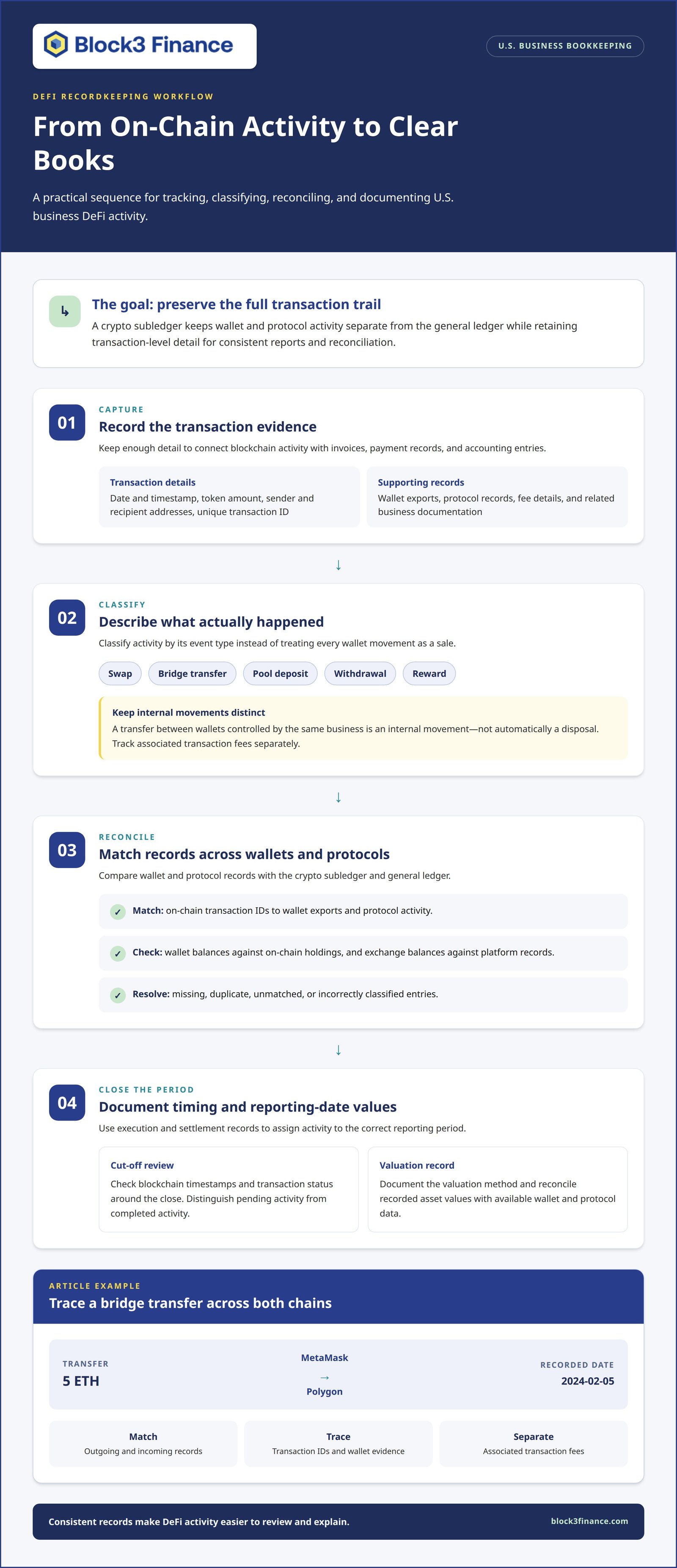
A crypto subledger is a detailed record that supports the general ledger by organizing wallet and protocol activity separately. It preserves transaction-level detail, helping finance teams reconcile digital asset balances and prepare consistent reports.
Crypto Transaction Tracking
Crypto transaction tracking records each transfer, receipt, or exchange with its supporting details. A professional records the date, amount, sender and recipient addresses, and unique transaction ID, then classifies the activity. These fields help connect blockchain records with invoices, payment records, and accounting entries.
Tax treatment depends on what happened. In the United States, buying cryptocurrency with fiat currency is described as non-taxable, while exchanging crypto for fiat can trigger a taxable event. Donating cryptocurrency to a tax-exempt organization is also described as non-taxable. The subledger should preserve the event type and supporting evidence, rather than treating every wallet movement as a sale.
Crypto invoices need a clear link between the business transaction and the on-chain payment. For example, a professional can match an issued invoice with the token received, wallet address, transaction ID, and payment date. This record helps distinguish customer revenue from transfers between wallets controlled by the same business.
When comparing DeFi bookkeeping tools with crypto tax software and traditional accounting software, a professional assesses wallet and protocol data coverage, transaction classification, tax reporting, and general-ledger exports. The right combination depends on whether the business needs detailed on-chain records, tax calculations, conventional invoicing, or integrated financial reporting.
DeFi Wallet and Protocol Reconciliation
Reconciliation compares wallet and protocol records with the crypto subledger and general ledger. A professional matches on-chain transaction IDs to wallet exports, identifies protocol activity, and checks wallet balances against on-chain holdings. This process can uncover missing entries, duplicate records, and transfers that need a different classification.
For example, a transfer between two wallets controlled by the same business is an internal movement, not automatically a disposal. Exchange balances should also be matched to platform records, and protocol positions reviewed against their transaction history. Accounting and tax software can help organize imported data, but a professional still needs to resolve unmatched entries and confirm their classifications.
Regular reconciliation keeps the transaction trail usable as activity grows. When a payment, wallet movement, or protocol event lacks an identifiable record, a professional can trace its transaction ID and supporting documentation before the books are closed. This creates a clearer audit trail across invoices, wallets, protocols, and ledger entries.
DeFi transaction complexity and recordkeeping
A single DeFi action can create several linked records across wallets, protocols, and chains. A professional follows each transaction through to the ledger, preserving its purpose, timing, fees, and supporting evidence.
Period-End Cut-Off and Documentation
Period-end cut-off assigns transactions to the correct reporting period based on execution and settlement records. This matters because pending and completed activity can affect balances differently. For example, a professional reviews blockchain timestamps and transaction status around the close, then matches completed activity to the ledger.
Documentation connects each entry to evidence. A transaction file can include the transaction ID, wallet addresses, token amounts, timestamps, protocol records, and fee details. For a transfer near the reporting date, a professional checks whether both wallets belong to the same entity. An internal movement should not be classified as a disposal solely because it crossed wallets.
Recording Staking and Yield Activities
Recording staking rewards, liquidity mining, and yield farming means distinguishing rewards from deposits, withdrawals, and returned principal. A professional links each reward to its protocol transaction, asset received, date, and recorded value. This separation helps explain how activity changes both token holdings and reported income.
For example, a yield-farming position may produce token rewards while the original assets remain in a liquidity pool. The ledger should distinguish rewards from the pool deposit and any later withdrawal. Staking records should also preserve when rewards became available, so the transaction history supports the accounting treatment.
Classifying DeFi Transactions and Assessing Risks
Transaction classification identifies whether activity represents a swap, bridge transfer, liquidity-pool deposit, withdrawal, or reward. For example, a recorded transfer of 5 ETH from MetaMask to Polygon on 2024-02-05 should be traced across both chains. The professional matches the outgoing and incoming records, then identifies associated transaction fees separately.
Classification matters because similar-looking wallet movements can represent different economic events. A swap exchanges one token for another; a bridge moves assets between networks; a pool transaction changes a protocol position. DeFi smart-contract vulnerabilities can be exploited, so audit records should retain transaction IDs, protocol details, wallet evidence, and any recorded loss or interruption. These records help explain unusual balance changes and support review.
Keep accurate cryptocurrency records to support compliance with tax laws and regulations. Record DeFi transactions promptly after execution. Near period-end, transfers between wallets controlled by the same entity are internal movements, not disposals.
Accounting challenges and software
DeFi activity can strain accounting systems when protocol events don’t fit existing categories. Professional review can catch classification gaps before they affect financial reports or profit calculations.
Common Accounting Errors
Common errors include duplicated imports, inconsistent token labels, and entries assigned to the wrong account. A reviewer can identify issues such as:
- The same transaction imported from multiple data sources.
- A protocol event coded without enough context.
- A software mapping that changes how similar entries appear.
DeFi bookkeeping software can organize protocol data, tax software can support tax calculations, and traditional accounting systems can manage ledger entries and financial reports. DeFi bookkeeping depends on how effectively these tools exchange reviewed information. A professional assesses the business’s workflow, including whether software exceptions can be traced and resolved.
Preventing Bookkeeping Errors
A documented review process helps prevent errors from carrying into later reports. A professional can apply consistent checks, such as:
- Reviewing software exceptions and investigating entries without clear classifications.
- Comparing account mappings when protocols or data sources change.
- Recording the reason for adjustments made during the close.
These controls help keep accounting treatment consistent across reporting periods. For example, if a software update changes an account mapping, a reviewer can assess affected entries and document corrections. This makes DeFi bookkeeping more reliable by ensuring changes are traceable rather than left unexplained.
Reconciliation also gives the review process a regular rhythm. Wallet balances can be compared with on-chain records, while protocol positions and newly recorded activity can also be reviewed regularly. These checks help identify unresolved items before they complicate the close and provide a clearer explanation of changes in assets, liabilities, and profit.
Software is a support tool, not the final decision-maker. A professional reviews the business’s accounting policies, data imports, and reporting needs together. Monthly accounting can make these reviews part of an ongoing process, with exceptions documented and resolved during the close. This gives management a more consistent view of financial performance and the records behind it.
At each monthly review, teams can pair position reviews with transaction-completeness checks: consider the DeFi positions, then inspect the period’s activity to see whether it has been recorded. Reviewing these questions together can reveal gaps between what is being tracked and what has entered the books. If an item cannot be readily matched, flag it for follow-up rather than assuming the record is complete.
A concise review record can note which positions and transaction groups were checked, what remains unresolved, and who will address it before the next close. This gives later reviewers a practical trail for revisiting open questions and helps prevent unrecorded items from blending into routine activity. Apply the process consistently each month and reflect its conclusions in the bookkeeping workflow. Position oversight and transaction recording then become recurring review tasks, not checks deferred until a reporting issue arises.
Cost basis and gains and losses
Cost basis gives each digital asset a starting value for gain and loss calculations. In the United States, a clear basis helps connect a disposal to its transaction history.
Determining Cost Basis
Cost basis is the recorded value assigned to an asset when acquired. Comparing it with the value received on disposal identifies a gain or loss. A professional links each token lot to its acquisition record, date, quantity, and value, then preserves that history through transfers and protocol activity.
For example, if ETH was purchased for US$1,500 and later exchanged when worth US$2,300, the difference is an US$800 gain. The acquisition record supports the starting value, while the later transaction establishes the amount received. Keeping both events connected helps prevent missing or duplicated basis when assets move between wallets.
Recognizing Gains and Losses
A gain occurs when the value received for a disposed asset exceeds its cost basis; a loss occurs when it is lower. For U.S. tax reporting, a professional identifies the disposal, calculates the difference, and records how long the asset was held. That holding period affects whether the gain is short-term or long-term.
According to the Internal Revenue Service, short-term U.S. crypto capital gains on assets held for one year or less may be taxed at ordinary income rates, which can be as high as 37%. Rates and tax rules can change, so confirm current details with the IRS. According to the Internal Revenue Service, long-term U.S. crypto capital gains may be taxed at rates of 0%, 15%, or 20%. The applicable rate depends on the taxpayer’s circumstances; confirm current details with the IRS.
Consider a token acquired in one transaction and swapped later for another asset. A professional records the value at the swap, compares it with the original basis, and documents the resulting gain or loss. A swap can require a calculation even when no dollars enter the wallet.
DeFi activity can complicate basis tracking when assets pass through multiple protocols. A liquidity-pool deposit, withdrawal, or reward may affect the records differently. The accounting file should retain linked transaction IDs and acquisition details so each later disposal can be traced to its source.
Consistent records also help distinguish realized gains from changes in market value. A token’s price movement alone does not establish the result of a disposal. A professional ties each calculation to a recorded transaction and supporting basis, giving the business a clearer account of its digital asset activity.
Digital asset valuation at reporting dates
A reporting-date valuation measures the value of a business’s digital assets at a specified financial close. A professional connects each recorded quantity with its value on that date, so the financial statements reflect a consistent snapshot.
The process starts by identifying every asset and position included in the close. A professional reviews wallet balances, exchange records, and protocol positions, then matches each quantity to supporting data. For example, a wallet balance and a protocol receipt may represent connected parts of one position, not separate holdings. Clear mapping helps prevent omissions and double counting.
Compound illustrates why token-specific records matter. The two assets need separate quantities and prices, even though they belong to the same protocol.
For each balance, a professional records the asset name, units held, valuation date, price used, and calculation. The price and quantity must refer to the same reporting point. If a position includes a receipt token and governance tokens, each component should have its own line. These details let finance teams trace the reported total back to individual assets.
Protocol positions can require additional analysis. A Compound position may include interest-bearing cUSDC alongside separate COMP tokens. A professional distinguishes the token balance from its recorded valuation, then reconciles both against protocol and wallet records. If quantities differ, reconciliation identifies which source supports the final amount and documents the adjustment.
Valuation also differs from cost basis. Cost basis supports gain or loss calculations when an asset is disposed of; reporting-date valuation captures the value assigned to holdings at the close. Keeping these records distinct helps avoid treating a change in market value as a disposal. The reporting file should preserve the date, asset quantities, pricing inputs, calculations, and reconciliation results.
A practical close therefore produces more than one total. It gives a traceable schedule showing what assets the business held, how each value was calculated, and how the balances connect to the ledger. For a position such as Compound’s 5.2 cUSDC and 12 COMP, that schedule makes the reported figures easier to review and explain.
Block3 Finance
Block3 Finance helps businesses bring DeFi activity into clearer accounting, tax, and compliance records. Its services can support companies that need a dependable view of wallet transactions, protocol positions, gains, losses, and reporting-date asset values.
The right support depends on where records become difficult to manage. For example, a business with regular activity across wallets and protocols may benefit from ongoing accounting, while a company preparing tax returns may need transaction classifications and calculations reviewed together. A professional can also connect accounting records with the business’s reporting needs.
Monthly Accounting suits a business that needs recurring transaction review and ledger reporting, rather than a one-time year-end cleanup. It brings wallet activity, protocol records, and financial entries into an ongoing process, giving finance teams a structured view of recorded activity as they prepare each close.
Tax Filing and Reporting helps organize DeFi transactions for U.S. tax reporting. A Crypto Tax Accountant can review recorded transactions, cost basis, and gains or losses as part of the filing work. This is particularly relevant when rewards, swaps, or token disposals complicate the business’s tax records.
- Audits and Compliance can help address the need for organized supporting records and reconciliations.
- CFO Services may help businesses connect digital asset records with broader financial oversight and reporting.
- Crypto to Fiat Payment Solutions may be relevant when a business needs to manage crypto-to-fiat payment activity alongside its accounting records.
For productive bookkeeping, the professional needs context about the business’s wallets, protocols, transaction activity, and reporting goals. Wallet exports, transaction IDs, invoices, and prior accounting entries can explain how an on-chain event relates to the company’s books. Clear supporting information also helps identify gaps and distinguish business transactions from internal wallet movements.
Block3 Finance’s accounting and tax support can be useful when a business needs more than raw blockchain data, but a coherent record that can inform reporting, filing, and review. It is not investment or trading advice; the focus is the accounting and tax treatment of recorded activity.
For support with your DeFi accounting and reporting needs, contact Block3 Finance.
Frequently Asked Questions
Why Is Crypto Bookkeeping Important For Your Business?
Clear records help business leaders use financial information when making operating decisions. For example, management can review whether DeFi activity contributes to revenue, creates costs, or ties up resources in protocol positions. Consistent accounting gives owners and finance teams a shared basis for discussing performance when preparing budgets, evaluating business results, or explaining financial activity to stakeholders.
What is DeFi bookkeeping?
DeFi bookkeeping applies accounting principles to a business’s decentralized finance activity. It translates protocol activity into financial information that management can interpret alongside the rest of the business. For example, a liquidity position can be reviewed not only as a token balance, but as part of the company’s overall financial position. The aim is consistent, decision-ready reporting, not simply a record of blockchain activity.
How does a professional track DeFi transactions for accounting and tax reporting?
A professional assesses each transaction’s business context before determining how it should be presented in the accounts or considered for tax reporting. For example, a token received through a protocol may need different treatment from a customer payment, even if both increase a wallet balance. The professional considers the transaction type, purpose, and relevant U.S. tax context, then applies consistent classifications throughout the reporting period.
What records should you provide to a professional?
Along with transaction data, share the business’s accounting policies, prior-period financial statements, and relevant tax filings. These materials help a professional understand how the business has previously presented its activity and identify changes that need explanation. For example, if the company changed its accounting treatment for a protocol position, prior-period records can provide context for current reporting. Include notes about unusual events or business changes.
How can you compare DeFi bookkeeping software options and their costs with a professional's help?
A professional can assess software against the business’s actual workflow before a decision is made. For example, they can review a representative period, identify transactions that require manual attention, and assess how each option handles them. Costs depend on the product’s pricing model and the business’s requirements. A useful comparison considers expected workload and whether the software can support reporting without adding unnecessary complexity.

Article by
Mahad Mohamed
Mahad Mohamed is an accountant and the CEO of Block3 Finance, with over 26+ years of Canadian and international tax and accounting experience. A crypto accounting specialist since the early days of Bitcoin, he has consulted for over 38 crypto companies and collaborated with legal professionals on regulatory matters. His expertise spans corporate reorganization, cross-border tax structuring (Canada & US), tax disputes, and CRA audits.
Previously, Mahad worked for the Canada Revenue Agency (CRA), Big4 accounting firms, and served as a Rulings Officer for the Federal Tax Authority of the UAE before acquiring Tax Partners in 2014.
Block3 Finance and Tax Partners has 44 full-time accountants and over 9,800+ clients.
Disclaimer
This article provides general information only and is current as of its publication date. It has not been updated and may be out of date. It does not constitute legal advice and should not be relied upon as such. Every tax situation is unique and may differ from the examples discussed in this article. If you have specific questions, you should seek the advice of our accountants for your unique circumstances.
Frequently Asked Questions
Why Is Crypto Bookkeeping Important For Your Business?
Clear records help business leaders use financial information when making operating decisions. For example, management can review whether DeFi activity contributes to revenue, creates costs, or ties up resources in protocol positions. Consistent accounting gives owners and finance teams a shared basis for discussing performance when preparing budgets, evaluating business results, or explaining financial activity to stakeholders.
What is DeFi bookkeeping?
DeFi bookkeeping applies accounting principles to a business’s decentralized finance activity. It translates protocol activity into financial information that management can interpret alongside the rest of the business. For example, a liquidity position can be reviewed not only as a token balance, but as part of the company’s overall financial position. The aim is consistent, decision-ready reporting, not simply a record of blockchain activity.
How does a professional track DeFi transactions for accounting and tax reporting?
A professional assesses each transaction’s business context before determining how it should be presented in the accounts or considered for tax reporting. For example, a token received through a protocol may need different treatment from a customer payment, even if both increase a wallet balance. The professional considers the transaction type, purpose, and relevant U.S. tax context, then applies consistent classifications throughout the reporting period.
What records should you provide to a professional?
Along with transaction data, share the business’s accounting policies, prior-period financial statements, and relevant tax filings. These materials help a professional understand how the business has previously presented its activity and identify changes that need explanation. For example, if the company changed its accounting treatment for a protocol position, prior-period records can provide context for current reporting. Include notes about unusual events or business changes.
How can you compare DeFi bookkeeping software options and their costs with a professional's help?
A professional can assess software against the business’s actual workflow before a decision is made. For example, they can review a representative period, identify transactions that require manual attention, and assess how each option handles them. Costs depend on the product’s pricing model and the business’s requirements. A useful comparison considers expected workload and whether the software can support reporting without adding unnecessary complexity.