
Under U.S. federal tax rules, a crypto transaction can create taxable income or a reportable gain, even when no cash changes hands. For U.S. corporations, Form 1120 cryptocurrency reporting includes a digital asset question, and according to the IRS, corporations filing the return must disclose digital asset activity beginning with the 2025 tax year. A corporation generally answers “Yes” if it received crypto as payment, sold or exchanged it, or otherwise disposed of a financial interest in it.
It’s understandable to focus on whether a sale triggered tax, but receipts and rewards can matter too. Crypto received as business income or through mining or staking may have tax consequences when received or when you gain control of it. Selling or exchanging crypto can also create a gain or loss.
This guide explains when business crypto receipts and rewards may be taxable, how corporations calculate and report gains, and which related U.S. federal forms may apply. It also clarifies how the Form 1120 digital asset question fits into the wider reporting picture, so you can distinguish disclosure from income and gain reporting.
Key Takeaways
- Crypto received as business income, mining proceeds, or staking rewards can create taxable income, even before the corporation sells the assets.
- For the 2025 tax year, corporations filing Form 1120 must disclose digital asset activity and answer the return’s digital asset question.
- Receiving crypto for goods or services and later disposing of it can involve separate tax calculations: income when received and a gain or loss when disposed of.
- Track each asset’s receipt or purchase value and later disposition details to calculate the amount used to measure gains or losses and report them accurately.
- Related business forms depend on the corporation’s activity, including whether it has crypto income, pays contractors in digital assets, or disposes of assets.
Income recognition for crypto receipts and rewards
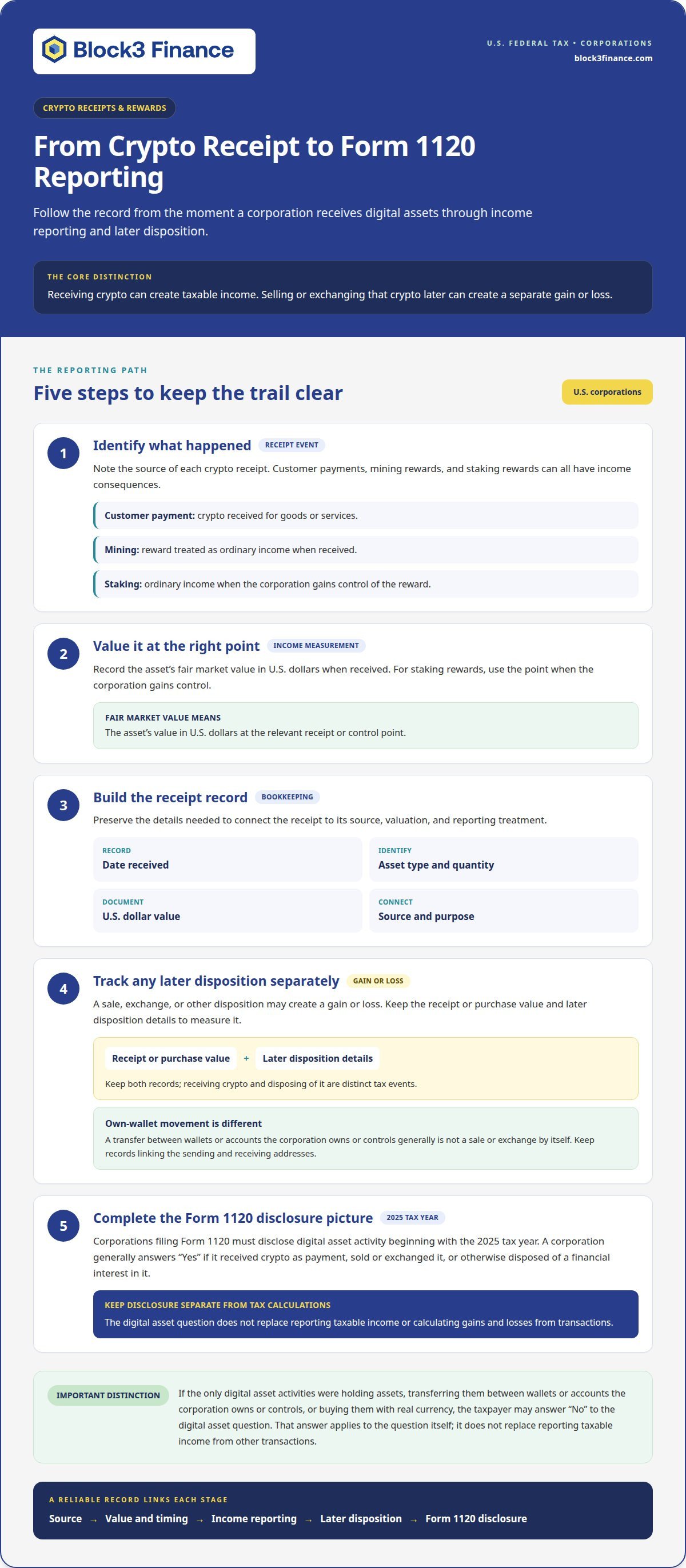
For a U.S. corporation, receiving cryptocurrency can create taxable income before the business converts it to dollars. The value of the digital assets when received is central to measuring that income. Treasury Regulation § 1.61-2(d)(2)(i) provides guidance on income recognition for corporate digital asset transactions, including compensation paid in property. The corporation records the receipt as business income and preserves its date, asset type, quantity, and fair market value, meaning the asset’s value in U.S. dollars when received.
Different receipts arise through different business activities, but each needs a clear transaction record. For example, cryptocurrency paid by a customer for services is a business receipt, while mining rewards are ordinary income, income taxed like wages or other regular earnings, measured at fair market value when received. Staking rewards are ordinary income when the recipient gains control of them, under Revenue Ruling 2023-14. An airdrop or hard fork may raise separate income questions; IRS Revenue Ruling 2019-24 addresses those events.
- Customer payments: Record the digital asset and its fair market value when received, then track any later sale or exchange separately.
- Mining: Record the reward’s value when received as ordinary income; a later disposition can create a separate gain or loss.
- Staking: Identify when the corporation gains control of the reward and record its value at that point.
How do transfers between a corporation’s own wallets affect Form 1120 reporting? Moving assets between wallets or accounts the corporation owns or controls generally isn’t a sale or exchange by itself. The transfer alone doesn’t create income, but the corporation should retain records linking the sending and receiving addresses so the movement isn’t mistaken for a payment or disposition.
Form 1120 reports the corporation’s income; Schedule C and Schedule 1 relate to individual returns, not a corporation’s Form 1120. An independent contractor reports business income on Schedule C (Form 1040), while employee crypto wages are reported as wages. These distinctions matter when a corporation pays people in digital assets: the recipient’s form depends on their relationship with the business, and payment records should identify the value and purpose.
Accurate recognition also protects the return’s integrity. The Internal Revenue Service states that the U.S. accuracy-related penalty for an underpayment attributable to negligence or substantial understatement is 20%. A disciplined accounting process connects each receipt to its source, valuation, and reporting treatment; the crypto tax filing and reporting process can bring those records into a coherent corporate return.
Cryptocurrency as property for U.S. tax purposes
For U.S. federal tax purposes, IRS Notice 2014-21 established cryptocurrency as property. That classification means a business must track digital assets like other property, rather than treating every movement as ordinary cash activity. A sale, exchange, or other disposition may create a gain or loss. The corporation’s records need to show what it received or paid, when the transaction occurred, and what happened to the asset afterward.
The Infrastructure Investment and Jobs Act defines a digital asset as a digital representation of value recorded on a cryptographically secured distributed ledger or similar technology. Blockchain records can help trace transactions, but they may not show a corporation’s tax basis: the amount used to calculate gain or loss when an asset is disposed of. For example, a wallet transfer may show a new address without indicating a change in ownership or the asset’s original purchase value.
Holding crypto is different from selling or exchanging it. A taxpayer whose only digital asset activities were holding assets, transferring them between wallets or accounts they own or control, or buying them with real currency may answer “No” to the digital asset question on a federal return. That answer applies only to the question itself; it does not replace reporting taxable income from other transactions.
- Holding: Retain records identifying the corporation’s assets and acquisition details, even if no sale occurs.
- Wallet transfers: Preserve transaction records linking the sending and receiving accounts to support continued ownership.
- Dispositions: Record sales, exchanges, and payments made with crypto separately from simple transfers.
Form 1099-DA adds another record source, not a substitute for the corporation’s own books. According to the Internal Revenue Service, brokers must report gross proceeds for covered digital asset transactions effected on or after January 1, 2025. For U.S. transactions conducted during the 2025 tax year, the IRS says brokers are expected to send Form 1099-DA to taxpayers and the IRS starting in early 2026. Compare proceeds with the corporation’s transaction records; proceeds alone don’t establish basis or taxable gain.
The classification also matters when an employee receives cryptocurrency as wages. The asset is property, while the payment is compensation that the employer records as wages. Keeping these distinct helps the corporation account for the payment and track any later disposition of the asset.
For a corporation with multiple wallets, employee payments, and broker statements, a conversation about digital-asset tax reporting can help clarify how property records connect to its U.S. return.
Business cryptocurrency tax reporting
For U.S. corporations, crypto reporting connects the digital asset question on Form 1120 with income and transaction records. The IRS rules require corporations to report the tax consequences of business receipts and dispositions, not just complete the disclosure question.
Corporate Business Cryptocurrency Reporting
Corporate cryptocurrency tax reporting means disclosing relevant digital asset activity and including its tax effects on the federal return. The Internal Revenue Service states that corporations filing Form 1120 must disclose digital asset activity beginning with the 2025 tax year. That disclosure makes it important to separate the question’s Yes-or-No answer from the calculations and income reported elsewhere on the tax return.
A corporation generally answers “Yes” if it received digital assets as payment, sold or exchanged them, or otherwise disposed of a financial interest in them. A transfer between wallets the corporation owns is different from a sale, but records should show that ownership continued. The answer describes activity during the tax year; it does not replace reporting taxable income or gains.
Crypto Received as Business Income
Crypto received by a corporation for goods or services is business income, measured at its fair market value when received. The corporation records the receipt and its business purpose, then includes the income in preparing its return. A change in value before a later sale does not alter the original receipt value; it affects the separate calculation for that later disposition.
The same recordkeeping approach applies to rewards and other business receipts. For example, a corporation receiving tokens as payment should document the date, asset, quantity, and value, then track any later sale or exchange separately. This prevents the receipt from being confused with proceeds from a subsequent transaction.
For a complete federal filing, the corporation’s records should reconcile wallet activity with accounting entries and supporting transaction data. The Internal Revenue Service says taxpayers with digital asset transactions should keep records of purchases, receipts, sales, exchanges, and other dispositions. A transaction ledger can link each entry to its purpose and tax treatment, including customer payments, rewards, transfers, and disposals.
- Disclosure: Match the Form 1120 digital asset question to the corporation’s activity for the tax year.
- Income: Separate crypto received as business income from later sales or exchanges.
- Return type: Identify the entity’s federal filing form. Relevant business returns include Forms 1120, 1120-S, and 1065, depending on the entity’s tax classification.
Form 1120 cryptocurrency reporting is therefore more than checking a box: the answer must align with the corporation’s books and reported tax items. A clear reconciliation helps connect the disclosure, income, and asset transactions without treating every blockchain movement as a taxable event.
How are cryptocurrency payments for goods or services reported by a C corporation?
A C corporation, meaning a corporation taxed separately from its owners, records cryptocurrency received as business revenue using the asset’s fair market value in U.S. dollars when received. That value measures the sale or service income, even if the corporation keeps the cryptocurrency rather than converting it to dollars. For Form 1120, the receipt belongs in the corporation’s income records and must reconcile with its sales documentation.
Consider a company that invoices a customer for consulting work and receives Bitcoin. Its records should connect the invoice to the payment date, quantity received, and U.S. dollar value. The blockchain transaction can help establish the transfer, while the invoice explains why the corporation received the asset. Together, these records create an auditable trail from customer sale to corporate revenue.
The receipt and any later disposal are separate events. The amount recorded as revenue establishes the asset’s starting tax basis, the value used to calculate later gain or loss. If the corporation later sells the Bitcoin, exchanges it for another digital asset, or uses it to pay a vendor, it compares the disposal proceeds or value with that basis. The difference may be a taxable gain or loss.
- At receipt: Match the customer invoice to the digital asset transaction and record its fair market value in U.S. dollars.
- During holding: Keep the asset linked to the receipt record and the corporation’s wallet activity.
- At disposal: Record the transaction and compare its value with the asset’s tax basis.
For a C corporation, those income and gain items feed into its federal corporate return. The general U.S. corporate income tax rate is 21 percent under IRC Section 11, and it applies to taxable income, not specifically to digital asset gains. The rate doesn’t replace the need to identify each transaction’s nature: customer revenue is distinct from a later gain on the asset received.
Payments made in cryptocurrency also need separate records. For example, when a corporation pays an independent contractor in digital assets, U.S. businesses must report payments of $600 or more on Form 1099-NEC, using the payment’s fair market value in U.S. dollars. The corporation should preserve the contractor payment date, amount, recipient details, and business purpose, then reconcile those records with its books.
Form 1120 cryptocurrency reporting therefore requires more than a wallet balance at year-end. The corporation’s records should show how each crypto payment relates to revenue, how its value was determined, and whether a later transaction created a separate gain or loss. Keeping those events distinct helps the tax return reflect both the original sale and the asset’s subsequent use.
How does a corporation calculate the tax basis and gain or loss on cryptocurrency?
A corporation calculates a crypto gain or loss by comparing an asset’s tax basis with its value when disposed of. Tax basis is generally the amount assigned to the asset when acquired, including its recorded value when received as income. For a sale, the basic calculation is proceeds minus basis. A positive result is a gain; a negative result is a loss.
For example, an ETH purchase for $150 in 2019, followed by a sale for $2,400 in 2024, produces a $2,250 gain before considering other relevant adjustments. The purchase amount establishes basis, while the sale proceeds establish the disposal value. The example illustrates why a corporation needs to preserve both acquisition and sale records, rather than relying only on a wallet’s current balance.
Exchanging one cryptocurrency for another is also a disposition because the corporation gives up one asset for another. To calculate the result, it records the value received in the exchange and compares it with the basis of the asset surrendered. The new asset needs its own acquisition record and basis. This applies even if no U.S. dollars enter the corporation’s bank account.
- Identify the asset: Match the transaction to the token, quantity, wallet, and transaction date.
- Establish basis: Link the asset to its purchase or receipt record and the value recorded at acquisition.
- Measure disposal value: Record the sale proceeds or value received in an exchange or other disposition.
- Calculate and report: Subtract basis from disposal value, then include the resulting gain or loss in the corporation’s tax records.
Consistent asset identification matters when a corporation holds the same token across several wallets or accounts. Revenue Procedure 2024-28 provides transitional guidance for allocating unused basis to digital assets held in each taxpayer wallet or account as of January 1, 2025. The allocation links existing basis to assets held in specific accounts, helping the corporation preserve continuity as it tracks later dispositions.
For 2025, the IRS’s rules for identifying digital assets when calculating cost basis may depend on the taxpayer’s records and circumstances. Do not assume that FIFO, LIFO, or HIFO is permitted; check current IRS guidance for the applicable method. A corporation should retain transaction dates, quantities, basis, and fair market values to support the gain or loss reported on its federal return.
If wallet-level basis records need reconciliation, discuss your corporate crypto basis and gain calculations with the team.
Block3 Finance: Tax Filing and Reporting
Block3 Finance helps corporations bring digital asset activity into a coherent federal tax filing. Its Tax Filing and Reporting work can address Form 1120 preparation, income classification, and the connection between wallet records and reported transactions. When recurring crypto activity makes those records harder to reconcile, Monthly Accounting can support ongoing bookkeeping, while Audits and Compliance can help assess reporting controls.
A Crypto Tax Accountant can help organize transaction histories, receipts, rewards, and disposal records into a consistent reporting process. This support is especially relevant when a corporation receives crypto from customers, pays contractors in digital assets, or calculates basis across multiple wallets. Clear records provide a stronger foundation for the return.
Contact Block3 Finance to discuss your corporation’s crypto tax reporting needs.
Build a stronger process for future filings
Crypto activity can change as a corporation adds payment methods, wallets, or transaction types. Make tax reporting part of the operating process so financial records stay aligned with digital asset activity as the business grows. A consistent framework can also help leadership understand how crypto flows through the company’s accounts.
Block3 Finance supports that work through Tax Filing and Reporting, Audits and Compliance, and Monthly Accounting. These services can help businesses strengthen reporting routines and maintain clearer accounting records across ongoing crypto activity. For companies preparing a return or improving their process for a future tax year, that support can turn fragmented transaction data into a more structured filing workflow.
Move forward with greater clarity. Contact Block3 Finance to discuss your corporate crypto tax needs and how Form 1120 cryptocurrency reporting fits your organization’s next filing cycle.
Frequently Asked Questions
Do I have to pay crypto taxes?
Possibly. Under U.S. federal tax rules, taxable income or a gain can arise from receiving crypto for services, mining, staking, selling, or exchanging assets. Simply holding crypto or buying it with U.S. dollars does not by itself mean tax is due. The outcome depends on what happened, the asset’s value and basis, and the corporation’s overall tax position for the year.
Does Form 1120 ask about cryptocurrency or digital asset transactions?
Yes. The U.S. Form 1120 includes a question about digital asset activity. The Internal Revenue Service says corporations filing Form 1120 must disclose digital asset activity beginning with the 2025 tax year. This disclosure is separate from calculating income or gain for the return. A corporation may need to report taxable results even after answering the question, so the checkbox alone doesn’t complete its tax reporting.
What digital asset question appears on the current Form 1120?
The U.S. Form 1120 asks whether the corporation received a digital asset as payment or reward, sold or exchanged one, or otherwise disposed of a financial interest in one. The corporation must select “Yes” or “No.” The question focuses on the corporation’s activity during the applicable tax year, not simply whether it owns crypto at filing time. Review the actual transactions, not only year-end wallet balances.
How should a C corporation answer the digital asset question on Form 1120?
A U.S. C corporation generally answers “Yes” if it received crypto as payment, sold or exchanged digital assets, or otherwise disposed of a financial interest in them during the tax year. Accepting tokens from a customer or exchanging one token for another may make “Yes” appropriate. A corporation whose only activity was holding assets or moving them between wallets it controls may answer “No.”
How are cryptocurrency sales reported on a corporation's federal tax return?
A U.S. corporation reports the tax result of a crypto sale on its corporate return, using the sale proceeds and the asset’s tax basis to determine gain or loss. Keep records linking the sold units to their acquisition details, because the wallet’s total balance alone may not identify which units were disposed of. The corporation should also distinguish sale proceeds from business revenue recorded when it first received the asset.
How should cryptocurrency mining, staking, or rewards be reported by a corporation?
A U.S. corporation generally records mining rewards as ordinary income at fair market value when received. Staking rewards are ordinary income when the corporation gains control of them, under Revenue Ruling 2023-14. Record the receipt date, token amount, and value, then track any later sale separately. A later disposal can produce a gain or loss measured against the basis established when the reward was recognized as income.

Article by
Mahad Mohamed
Mahad Mohamed is an accountant and the CEO of Block3 Finance, with over 26+ years of Canadian and international tax and accounting experience. A crypto accounting specialist since the early days of Bitcoin, he has consulted for over 38 crypto companies and collaborated with legal professionals on regulatory matters. His expertise spans corporate reorganization, cross-border tax structuring (Canada & US), tax disputes, and CRA audits.
Previously, Mahad worked for the Canada Revenue Agency (CRA), Big4 accounting firms, and served as a Rulings Officer for the Federal Tax Authority of the UAE before acquiring Tax Partners in 2014.
Block3 Finance and Tax Partners has 44 full-time accountants and over 9,800+ clients.
Disclaimer
This article provides general information only and is current as of its publication date. It has not been updated and may be out of date. It does not constitute legal advice and should not be relied upon as such. Every tax situation is unique and may differ from the examples discussed in this article. If you have specific questions, you should seek the advice of our accountants for your unique circumstances.
Frequently Asked Questions
Do I have to pay crypto taxes?
Possibly. Under U.S. federal tax rules, taxable income or a gain can arise from receiving crypto for services, mining, staking, selling, or exchanging assets. Simply holding crypto or buying it with U.S. dollars does not by itself mean tax is due. The outcome depends on what happened, the asset’s value and basis, and the corporation’s overall tax position for the year.
Does Form 1120 ask about cryptocurrency or digital asset transactions?
Yes. The U.S. Form 1120 includes a question about digital asset activity. The Internal Revenue Service says corporations filing Form 1120 must disclose digital asset activity beginning with the 2025 tax year. This disclosure is separate from calculating income or gain for the return. A corporation may need to report taxable results even after answering the question, so the checkbox alone doesn’t complete its tax reporting.
What digital asset question appears on the current Form 1120?
The U.S. Form 1120 asks whether the corporation received a digital asset as payment or reward, sold or exchanged one, or otherwise disposed of a financial interest in one. The corporation must select “Yes” or “No.” The question focuses on the corporation’s activity during the applicable tax year, not simply whether it owns crypto at filing time. Review the actual transactions, not only year-end wallet balances.
How should a C corporation answer the digital asset question on Form 1120?
A U.S. C corporation generally answers “Yes” if it received crypto as payment, sold or exchanged digital assets, or otherwise disposed of a financial interest in them during the tax year. Accepting tokens from a customer or exchanging one token for another may make “Yes” appropriate. A corporation whose only activity was holding assets or moving them between wallets it controls may answer “No.”
How are cryptocurrency sales reported on a corporation's federal tax return?
A U.S. corporation reports the tax result of a crypto sale on its corporate return, using the sale proceeds and the asset’s tax basis to determine gain or loss. Keep records linking the sold units to their acquisition details, because the wallet’s total balance alone may not identify which units were disposed of. The corporation should also distinguish sale proceeds from business revenue recorded when it first received the asset.
How should cryptocurrency mining, staking, or rewards be reported by a corporation?
A U.S. corporation generally records mining rewards as ordinary income at fair market value when received. Staking rewards are ordinary income when the corporation gains control of them, under Revenue Ruling 2023-14. Record the receipt date, token amount, and value, then track any later sale separately. A later disposal can produce a gain or loss measured against the basis established when the reward was recognized as income.