
A high-value crypto portfolio is only as clear as the records behind it. A crypto accountant for high net worth individuals reconciles digital-asset activity and organizes it for U.S. tax reporting. The IRS treats digital assets as property for U.S. tax purposes. The goal is a complete, traceable account of activity across your portfolio.
Tax work becomes more involved when activity spans wallets, exchanges, DeFi protocols, staking, or NFTs. This guide explains what a U.S. crypto tax accountant does, how reconciliation and reporting work, and which parts of a complex portfolio need particular attention.
You’ll also learn how to assess an accountant’s digital-asset experience and when specialist support can bring greater structure to your records. The focus is practical: understand the work, the decisions it informs, and how personal and business accounting needs can intersect without losing sight of your personal tax position.
Key Takeaways
- Map DeFi, staking, yield farming, liquidity pools, and airdrops separately so each activity can be reviewed with the right records.
- Assess an accountant’s ability to reconcile activity across wallets and platforms, trace cost basis, and explain how calculations were prepared.
- Compare exchange records with your own transaction history; U.S. brokers generally reported gross proceeds without cost basis on Form 1099-DA for 2025 transactions, according to the Internal Revenue Service.
- Review NFT characteristics carefully, since the Internal Revenue Service introduced a look-through analysis for some NFTs in Notice 2023-27 that could make them collectibles subject to a 28% long-term tax rate.
- Consider how personal and business crypto activity connect, and organize reporting responsibilities so transactions are recorded consistently.
Can the accountant handle DeFi, staking, and NFTs?
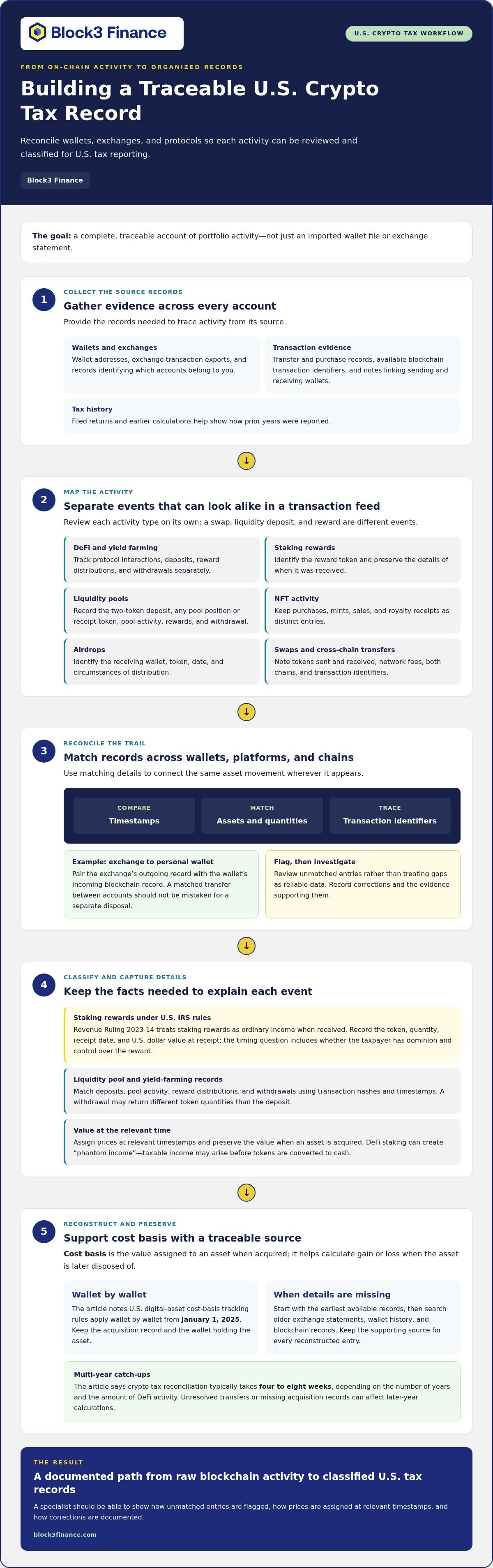
Yes, when the accountant’s process traces activity across protocols, wallets, and chains. For a high-net-worth portfolio, reviewing exchange statements alone can miss transactions created by decentralized finance (DeFi). A crypto accountant for high net worth individuals should reconcile on-chain records with wallet histories, then classify each event according to what happened. A token swap, liquidity deposit, and reward may look similar in a transaction feed but represent different events.
Start with staking and yield farming. Staking rewards are treated as ordinary income when received under U.S. IRS Revenue Ruling 2023-14. Ordinary income means income generally taxed under regular income-tax rates, rather than capital-gains rates. The timing question is whether the taxpayer has dominion and control over the reward. A sound ledger records the token, quantity, receipt date, and U.S. dollar value at receipt. Yield farming can involve deposits, reward distributions, and withdrawals, so each protocol interaction needs its own record rather than one net result.
Liquidity pools add another reconciliation challenge. Depositing two tokens may create a pool position or receipt token, while a later withdrawal may return different token quantities. The accountant should match the deposit, pool activity, rewards, and withdrawal using transaction hashes and timestamps. DeFi staking can also create phantom income, meaning taxable income may arise before a participant converts tokens to cash. Recording the asset’s value when acquired helps preserve the detail needed for reporting.
- Swaps: Match the tokens sent and received, including network fees recorded in the transaction.
- Airdrops: Identify the wallet receipt, token, date, and circumstances of distribution before classifying it.
- NFTs: Separate a purchase, mint, sale, and royalty receipt instead of grouping every event as an NFT transaction.
- Cross-chain transfers: Pair the outgoing asset with its incoming representation, noting both chains and transaction identifiers.
NFT and cross-chain records need a clear trail. Moving an asset from Ethereum to another network, for example, can create a separate outgoing transaction and incoming record. Matching those entries helps prevent a transfer from being mistaken for a disposal. NFT classification also depends on the event: minting, acquiring, selling, or receiving proceeds as a creator are distinct accounting entries. Keep marketplace records with your wallet data.
Ask the accountant to demonstrate a reconciliation workflow using a real protocol position. They should show how they flag unmatched entries, assign prices at relevant timestamps, and document corrections. For a DeFi-heavy portfolio, expertise means explaining the path from raw blockchain activity to classified income and transaction records, not simply importing a wallet file.
What Is A US Crypto Tax Accountant?
A U.S. crypto tax accountant organizes digital-asset records for tax reporting, including transaction history and cost basis. Provide wallet addresses, exchange transaction exports, transfer and purchase records, prior tax returns, and available blockchain transaction identifiers so each entry can be traced.
Cost basis is the value assigned to an asset when acquired; it helps calculate gain or loss when that asset is later disposed of. For U.S. digital assets, cost basis tracking applies wallet by wallet under rules applying from January 1, 2025. That makes the acquisition record and the wallet holding the asset important details, not administrative extras.
A specialist reconciles activity by matching each wallet or exchange record with the corresponding blockchain transaction. Consider a transfer from an exchange to a personal wallet: the exchange shows an outgoing transaction, while the blockchain shows an incoming one. Matching timestamps, assets, quantities, and transaction identifiers helps distinguish a transfer between accounts from a separate disposal. The accountant should review unmatched entries rather than treat gaps as reliable data.
Missing cost basis can distort gain or loss calculations. Historical reconstruction starts with the earliest available records and follows the asset through later transactions. For example, an exchange export may show a sale without acquisition details. The accountant can search older exchange statements, wallet history, and blockchain records for evidence of when and where the asset entered the portfolio. Keep the supporting source for every reconstructed entry.
- Wallet and exchange records: Export transaction histories and identify which accounts belong to you.
- Transfer evidence: Preserve transaction identifiers and notes linking sending and receiving wallets.
- Acquisition records: Gather purchase confirmations, dates, quantities, and available valuation details.
- Tax history: Include filed returns and earlier calculations to show how prior years were reported.
For multi-year tax catch-ups, organizing years in sequence gives the accountant a clearer path from opening balances to later sales. Crypto tax reconciliation for multi-year catch-ups typically takes four to eight weeks, depending on the number of years and the amount of DeFi activity. This is reconstruction work, not simply importing a spreadsheet: unresolved transfers or missing acquisition records can affect later-year calculations.
A crypto accountant for high net worth individuals should be able to explain how each cost-basis figure connects to source records and how corrections are documented. That clarity supports consistent U.S. taxation across years, especially when capital has moved between wallets, exchanges, and blockchain networks. To discuss complex records and reporting needs, connect with a crypto tax accountant.
Crypto and fiat bookkeeping and financial reporting
U.S. crypto reporting connects transaction records to tax forms and financial statements. Investors should compare broker documents with portfolio activity before filing.
Crypto and Fiat Bookkeeping
Bookkeeping should connect digital-asset activity with related U.S. dollar movements. For example, record a crypto sale alongside its proceeds, fees, and bank deposit, then compare those entries with exchange statements. Review whether the books distinguish transfers, disposals, and business receipts. For portfolios with substantial transaction volume, clear categories make it easier to trace asset movements and see how reported totals were compiled. For an event contract, record the contract details and settlement separately from ordinary exchange trades.
Tax Forms and Broker Reporting
In the United States, brokers report digital asset sales to the IRS on Form 1099-DA, according to the Internal Revenue Service. For U.S. digital asset transactions in 2025, brokers generally reported gross proceeds without cost basis on Form 1099-DA, according to the Internal Revenue Service. Gross proceeds are the total amount received from a sale before subtracting the asset’s cost basis. For certain covered digital assets sold in 2026, Form 1099-DA basis reporting begins, while transferred-in and other noncovered assets may still have missing basis, according to the Internal Revenue Service. Compare each form with your own records.
For U.S. returns, Form 8949 reports digital asset disposals, while Schedule D (Form 1040) totals capital gains and losses, according to the Internal Revenue Service. Capital gains and losses are the differences between an asset’s sale proceeds and its cost basis, showing whether the sale produced a gain or a loss. Review proceeds, basis, and transaction details before figures reach the return.
Audit Trails and IRS Reporting
An audit-trail report links reported totals to source documents, such as exchange statements, bank records, and transaction histories. Check that each adjustment has a reason and supporting record, rather than relying on a summary total alone. For prediction-market or event-contract activity, preserve the contract details, transaction date, settlement, and payout. Recording these separately allows the tax preparer to review the instrument and transaction facts before classification.
Audit Support and Tax Corrections
Inaccurate reporting can lead to IRS discrepancies, examination risk, and penalties or interest where applicable. Consequences depend on the error and circumstances; complete records help explain how figures were calculated. An accountant can organize supporting schedules for an IRS audit, calculate amended-return figures, and assemble transaction records relevant to voluntary disclosure. Keep corrected calculations tied to source documents and the tax year they address.
Before filing, compare broker forms against the ledger, identify missing basis, and reconcile differences in proceeds. A crypto accountant can help prepare reporting schedules and organize audit documentation, while complex legal questions require careful professional judgment. Structured crypto tax reporting support can help investors bring these records into a consistent filing process.
Crypto tax complexity for high-net-worth individuals
For U.S. investors, tax complexity often stems from varied transactions, missing records, and multiple reporting periods. Portfolio volume, asset types, and documentation shape the preparation work.
Tax Return Preparation
Tax return preparation brings transaction records into a consistent filing position. A preparer reviews exchange statements, wallet histories, prior returns, and supporting documents, then investigates differences before completing tax calculations. For example, a sale record without acquisition history needs further review because the missing information can affect the reported gain or loss.
Blockchain analytics can help trace transactions between wallets and identify activity for review. These tools can organize transaction flows, but the analysis still needs context: a wallet connection alone does not explain who controlled an address or why a transfer occurred. For each flagged entry, preserve the transaction identifier and relevant exchange or wallet records.
Tax Planning
Tax planning connects current portfolio activity with accurate reporting decisions. Review proposed disposals, prior acquisition records, and transaction timing before preparing a return. Hourly pricing depends on the case and is provided after a quote request; key factors include transaction volume, wallet count, DeFi activity, years requiring cleanup, and the quality of supporting records.
NFT classification can also affect U.S. tax analysis. The Internal Revenue Service introduced a look-through analysis for some NFTs in Notice 2023-27. This means examining an NFT’s underlying asset to determine how it may be treated for tax purposes, which could make some NFTs collectibles subject to a 28% long-term tax rate. The NFT’s underlying asset and transaction records matter when assessing how the analysis applies.
Compliance work should leave a clear audit trail. Keep source records for each reported figure, document corrections, and separate unresolved items from completed calculations. For a portfolio spanning several exchanges, compare exported histories with blockchain activity, then document why each discrepancy was resolved or remains open.
Accountants serving individuals and businesses
A U.S. crypto accountant may work with individual investors, companies, or both, but the records and reporting objectives differ. An investor’s portfolio may center on personal wallets and exchange activity; a crypto business may also need books tracking customer receipts, operating costs, and company-owned digital assets. Start by identifying which activity belongs to you and which belongs to a business.
That distinction matters when one person uses digital assets in several roles. For example, a founder might hold personal tokens, receive business revenue in crypto, and approve company payments from a separate wallet. A useful accounting process records each activity under the correct owner and purpose, then reconciles the relevant platforms and supporting records. Combining these streams can obscure whether a transaction reflects personal investing or business operations.
- For an individual: Organize personal exchange statements, wallet activity, asset transfers, and records supporting reported returns.
- For a business: Track company receipts, payments, expenses, and digital-asset balances in its books.
- For shared activity: Document who controlled the wallet and why each transaction occurred.
- For review: Match accounting entries to platform exports and transaction records before reporting.
Individuals and businesses may also need different reporting outputs. An investor may need an organized transaction summary for a personal U.S. return, while a company may need consistent bookkeeping for its operating activity and assets. The accountant should explain which records support each output and how personal and business entries remain distinct. For example, document the purpose of a company-to-owner transfer rather than treating it as an exchange trade by default.
Ask how the accountant handles activity across platforms and escalates unresolved entries. A practical review can sample a personal transaction and a business transaction, then trace each from source record to accounting classification. Confirm that the accountant can explain the difference between a wallet transfer, a business payment, and an investor’s disposal in plain language. Clear explanations make it easier to maintain accurate records throughout the year.
A specialist serving both audiences should understand that combined experience does not mean combining client records. Individual returns and business books have separate purposes, source documents, and review steps. If you operate a crypto business while holding personal digital assets, bring both activity streams into the discussion and identify which accounts belong to each. This helps define the work and keeps reporting responsibilities clear.
For support that fits your personal or business crypto accounting needs, speak with a crypto accounting specialist.
Block3 Finance: Tax Filing and Reporting
Block3 Finance helps individuals bring digital-asset records into a clear U.S. tax filing and reporting process. Turn to its crypto tax accountant support when activity across wallets, exchanges, or protocols makes preparation difficult to manage independently.
Tax Filing and Reporting can organize transaction information for returns, while Audits and Compliance can support documentation and review needs. Monthly Accounting helps maintain orderly records throughout the year, so filing does not begin with fragmented histories and unresolved entries.
The right starting point is a defined picture of your needs: individual tax reporting, ongoing bookkeeping, or audit-related support. Share the records and questions shaping your situation, then discuss the appropriate next step with Block3 Finance.
Build a More Deliberate Reporting Process
Make crypto accounting part of your financial routine, rather than a scramble triggered by filing deadlines. Set a consistent process for preserving records, separating personal and business activity, and reviewing transactions as they occur. This creates a stronger foundation for decisions and future reporting.
A crypto accountant for high net worth individuals can help turn that process into organized, traceable work. Block3 Finance offers Tax Filing and Reporting, Audits and Compliance, and Monthly Accounting to support reporting, review, and ongoing recordkeeping. The right place to begin is the task creating the most friction in your current process.
Bring your priorities and available records into a conversation, then decide on a practical next step. Contact Block3 Finance to discuss your crypto accounting needs and move forward with greater clarity.
Frequently Asked Questions
What if I don't have time to reconcile my crypto transactions for taxes?
You can organize the records you already have and use a specialist for reconciliation. Start by gathering exchange exports, wallet addresses, transaction histories, and prior-year tax documents. Keep access details secure, and never share private keys or seed phrases. If records span several platforms, note which accounts you controlled and flag incomplete periods. This gives the accountant a clearer starting point and helps focus the work on unresolved entries.
Can I hire a regular CPA for crypto taxes?
Yes, a regular CPA can help if they understand digital-asset transactions and can support the specific work your return requires. Ask how they handle wallet transfers, token swaps, staking records, and cost-basis gaps. A useful discussion should show how they trace an entry from source documents to tax calculations. If your activity includes multiple protocols or years of missing records, prioritize relevant crypto experience over a general accounting background alone.
What services are available?
Available support includes digital-asset tax filing and reporting, monthly accounting, audits and compliance, and crypto tax accountant services. Depending on your needs, support can also cover CFO services, corporate structuring, on- and off-ramp solutions, and crypto-to-fiat payment solutions. An investor preparing a return may need reporting support, while a business receiving crypto payments may need ongoing accounting records. Match the service to the task you need addressed.
Which tax service is best for crypto?
The right service depends on the work involved. Software may suit a straightforward portfolio with complete exchange records, while professional tax preparation can help when activity includes DeFi, staking, NFTs, or missing historical data. Ongoing bookkeeping is useful when crypto is part of business operations. Before choosing, define the outcome you need, such as a return, reconciled transaction history, or organized records for an audit review.
What services do crypto accountants offer to high-net-worth individuals?
For high-net-worth individuals, crypto accountants may reconcile complex portfolios, prepare tax reporting, maintain books, and organize documentation for compliance reviews. The work can involve activity across exchanges, wallets, blockchains, and business interests. Someone with personal investments and a company that accepts digital assets, for example, may need separate records for each. Clarify whether the engagement covers tax preparation alone or also ongoing accounting and audit-readiness.
How do I choose a crypto tax accountant with experience serving high-net-worth clients?
Choose an accountant who can explain complex transactions and document the work. Ask for a walkthrough of how they reconcile a transfer, identify an unmatched transaction, and support a cost-basis calculation. A crypto accountant for high net worth individuals should also distinguish personal holdings from business activity when both appear in your records. Look for clear communication, defined deliverables, and a process for handling corrections and supporting documents.
How much do crypto accountants charge for high-net-worth individuals in the United States?
Pricing depends on the case and is provided after a quote request. Key cost factors include transaction volume, the number of wallets and platforms, DeFi activity, the number of tax years involved, and the condition of available records. Historical reconstruction requires different work from reviewing complete, well-organized exchange statements. Define whether you need filing, reconciliation, or ongoing accounting so the requested scope reflects the task.
What U.S. tax rules apply to cryptocurrency trading, staking, mining, and DeFi income?
For U.S. tax purposes, the IRS treats digital assets as property, so trading activity can require records of each disposal and its cost basis. Staking rewards are treated as ordinary income when received under IRS Revenue Ruling 2023-14. Mining and DeFi activity also need transaction-level records, including dates, assets, values, and protocol details, so income and later disposals can be evaluated separately. Keep supporting records for each activity type.

Article by
Mahad Mohamed
Mahad Mohamed is an accountant and the CEO of Block3 Finance, with over 26+ years of Canadian and international tax and accounting experience. A crypto accounting specialist since the early days of Bitcoin, he has consulted for over 38 crypto companies and collaborated with legal professionals on regulatory matters. His expertise spans corporate reorganization, cross-border tax structuring (Canada & US), tax disputes, and CRA audits.
Previously, Mahad worked for the Canada Revenue Agency (CRA), Big4 accounting firms, and served as a Rulings Officer for the Federal Tax Authority of the UAE before acquiring Tax Partners in 2014.
Block3 Finance and Tax Partners has 44 full-time accountants and over 9,800+ clients.
Disclaimer
This article provides general information only and is current as of its publication date. It has not been updated and may be out of date. It does not constitute legal advice and should not be relied upon as such. Every tax situation is unique and may differ from the examples discussed in this article. If you have specific questions, you should seek the advice of our accountants for your unique circumstances.
Frequently Asked Questions
What if I don't have time to reconcile my crypto transactions for taxes?
You can organize the records you already have and use a specialist for reconciliation. Start by gathering exchange exports, wallet addresses, transaction histories, and prior-year tax documents. Keep access details secure, and never share private keys or seed phrases. If records span several platforms, note which accounts you controlled and flag incomplete periods. This gives the accountant a clearer starting point and helps focus the work on unresolved entries.
Can I hire a regular CPA for crypto taxes?
Yes, a regular CPA can help if they understand digital-asset transactions and can support the specific work your return requires. Ask how they handle wallet transfers, token swaps, staking records, and cost-basis gaps. A useful discussion should show how they trace an entry from source documents to tax calculations. If your activity includes multiple protocols or years of missing records, prioritize relevant crypto experience over a general accounting background alone.
What services are available?
Available support includes digital-asset tax filing and reporting, monthly accounting, audits and compliance, and crypto tax accountant services. Depending on your needs, support can also cover CFO services, corporate structuring, on- and off-ramp solutions, and crypto-to-fiat payment solutions. An investor preparing a return may need reporting support, while a business receiving crypto payments may need ongoing accounting records. Match the service to the task you need addressed.
Which tax service is best for crypto?
The right service depends on the work involved. Software may suit a straightforward portfolio with complete exchange records, while professional tax preparation can help when activity includes DeFi, staking, NFTs, or missing historical data. Ongoing bookkeeping is useful when crypto is part of business operations. Before choosing, define the outcome you need, such as a return, reconciled transaction history, or organized records for an audit review.
What services do crypto accountants offer to high-net-worth individuals?
For high-net-worth individuals, crypto accountants may reconcile complex portfolios, prepare tax reporting, maintain books, and organize documentation for compliance reviews. The work can involve activity across exchanges, wallets, blockchains, and business interests. Someone with personal investments and a company that accepts digital assets, for example, may need separate records for each. Clarify whether the engagement covers tax preparation alone or also ongoing accounting and audit-readiness.
How do I choose a crypto tax accountant with experience serving high-net-worth clients?
Choose an accountant who can explain complex transactions and document the work. Ask for a walkthrough of how they reconcile a transfer, identify an unmatched transaction, and support a cost-basis calculation. A crypto accountant for high net worth individuals should also distinguish personal holdings from business activity when both appear in your records. Look for clear communication, defined deliverables, and a process for handling corrections and supporting documents.
How much do crypto accountants charge for high-net-worth individuals in the United States?
Pricing depends on the case and is provided after a quote request. Key cost factors include transaction volume, the number of wallets and platforms, DeFi activity, the number of tax years involved, and the condition of available records. Historical reconstruction requires different work from reviewing complete, well-organized exchange statements. Define whether you need filing, reconciliation, or ongoing accounting so the requested scope reflects the task.
What U.S. tax rules apply to cryptocurrency trading, staking, mining, and DeFi income?
For U.S. tax purposes, the IRS treats digital assets as property, so trading activity can require records of each disposal and its cost basis. Staking rewards are treated as ordinary income when received under IRS Revenue Ruling 2023-14. Mining and DeFi activity also need transaction-level records, including dates, assets, values, and protocol details, so income and later disposals can be evaluated separately. Keep supporting records for each activity type.